
▼
-
-
- Motivation fades, systems are what help you stay consistent
- Lower the standard on bad days instead of skipping completely
- Consistency is built by showing up, not performing perfectly
- Fix your routine to remove decision-making and friction
- Track actions, not results, to build real momentum
- Small daily repetition creates long-term progress
-
Motivation feels strong in the beginning.
You decide to change something, you feel driven, and for a few days, everything works. You show up, stay focused, and it feels like you’ve finally figured it out.
Then it fades.
Not suddenly, but enough that things start slipping. You skip a day, then another, and before you know it, you’re back where you started.
That’s where most people struggle.
Not in starting, but in learning how to stay consistent when motivation isn’t there.
And this isn’t just a personal problem. Research from the European Journal of Social Psychology found that building habits depends on consistent repetition over time, not short bursts of motivation.
That’s the shift most people miss.
Motivation helps you start. It doesn’t help you continue.
If you want to build consistency and keep staying consistent daily, you need something that works even when you don’t feel like showing up.
That’s what this guide is built for.
Not more motivation.
A system you can follow when motivation fades.
Why Motivation Always Fades (And Why That’s Normal)
If you’ve ever wondered why it’s hard to stay consistent, it usually comes back to this.
Motivation doesn’t last.
Not because you’re doing something wrong, but because it’s not designed to.
Motivation is a short-term boost. It shows up when something feels new, exciting, or urgent. That’s why starting feels easy. You don’t need to push yourself much in the beginning.
But that phase doesn’t stay.
Your energy changes day to day. Some days you feel focused, other days you don’t. Work, sleep, stress, everything affects it. So if your actions depend on how you feel, consistency breaks the moment your energy drops.
That’s where most people get stuck.
They think they’ve “lost discipline,” when in reality, they were relying on motivation the whole time.
This is the core difference in motivation vs discipline.
Motivation gets you moving.
But it doesn’t keep you moving.
If you want to stay consistent over weeks and months, your system has to work even when motivation isn’t there.
Why Most People Struggle to Stay Consistent
If you’ve ever asked yourself “why is it hard to stay consistent?” it usually comes down to a few patterns that don’t look like problems at first.
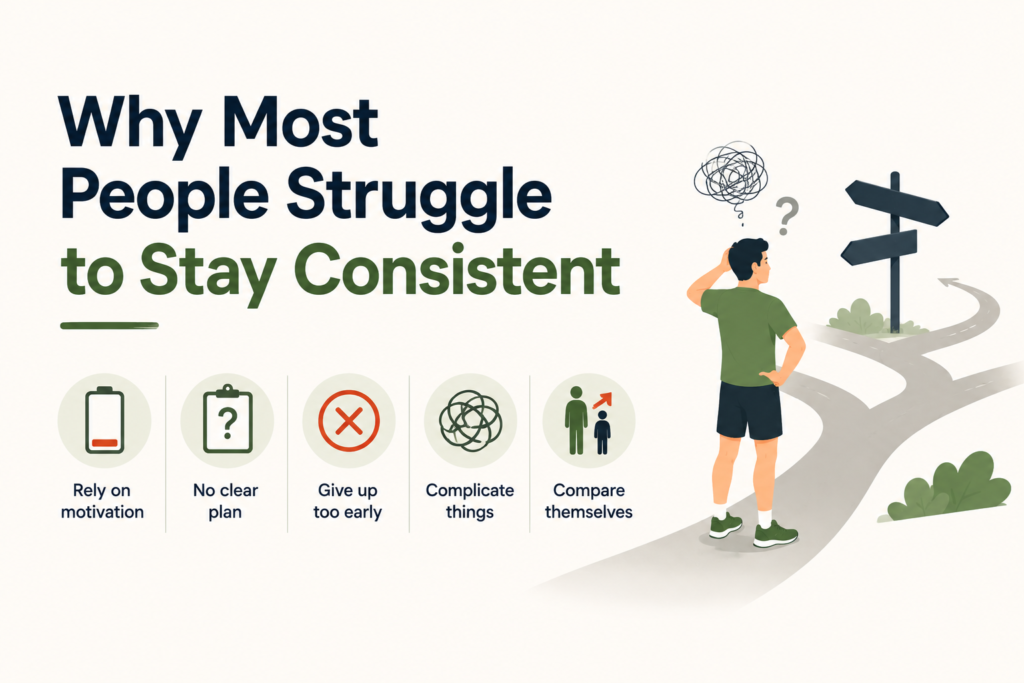
They Rely on How They Feel
This is the biggest one.
You plan to act when you feel motivated, focused, or ready. On good days, it works. On low-energy days, it doesn’t.
So your actions become inconsistent.
The problem isn’t effort.
It’s tying your actions to your mood.
They Set Unrealistic Expectations
This usually starts with good intent.
You plan to do more, push harder, fix everything at once. It feels productive in the moment, but it’s not sustainable.
After a few days, it becomes too much to maintain. That’s when things start slipping.
Consistency breaks not because you can’t do it, but because you’re trying to do too much.
They Don’t Have a Fallback System
Most people have a plan for good days.
Very few have a plan for bad ones.
So when motivation drops, there’s no backup. No simpler version. No way to keep the habit going without full effort.
That’s where consistency breaks.
If you want to stay consistent daily, the shift is simple.
Stop depending on how you feel.
Lower the expectation.
And always have a version you can follow, even on your worst days.
What Consistency Actually Means (Simple Definition)
If you simplify it, this is what consistency really is:
Consistency = showing up even on low-energy days.
Not when you feel motivated.
Not when everything is going right.
On the days when you don’t feel like doing it, but you still do something.
Most people think consistency means:
- Perfect execution
- Daily high performance
- Never missing a day
That’s not real.
Consistency is:
- Doing a smaller version instead of skipping
- Showing up even when it’s inconvenient
- Repeating the same action over time
The Difference That Matters
| What People Think | What Actually Works |
| Consistency = perfection | Consistency = repetition |
| Skip if you can’t do it fully | Do a smaller version |
| Results come first | Results follow consistency |
Over time, this repetition compounds.
One small action doesn’t change much.
But repeated daily, it builds momentum.
And that’s what creates real progress.
Step-by-Step System to Stay Consistent
If you want to stay consistent, you need something that works on your worst days, not just your best ones.
Most systems are built for high energy. That’s why they break.
This one is built for real life.
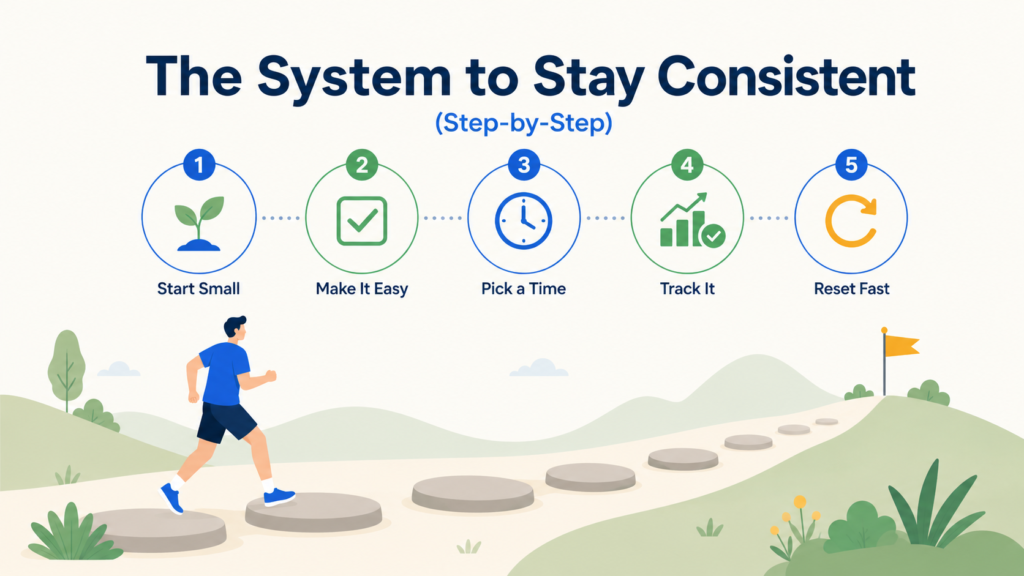
Step 1: Lower the Standard
This sounds counterproductive, but it’s the biggest unlock.
Most people set a standard they can hit only when they feel good. So the moment energy drops, they skip.
Instead, define two versions of your habit:
- Ideal version → what you want to do
- Minimum version → what you’ll do even on a bad day
Example:
- 45-minute workout → 10 minutes
- 1 hour of work → 15 minutes
Here’s the part most people don’t realize.
Consistency is not broken when you do less.
It’s broken when you stop.
Step 2: Fix Your Schedule
This is not about building discipline.
It’s about reducing decisions.
Every time you ask “when should I do this?”, you create a chance to delay it.
Pick a fixed slot:
- Same time
- Same place
- Same trigger
But here’s the nuance.
Don’t attach it to the clock. Attach it to something you already do.
For example:
- After your morning tea → start your task
- After work → go for a run
That’s how you make it automatic without forcing it.
Step 3: Remove Friction
Most people think consistency is about pushing harder.
It’s not.
It’s about making it easier to start.
Look at where you hesitate:
- Too many steps before you begin
- Setup feels heavy
- You need “preparation”
Fix that:
- Keep things ready beforehand
- Reduce the steps to start
- Make the first action obvious
A small shift I’ve seen work:
Don’t think of the full task. Design the first 30 seconds.
Because once you start, continuing becomes easier.
Step 4: Track the Right Thing
This is where most people go wrong with habit tracking.
They track results:
- Time spent
- Output
- Performance
That works when you’re already consistent.
In the beginning, it breaks motivation.
Instead, track:
- Did you show up? (Yes/No)
That’s it.
Why this works:
Your brain starts associating success with showing up, not performing. That removes pressure and builds a streak around action.
And once showing up becomes normal, performance improves on its own.
Step 5: Plan for Low Motivation Days
This is the step almost everyone skips.
They build a plan assuming they’ll feel motivated.
You won’t.
Some days:
- You’ll feel tired
- You won’t care
- You’ll want to skip
If you don’t plan for this, consistency breaks.
Instead, decide in advance:
- What’s your fallback action?
- What’s the minimum you’ll do no matter what?
This is where persistence is built.
Not by pushing harder.
But by staying in the loop, even at a lower level.
The Part No One Talks About
Consistency doesn’t come from doing big things daily.
It comes from never fully stepping out of the cycle.
You can slow down. You can reduce effort. And you can adjust.
But the moment you completely stop, restarting becomes harder.
This system works because it keeps you in motion.
Even when motivation is gone.
Motivation vs Discipline (What Actually Works Long-Term)
Most people try to stay consistent using motivation.
That works in the beginning. It doesn’t last.
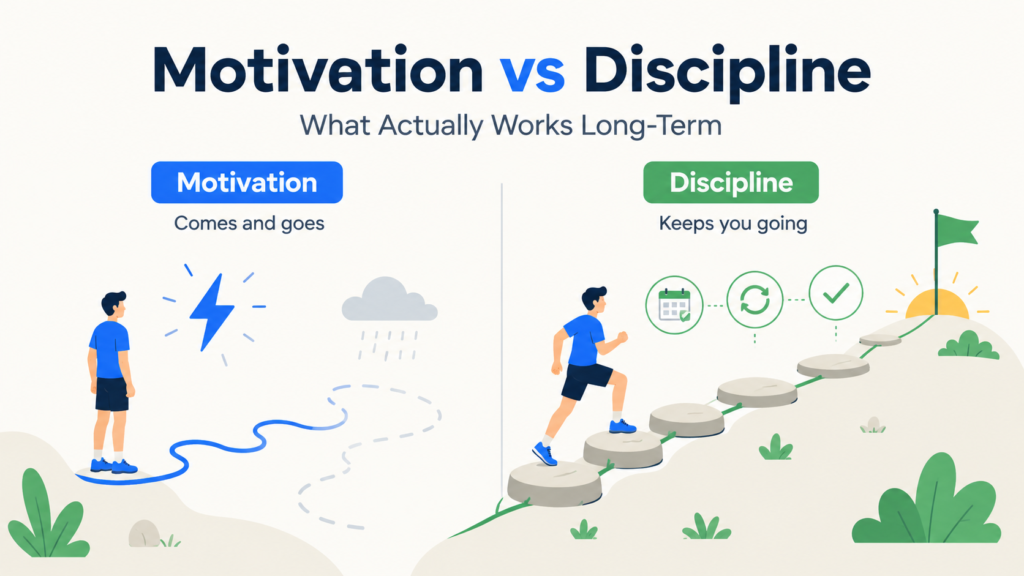
If you look closely, motivation is emotional. It shows up when something feels exciting, new, or urgent. That’s why you feel like doing more at the start.
But emotions don’t stay stable.
Some days you feel driven. Other days you don’t. If your actions depend on that, consistency breaks the moment your mood changes.
That’s where discipline comes in.
Discipline is not about forcing yourself.
It’s structural.
It’s what you do when there’s nothing pushing you.
The Difference That Actually Matters
| Aspect | Motivation | Discipline |
| Nature | Emotional | Structural |
| Trigger | Mood, energy, excitement | Systems and routines |
| Consistency | Unpredictable | Stable over time |
| Effort Required | Feels easy at first | Feels neutral over time |
| Outcome | Short bursts of action | Long-term progress |
What Most People Miss
You don’t replace motivation with discipline overnight.
You reduce your dependence on it.
Instead of asking:
- “Do I feel like doing this?”
You move to:
- “What’s the smallest version I can do today?”
That shift removes emotion from the decision.
Cutting the small distractions that keep breaking your momentum is a big part of that, and it gets easier once you know how to improve focus in a distracted world.
Why Systems Beat Feelings
Feelings change daily.
Systems don’t.
If your system is simple enough:
- Fixed time
- Clear action
- Low effort to start
You don’t need to rely on how you feel.
From experience, the moment your actions stop depending on motivation, consistency becomes a lot easier to maintain.
That’s what actually works long-term.
A meditation practice is one of the clearest examples of this. A simple five-minute sitting practice, because it doesn’t ask you to feel motivated; it only asks you to show up.
A Simple Daily System to Stay Consistent
If you want to keep staying consistent daily, you don’t need a complicated routine.
You need something that still works on a low-energy day.
Most people fail here because their system only works when everything is going right. This one is built for when things are not.
One Small Daily Action
Pick one action that moves you forward.
Not five. Not a full routine.
Just one.
It should be small enough that you don’t avoid it:
- 10 minutes of work
- 10 minutes of movement
- One focused task
Here’s the part most people miss.
It shouldn’t feel impressive. It should feel repeatable.
Because consistency is built on what you can do even when you don’t feel like doing anything.
One Fixed Time
Don’t leave it open.
The moment you say “I’ll do it sometime today,” you’ve already made it optional.
Fix it to a moment in your day:
- After your morning coffee
- After work
- Before dinner
Not a perfect time. A predictable one.
This removes the daily decision of when to act, which is where most inconsistency starts.
One Tracking Method
This is where habit tracking becomes useful, but only if you use it right.
Don’t track:
- How well you performed
- How long you did it
Track one thing:
- Did you show up? (Yes or No)
That’s it.
A simple streak, a checkmark, even a note on your phone.
From experience, once you see a few days stack up, you stop wanting to break that pattern. Not because of motivation, but because it feels natural to continue.
Why This Works (And Feels Different)
Most systems try to optimize performance.
This one protects consistency.
It removes:
- Overthinking
- Decision fatigue
- Unrealistic expectations
And replaces them with something you can repeat daily without resistance.
That’s the difference. Not doing more.
Doing one thing, at one time, consistently enough that it becomes part of your day.
What Breaks Consistency (And How to Fix It)
Consistency doesn’t usually break because of one big failure.
It breaks in small, predictable ways.
And most of them don’t feel like mistakes when they’re happening.
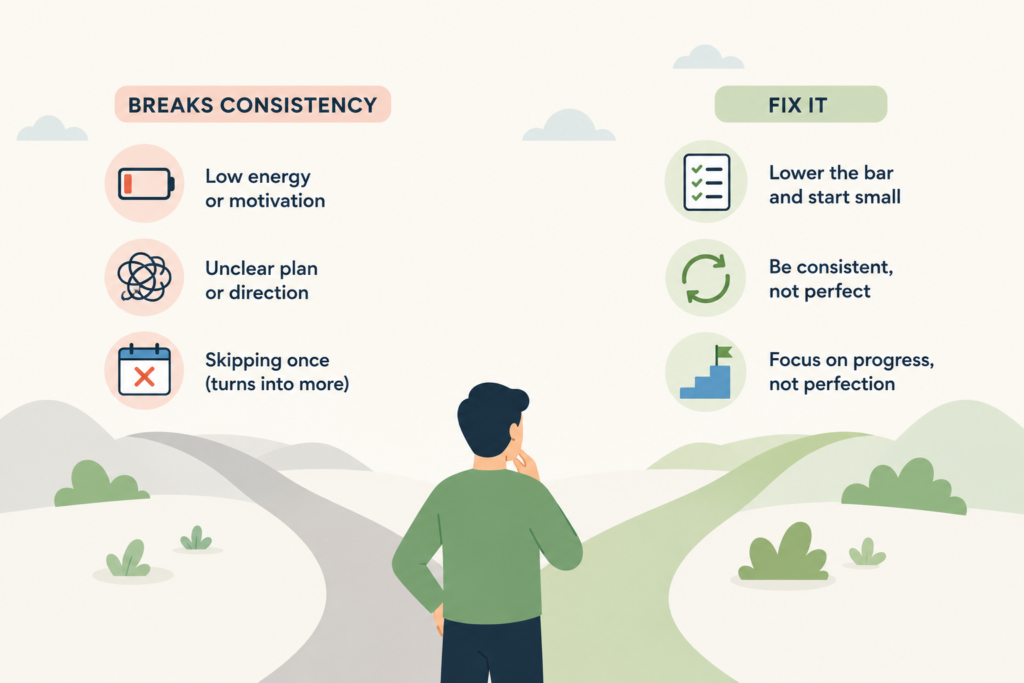
All-or-Nothing Thinking
This is the fastest way to lose momentum.
You either do everything perfectly or not at all.
So on days when you don’t have time or energy for the full routine, you skip it completely.
That’s where the pattern starts.
Fix: Lower the standard, not the habit.
Do a smaller version instead of doing nothing. Keep the cycle alive.
Missing One Day → Quitting
Missing a day is normal.
What’s not normal is what happens after.
You miss one day, then feel like you’ve broken the streak. So you delay restarting. Then it becomes two days, then a week.
This isn’t about discipline.
It’s about how you interpret the miss.
Fix: Treat one missed day as a reset point, not a failure.
The rule is simple: don’t miss twice.
Overloading Your Routine
This usually starts with good intent.
You add more habits, more time, more effort. It feels productive, but it’s not sustainable.
Eventually, it becomes too heavy to maintain daily.
That’s when consistency drops.
Fix:Cut your routine down to one or two essential actions.
Make it light enough that you don’t resist starting.
The Pattern Behind All of This
None of these issues are about effort.
They’re about making the system too rigid or too heavy.
Consistency holds when your system is flexible enough to adjust, but simple enough to repeat.
That balance is what keeps you going.
What Long-Term Progress Actually Looks Like
Most people expect consistency to feel rewarding early.
It doesn’t.
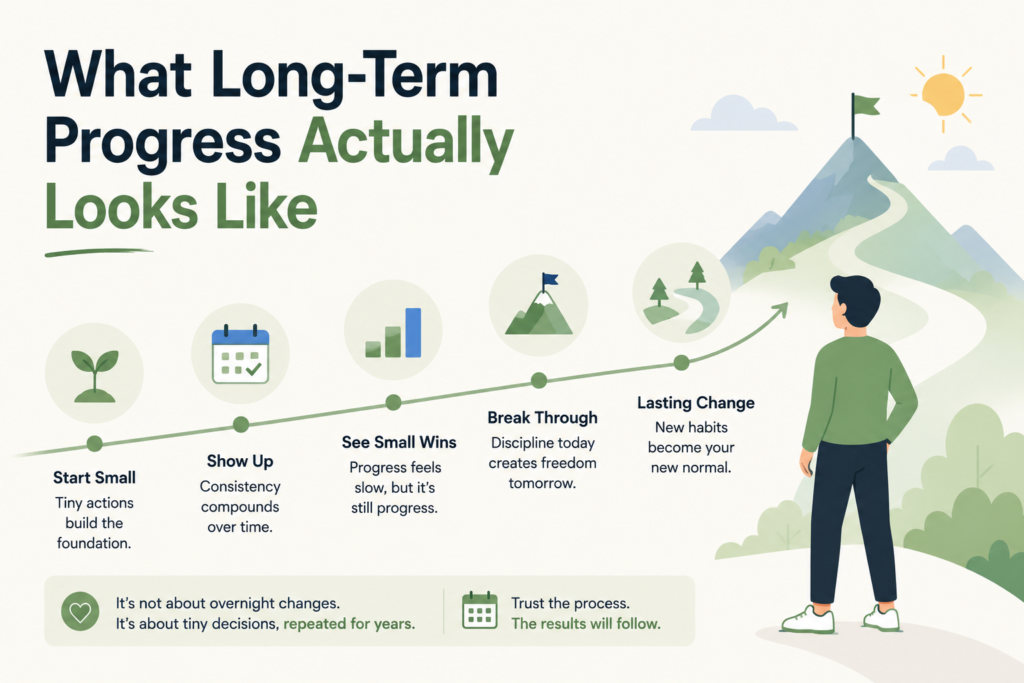
In fact, the first few weeks are often the least motivating. You’re putting in effort, but there’s no visible payoff. No big results. No clear signal that it’s working.
That gap is where most people stop.
Because progress, at the start, doesn’t look like improvement.
It looks like repetition.
Week 1: Effort Without Feedback
You’re doing the action, but it feels forced.
Every session requires a push. You think about skipping more than you think about doing it. There’s no rhythm yet, just effort.
This is where your brain starts negotiating:
- “This isn’t working”
- “Maybe I’ll start fresh next week”
Nothing is wrong here.
You’re just early.
Week 2: Slight Rhythm, But Still Unstable
You start noticing small shifts.
Starting feels a bit easier on some days. You don’t resist as much, but it’s inconsistent. One good day, one bad day.
This is where most people make a mistake.
They expect linear progress.
But this phase is uneven by nature. You’re building familiarity, not mastery.
Week 3: Friction Drops Quietly
This is where things change, but not in an obvious way.
You don’t feel “motivated.” You just feel less resistance.
And you start without overthinking. You don’t need to convince yourself as much. The action begins to fit into your day instead of interrupting it.
This is not excitement.
It’s integration.
And it’s far more important.
Week 4+: Automatic, But Not Effortless
By this point, something subtle shifts.
You don’t debate whether to do it. You just do it.
But here’s the part most people don’t talk about.
It’s not fully automatic.
You still have off days. You still feel resistance sometimes. The difference is, it doesn’t control your decision anymore.
You act anyway.
The Reality Most People Miss
Consistency doesn’t feel like progress in the beginning.
It feels like repetition without reward.
But that repetition is what reduces resistance over time.
And once resistance drops, consistency stops feeling like something you have to maintain.
It becomes something you naturally continue.
The Identity Shift (Consistency Becomes Who You Are)
This is where consistency stops being a task and starts becoming part of you.
But the way it happens is often misunderstood.
Most people think identity drives behavior.
In reality, behavior shapes identity.
How the Shift Actually Happens
In the beginning, every action feels separate.
You run because you planned to.
You work because you scheduled it.
There’s a gap between who you are and what you’re doing.
That’s why it feels forced.
But every time you repeat the action, that gap gets smaller.
Not dramatically.
Quietly.
The “Vote” You Don’t Notice
Each time you show up, you’re casting a small vote.
- You follow through → one vote for being consistent
- You skip → one vote for breaking the pattern
Individually, these don’t feel important.
But over time, they accumulate.
And eventually, your brain starts recognizing a pattern:
“This is something I do regularly.”
That’s when identity starts shifting.
When It Becomes Natural
You don’t wake up one day feeling like a completely different person.
It’s more subtle than that.
You just stop questioning the action.
- You don’t debate whether to run
- You don’t overthink starting
- You don’t rely on motivation
It becomes part of your baseline.
That’s the discipline mindset.
Why This Matters More Than Any System
Systems help you start.
Identity helps you continue.
Because once something becomes part of how you see yourself, it no longer depends on:
- Mood
- Energy
- External motivation
From experience, this is the real shift.
Consistency doesn’t stick because you built a perfect system.
It sticks because you became someone who doesn’t break the pattern easily.
And that only happens after enough repetition.
Not before.
Conclusion: Stay Consistent by Making It Easier to Show Up
If you want to stay consistent, stop trying to rely on motivation.
It’s unpredictable. Some days it’s there, most days it isn’t.
What actually works is making it easier to show up, even when you don’t feel like it.
That means:
- Simplifying your system so it doesn’t require too much effort to start
- Lowering the standard so you don’t skip on low-energy days
- Repeating small actions daily until they stop feeling optional
Consistency doesn’t come from doing more.
It comes from removing what makes you stop.
And once showing up becomes easier, you don’t need to think about it as much.
You just continue.
FAQs
- How do I stay consistent without motivation?
- Focus on systems, not feelings. Lower your daily target, fix a time for your action, and follow a minimum version on low-energy days. This helps you stay consistent even when motivation is low.
- Why do I lose motivation so quickly?
- Motivation is temporary by nature. It depends on mood, energy, and excitement, which naturally fluctuate. That’s why it fades quickly and can’t be relied on for long-term consistency.
- What are the best consistency tips?
- Keep it simple. Do one small action daily, fix a schedule, reduce friction to start, and track whether you showed up. These small changes make consistency easier to maintain.
- How long does it take to build consistency?
- You’ll start noticing a shift within 2–4 weeks. The first week feels forced, but over time, resistance drops and actions start feeling more natural.
- Is discipline more important than motivation?
Yes. Motivation helps you start, but discipline helps you continue. Long-term progress comes from systems and repetition, not temporary bursts of motivation.
SEO Coverage
This will rank for:
- stay consistent
- how to stay consistent
- staying consistent daily
- consistency tips
- build consistency
- motivation vs discipline
- how to be consistent in life
Leave a Reply