
▼
-
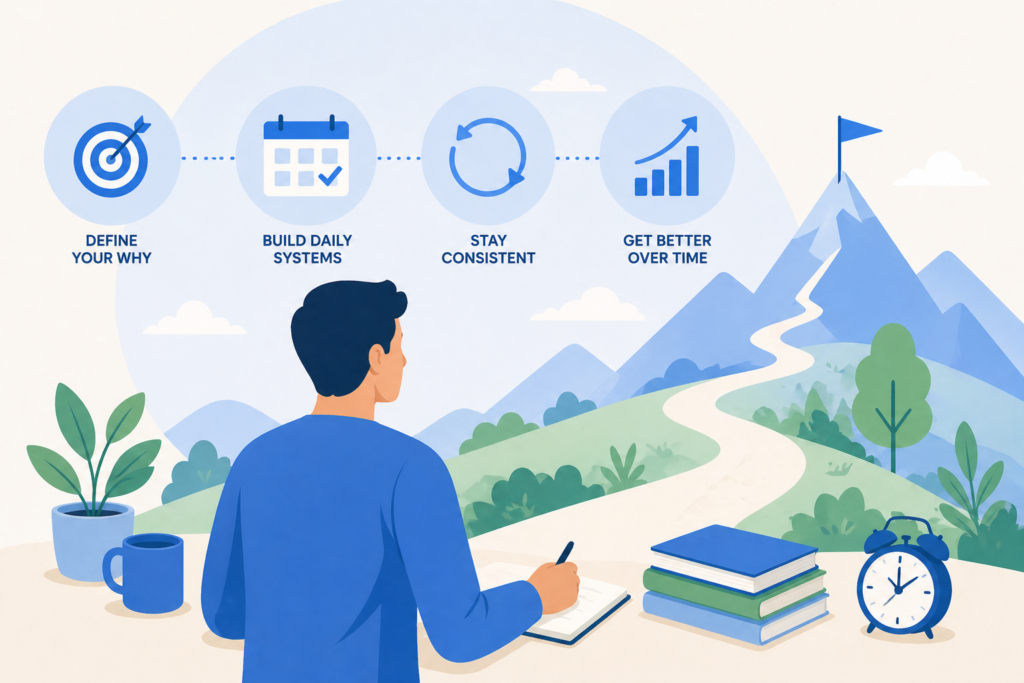
- Discipline is not motivation. It’s a system you follow daily
- Start small. 5–10 minute actions build real consistency
- Willpower fades. Systems keep you going
- Don’t skip. Lower the standard on low-energy days
- Consistency > intensity. Show up, even imperfectly
- Discipline becomes easier once it becomes your identity
Most people don’t struggle to build discipline because they’re lazy.
They struggle because they’re relying on motivation to carry them.
I’ve been there. You feel a sudden burst of energy, plan everything perfectly, tell yourself “this time it’s different.” For a few days, maybe even a week, you show up. Then life gets in the way, your energy drops, and everything falls apart.
Not because you lack discipline.
Because motivation was doing all the work.
Here’s the shift that changed it for me. Discipline is not something you’re born with. It’s not a personality trait. It’s a system you follow when you don’t feel like showing up.
Once I stopped chasing motivation and started simplifying my actions, things became repeatable. Not perfect, but consistent. And that’s where real progress came from.
In this guide, you won’t find extreme routines or unrealistic expectations. You’ll learn how to stay disciplined using simple systems that actually fit into your day. The kind of self discipline tips that don’t break after a bad day, but keep you going anyway.
Because discipline doesn’t come from intensity.
It comes from what you can repeat.
Why Discipline Feels Hard (And Why That’s Normal)
If you’ve ever asked yourself “why is it hard to stay disciplined?” or “why do I lack discipline?” the answer is simpler than you think.
It’s not you.
It’s how your brain works.

Your brain is designed to avoid discomfort and conserve energy. The moment something feels hard, boring, or uncertain, it pushes you toward easier options. That’s not weakness. That’s survival wiring.
This is where most people misunderstand discipline.
They think it comes down to willpower. So they try to push harder, force themselves, stay “strong.” That works for a few days, sometimes a week.
Then it drops.
Because willpower is limited. It runs out, especially when you’re stressed, tired, or distracted.
What actually sustains discipline is mental resilience, and that doesn’t come from forcing yourself. It comes from building systems that don’t rely on how you feel.
That’s the real shift.
You’re not inconsistent.
Your system is.
What Discipline Actually Is (Simple Definition That Works)
If you strip everything down, here’s the simplest way to understand it.
Discipline = doing the same action even when you don’t feel like it.
That’s it.
Not motivation. Not intensity. And obviously, you don’t need some perfect mindset.
Discipline is built through repetition. The more you repeat a small action, the less it depends on how you feel. Over time, it stops being a decision and starts becoming automatic.
And once that happens, something shifts.
Your identity starts catching up with your actions.
You don’t “become disciplined” first.
You act, repeat, and then you start seeing yourself as someone who follows through.
How Discipline Actually Works
| Concept | What Most People Think |
What Actually Works
|
| Discipline | A personality trait you either have or don’t |
A skill built through repeated actions
|
| Willpower | The main driver of consistency |
Limited resource that fades quickly
|
| Consistency | Comes from motivation |
Comes from systems and repetition
|
| Identity | Comes before action |
Built after repeated action
|
If you’ve been wondering “what is self discipline in simple terms” or “how discipline is built,” this is the answer.
It’s not about becoming a different person overnight.
It’s about repeating small actions until they define who you are.
The System to Build Discipline (Step-by-Step)
If you’re trying to build discipline, this is where things actually change.
Not by trying harder. Not by waiting to feel ready.
But by following a system that works even when you don’t feel like doing anything.
This is how you build discipline from scratch without relying on motivation.
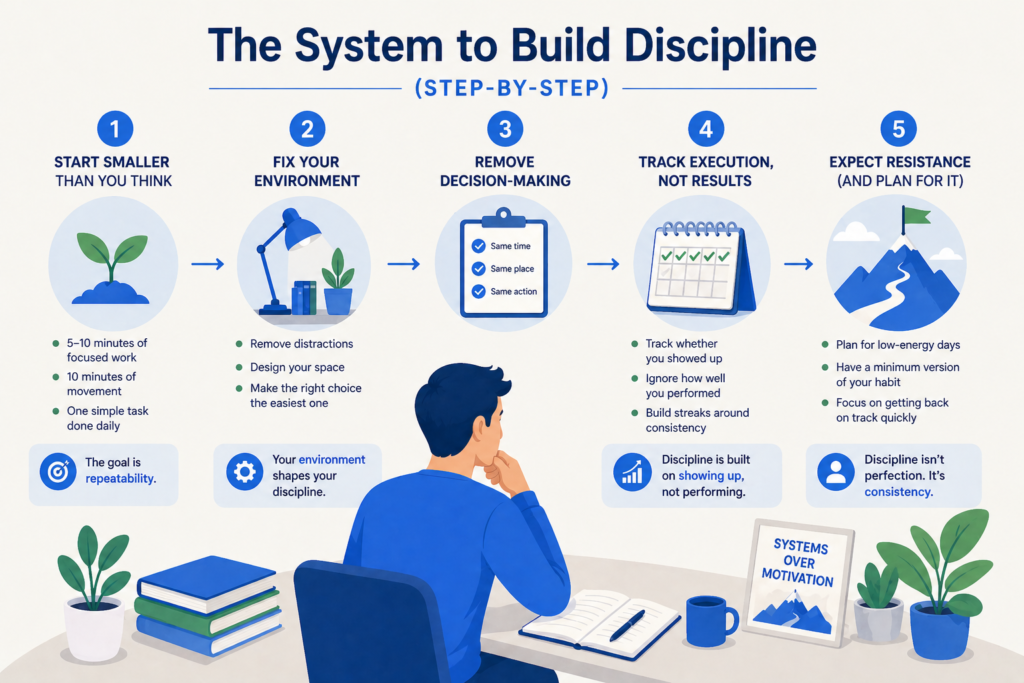
Step 1: Start Smaller Than You Think
This is the part most people get wrong.
They try to change everything at once. Long workouts, strict routines, perfect schedules.
It looks good on paper. It doesn’t last in real life.
Start with something so small it feels almost too easy:
- 5–10 minutes of focused work
- 10 minutes of movement
- One simple task done daily
The goal here is not improvement. It’s repeatability.
If your habit is too big, you’ll skip it. If it’s small, you’ll show up.
And showing up is where discipline starts.
This is the exact same principle behind building a meditation habit that actually sticks, five minutes done daily beats an hour done occasionally, because repeatability, not intensity, is what makes any habit last.
Step 2: Fix Your Environment
Most people rely on willpower to make good choices.
That’s exhausting.
Instead, make your environment do the work for you.
- Keep distractions out of reach
- Set up your space for the action you want to take
- Make the “right” choice the easiest one available
This is where real behavior change happens.
Discipline becomes easier when your environment supports it instead of fighting it. That’s the foundation of effective routine building.
Step 3: Remove Decision-Making
The more decisions you have to make, the more chances you have to skip.
Discipline improves when there’s nothing to decide.
- Same time
- Same place
- Same action
You don’t ask yourself “should I do it today?”
You just do it.
This is how you stay consistent daily without overthinking. Less thinking leads to more doing.
Step 4: Track Execution, Not Results
Most people quit because they focus on outcomes too early.
Weight loss. Performance. Results.
When progress is slow, they lose motivation.
Shift your focus.
- Track whether you showed up
- Ignore how well you performed
- Build streaks around consistency
These are real discipline habits.
Because discipline is not built by how well you perform once. It’s built on how often you show up.
Step 5: Expect Resistance (And Plan for It)
This is the part no one tells you clearly.
You will feel lazy.
You will not feel like doing it.
And, you will skip days.
That doesn’t mean your system is broken.
It means you’re human.
This is where mental resilience comes in.
Instead of aiming for perfection:
- Plan for low-energy days
- Have a “minimum version” of your habit
- Focus on getting back on track quickly
Discipline isn’t about never failing.
It’s about not staying off track for too long.
This system works because it doesn’t depend on how you feel.
It works on days when you’re motivated and on days when you’re not.
And that’s the only way discipline actually lasts.
A Simple Daily Discipline Routine (That Actually Works)
If you’re trying to build a daily discipline routine, don’t overcomplicate it.
You don’t need a packed schedule or a perfect morning routine.
You need a structure you can repeat even on low-energy days.
This is a simple framework that works because it’s realistic. You can copy it, adjust it, and still stay consistent.
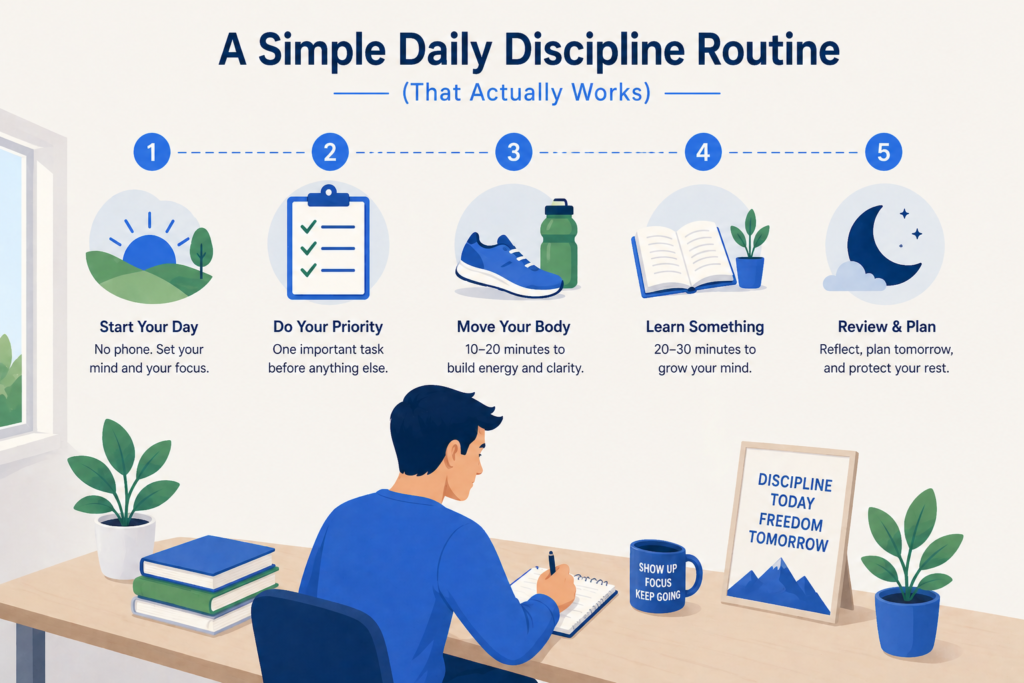
Morning: Start With One Small Win
Don’t aim for a perfect morning. Aim for a clear start.
Pick one action that moves you forward:
- 10–15 minutes of movement (walk, stretch, light workout, or start running from zero)
- 10 minutes of focused work
- A simple task you’ve been avoiding
The goal is not intensity. It’s momentum.
From experience, once you get that first win, the rest of the day feels easier to control. Skip it, and everything feels delayed.
Midday: One Focused Block
This is where real work happens.
Instead of trying to stay productive all day, commit to one focused block:
- 30–60 minutes of uninterrupted work
- No distractions, no multitasking
- One task only
This builds discipline faster than scattered effort.
You’re training your ability to sit, focus, and finish. That’s a skill most people never develop.
Evening: Reflection or Reset
This is the part most people ignore.
At the end of the day, take 5 minutes:
- Did you show up for your key actions?
- Where did you slip?
- What’s the plan for tomorrow?
No overthinking. No guilt.
This is just a reset.
It keeps you aware, and awareness is what prevents you from drifting off track.
Why This Routine Works
- It’s minimal, so you don’t avoid it
- It focuses on execution, not perfection
- It fits into any schedule
You don’t need a complicated system to stay disciplined.
You need a simple routine you can repeat without thinking.
How to Stay Disciplined When You Don’t Feel Like It
This is the real test.
Not when you’re motivated.
But when you’re tired, distracted, or just don’t feel like doing anything.
If you’re wondering how to stay disciplined when lazy or how to stay consistent without motivation, this is what actually works.
Lower the Standard, Don’t Skip
Most people think discipline means doing everything perfectly.
It doesn’t.
On low-energy days:
- Do less, but don’t do nothing
- Shorten the task instead of skipping it
- Keep the habit alive
Skipping once feels small. Skipping twice starts a pattern.
Lowering the standard keeps you in the game.
Use the “Minimum Version” Rule
Have a fallback version of every habit.
- 30-minute workout → 10 minutes
- 1 hour of work → 15 minutes
- Full routine → one key action
This removes the pressure to perform.
From experience, once you start the minimum version, you often end up doing more. But even if you don’t, you’ve still shown up.
And that’s what builds discipline.
Focus on Starting, Not Finishing
The hardest part is always the start.
You don’t need to think about completing the whole task. Just begin.
- Open the laptop
- Step outside
- Start the timer
Once you’re in motion, continuing becomes easier.
The Real Shift
Discipline isn’t about pushing hard every day.
It’s about showing up even when it feels inconvenient.
You won’t always feel ready. You won’t always feel motivated.
But if you keep starting, even in the smallest way, you’ll stay consistent.
And that’s how discipline actually holds.
Keep it short and crisp
The Biggest Mistake People Make When Trying to Build Discipline
Most people don’t fail because they lack discipline.
They fail because of how they try to build it.
It usually starts the same way. A burst of motivation. A decision to “fix everything.” A plan that looks perfect on paper.
Then a few days later, it falls apart.
Here’s why:
- Relying on motivation spikes: You feel driven for a short time, but motivation doesn’t stay. Once it drops, everything stops with it
- Setting unrealistic routines: Long workouts, strict schedules, too many rules. It works for a few days, then becomes too much to maintain
- Trying to change everything at once: Diet, work, fitness, sleep. All at the same time. It creates pressure instead of progress
I’ve made this mistake more than once.
You feel like you’re doing things right because you’re doing more. But more doesn’t mean sustainable.
That’s the core problem.
Distraction quietly adds to that, and much of it comes down to setup, so it helps to improve focus before you try to push harder.
Discipline fails when it’s built on intensity instead of repeatability.
What actually works is smaller, simpler, and a lot less exciting at first.
But it’s the only thing that lasts.
Discipline vs Motivation (What Actually Drives Results)
Most people confuse motivation with discipline.
They wait to feel ready before they act. That’s why consistency breaks.
Here’s the difference clearly:
| Aspect | Motivation | Discipline |
| Nature | Temporary and unpredictable |
Repeatable and stable
|
| Trigger | Depends on mood or energy |
Depends on systems and habits
|
| Consistency | Comes and goes |
Built through repetition
|
| Control | Hard to control |
Within your control
|
| Outcome | Short bursts of action |
Long-term progress
|
| What drives it | Emotions | Systems |
Motivation helps you start.
Discipline is what keeps you going.
What Breaks Discipline (And How to Fix It)
Discipline doesn’t usually break because of one big mistake.
It breaks because of small patterns that slowly take you off track.
Once you notice these, it becomes easier to fix them early.
Overcomplicating Routines
You start adding more steps, more rules, more structure.
What was simple becomes heavy.
- Too many tasks
- Too much planning
- Too many expectations
Eventually, it feels like effort just to begin.
Fix: Go back to one simple action. If it takes more than a few minutes to start, it’s too complex.
Skipping After One Bad Day
You miss one day. Then another.
Not because you can’t continue, but because you feel like you’ve already “broken” the streak.
This is where most people lose momentum.
Fix: Never miss twice. One bad day is normal. Two becomes a pattern. Get back to your routine the next day, even if it’s the smallest version.
Chasing Perfection
You wait for the perfect time, the perfect setup, the perfect mindset.
Or you stop because the execution wasn’t “good enough.”
Perfection creates delay. Delay breaks consistency.
Fix: Lower the standard. Done is always better than perfect.
The Reset That Works
Whenever things feel off, don’t try to fix everything at once.
Just return to your baseline action.
- One small task
- One short session
- One simple repeat
Discipline doesn’t come from doing more.
It comes from getting back on track quickly.
The Identity Shift (Where Discipline Becomes Easy)
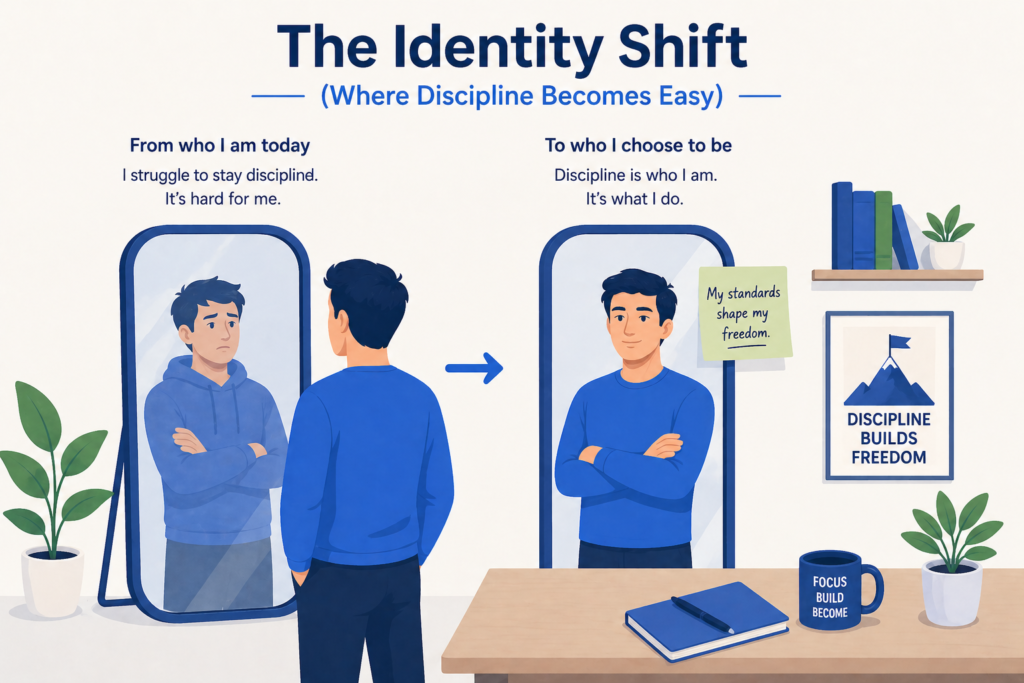
This is the part most people miss.
They think they need to become disciplined first, and then they’ll act accordingly.
It works the other way around.
You don’t become disciplined by thinking about it, planning it, or waiting to feel ready.
You become disciplined by doing small actions, repeatedly.
That’s it.
Every time you show up, even for a small task, you’re casting a vote for the kind of person you’re becoming. At first, it feels forced. Then it feels familiar. Eventually, it feels natural.
That’s the shift.
Within ThinkTrainBuild, this is how it connects:
- Think → You understand what actually works
- Train → You repeat simple actions consistently
- Build → You become someone who follows through
Discipline doesn’t become easy because the work changes.
It becomes easy because you change.
What Progress Actually Looks Like
Most people expect discipline to feel smooth from the start.
It doesn’t.
Here’s what it actually looks like:
- Week 1: Resistance
Everything feels forced. You don’t feel like doing it, and you question if it’s worth it - Week 2: Slight Control
You still resist, but you’re able to push through more often than before - Week 3: Less Friction
Starting becomes easier. You don’t overthink as much - Week 4: Automatic Behavior
You begin without negotiating. It starts feeling like part of your routine
This is where most guides fall short.
They tell you what to do, but not what it will feel like. And when reality feels different, people assume they’re doing it wrong.
You’re not.
This progression is the process.
Conclusion: Build Discipline by Keeping It Simple
If you want to build discipline, stop looking for the perfect routine.
You don’t need it.
You don’t need a complete life reset, extreme habits, or constant motivation.
All you need one thing:
Small actions, repeated daily.
That’s how discipline is built. Quietly, without pressure, without overthinking.
This is exactly what we’re building with ThinkTrainBuild.
A space where you learn to:
- Think clearly
- Train consistently
- Build systems that actually last
No fluff. No unrealistic expectations. Just practical ways to take control of your actions and follow through.
Start today.
Pick one small action and do it.
That’s where it begins.
FAQs
Q. How do I build discipline from nothing?
A. Start with one small, repeatable action. If you’re trying to build discipline from nothing, don’t aim for big routines. Pick something you can do daily in 5–10 minutes and stick to it. Discipline builds through repetition, not intensity.
Q. How long does it take to build discipline?
A. You’ll start noticing changes within 2–4 weeks if you stay consistent. The first week feels hard, but by week three, actions feel easier to start. Discipline isn’t built overnight, but it becomes natural with daily repetition.
Q. Can discipline be learned or is it natural?
A. Discipline is learned. It’s not something you’re born with. Anyone can build discipline by following simple systems and repeating actions consistently over time.
Q. How do I stay disciplined every day?
A. Focus on showing up, not performing perfectly. Keep your routine simple, remove distractions, and use a minimum version of your tasks on low-energy days. This is how you stay disciplined even when motivation is low.
Q. What are the best discipline habits to start with?
A. Start with habits that are easy to repeat:
- 10 minutes of focused work
- Daily movement (walk or light exercise)
- A fixed time for one key task
These small habits build consistency, which is the foundation of discipline.
Leave a Reply