
▼
-
-
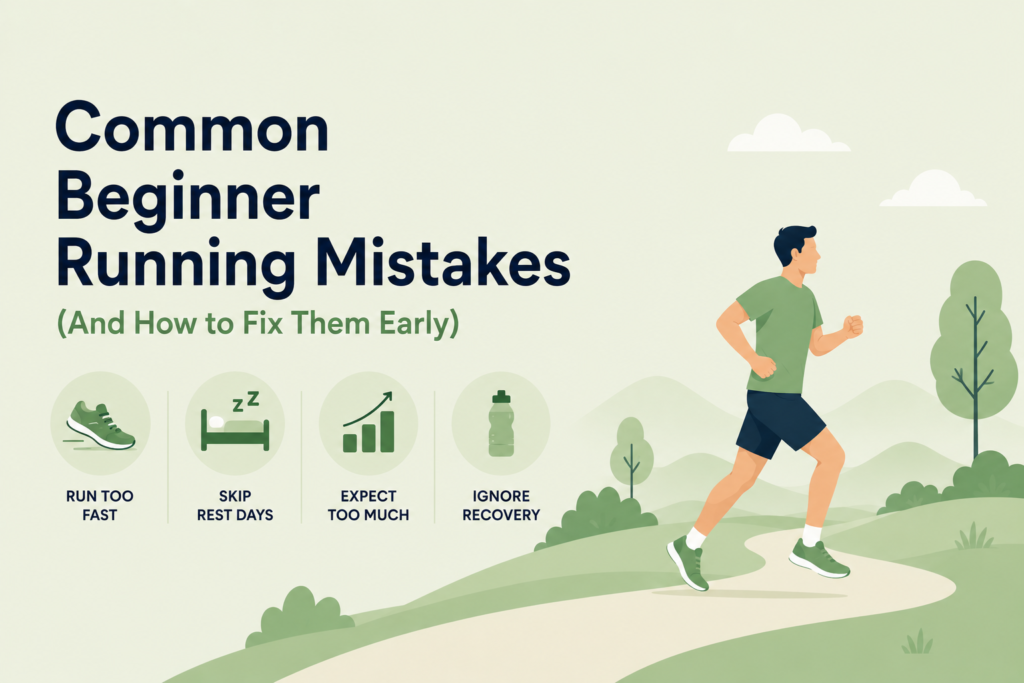
- Most running mistakes come from poor structure, not lack of effort
- Running too fast early kills endurance and consistency
- Rest and recovery are part of progress, not a break from it
- Small mistakes compound, fix them early before they derail you
- Consistency improves when you simplify, slow down, and follow a plan
-
Most people don’t quit running on Day 1.
They quit a week or two later.
Not because running is too hard, but because a few small running mistakes start adding up. You run a bit too fast, skip a rest day, try to do more than your body is ready for.
At first, it feels fine.
Then your runs get harder, not easier. You feel more tired, not stronger. And slowly, you stop showing up.
It feels like running isn’t for you.
But most of the time, it’s just the approach.
According to the Mayo Clinic, many running injuries are linked to training errors, such as doing too much too soon and not allowing proper recovery.
I’ve made these same beginner running mistakes early on. They don’t look like mistakes at the time, but they quietly make running harder than it needs to be.
This guide will help you spot those running errors early and fix them before they push you off track.
Because once you remove them, running gets a lot easier to stick with.
Why Most Beginner Running Mistakes Happen
Most beginners don’t lack effort. They lack direction. That’s the real problem.
When you start running from zero, you don’t have a structure; every run becomes a guess. One day you push harder, another day you slow down, sometimes you skip, sometimes you overdo it. It feels like effort, but there’s no progression behind it.
Then comes the second layer. You try to do too much too soon.
Longer runs, faster pace, fewer breaks. It feels like progress in the moment, but your body hasn’t caught up yet. That gap is where fatigue, frustration, and eventually injury begin to build.
And on top of that, there’s noise.
You pick up random advice from different places. One person says run daily, another says rest more, someone else talks about pace, someone else about form. None of it connects.
So you end up doing everything and nothing at the same time.
That’s how most running mistakes happen.
Not because you’re doing too little. But because there’s no clear direction behind what you’re doing.
1. Running Too Fast (The Most Common Mistake)
If there’s one mistake that ruins most beginner runs, it’s this.
Running too fast.
It doesn’t feel like a mistake when you’re doing it. It feels like effort. And effort feels like progress.
That’s where it goes wrong.
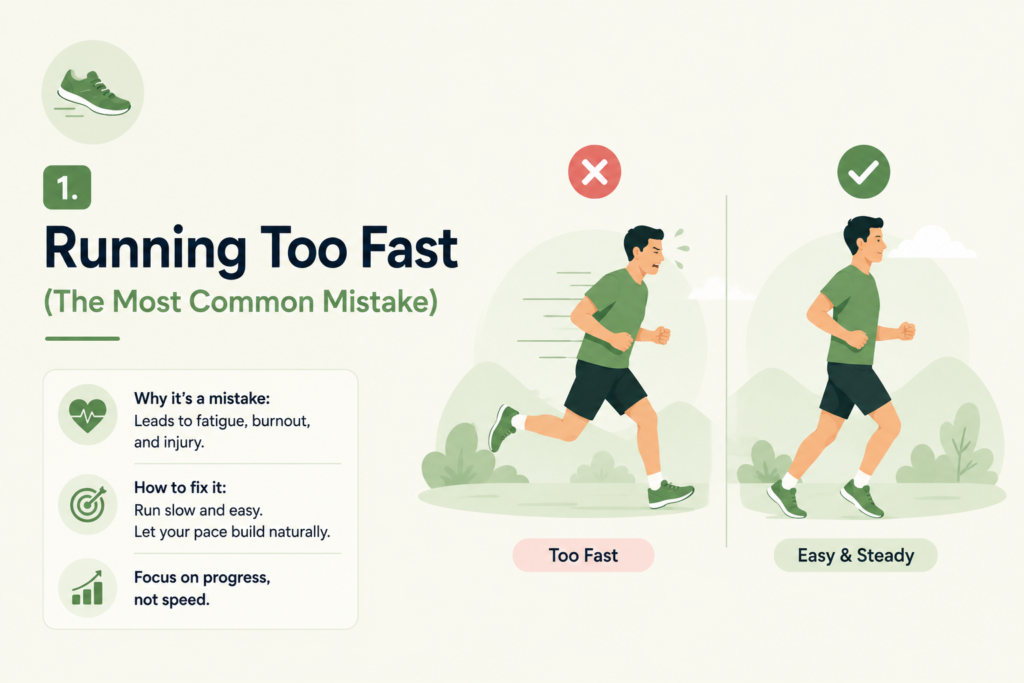
Most beginners start at a pace they can’t sustain. Within a minute or two, breathing spikes, legs tighten, and the run turns into survival instead of rhythm.
That’s not building endurance. That’s exhausting.
If you’ve ever wondered why beginners run too fast, it’s usually because there’s no reference point. You run based on how you think running should feel, not how it actually works at the beginning.
How to Fix This (Without Overthinking It)
- Slow down more than you think
If it feels easy in the first few minutes, you’re probably doing it right - Run at a conversational pace
You should be able to say a few words without gasping - Ignore speed completely
Your pace doesn’t matter right now. Staying in control does
This is one of the biggest pacing mistakes beginners make.
Once you fix it, everything else improves. You last longer, recover faster, and running starts feeling manageable instead of overwhelming.
2. Skipping Warm-Up and Recovery
This is one of those things you ignore in the beginning.
You step out, start running immediately, finish, and move on with your day. It feels efficient.
But you’ll notice something after a few runs.
The first few minutes always feel off. Legs feel tight, breathing feels rushed, and the run never really settles.
That’s not random.
Your body just isn’t ready yet.
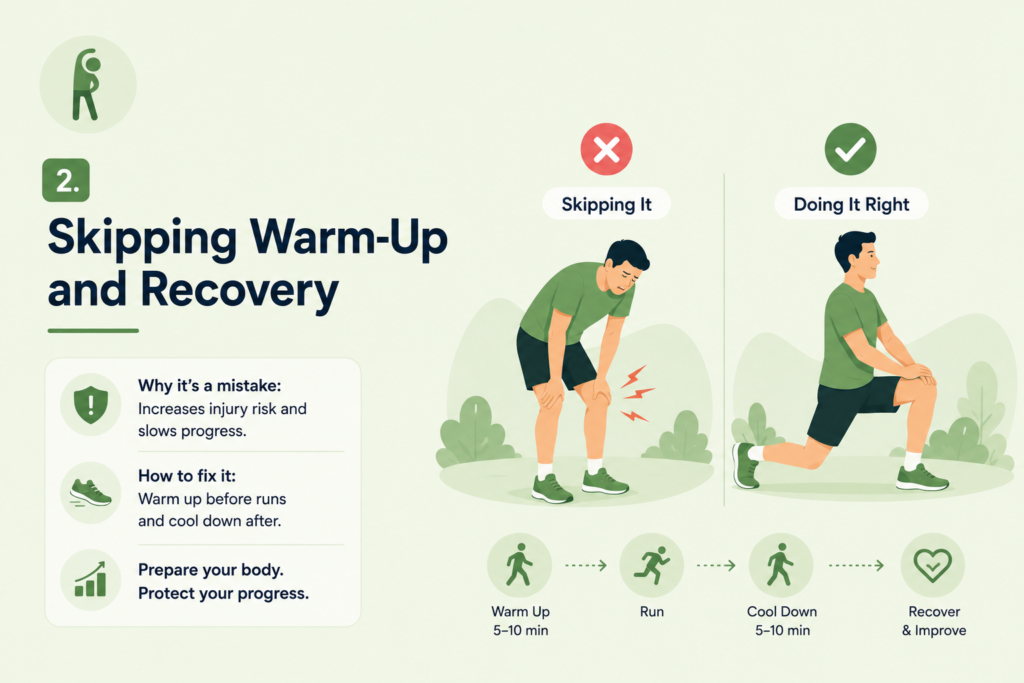
When you skip a warm-up, you’re going from zero to impact instantly. Muscles are stiff, joints aren’t moving freely, and everything feels harder than it should.
And when you finish and stop suddenly, that tightness just stays there.
Next run, it feels slightly worse.
That’s how small issues build up into actual injury risk.
What Actually Helps (Without Making It a Routine)
- Walk for 3–5 minutes before you start
Not as a “warm-up”, just ease into it. You’ll feel the difference almost immediately - Don’t stop abruptly at the end
Slow down for a minute or two instead of stopping dead - Stretch a little after, if you feel tight
Nothing fancy. Just loosen up your calves and legs
You don’t need a full routine here.
Just don’t go from zero to running and back to zero again.
That small shift makes your runs feel smoother and your body feel a lot better the next day.
3. Running Every Day (Without Recovery)
This usually comes from a good place.
You feel motivated, so you decide to run every day. It feels like building discipline. Like you’re doing more than most people.
For a few days, it works.
Then it starts catching up.
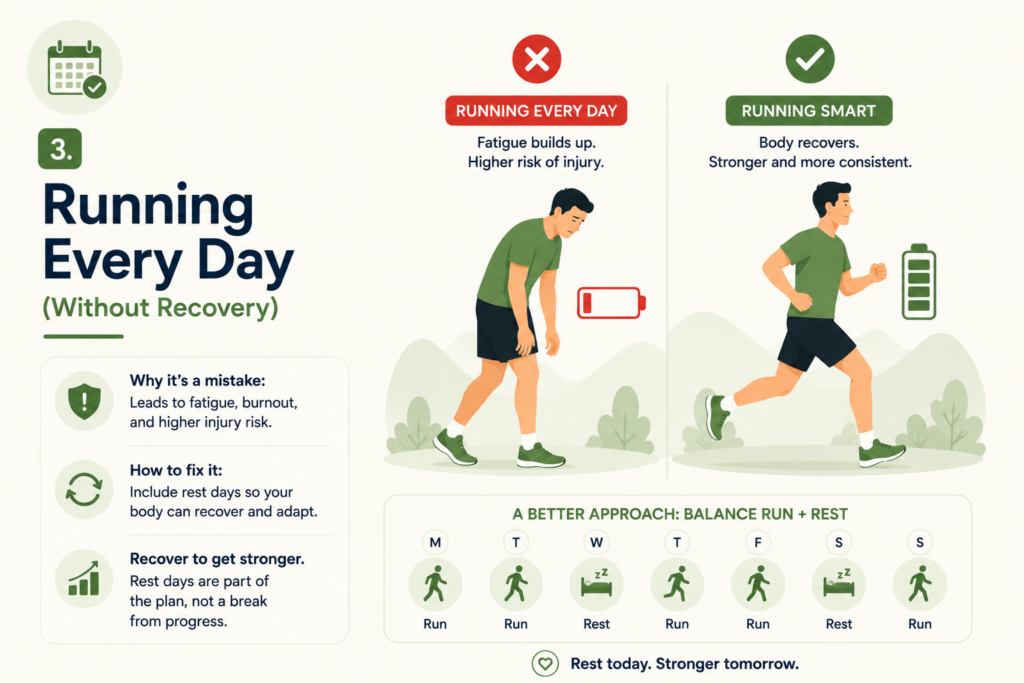
Your legs feel heavier, not stronger. Runs don’t feel easier. You’re more tired before you even start. And slowly, you begin skipping days not because you want to, but because you have to.
That’s not lack of discipline.
That’s overtraining too early.
When you’re starting out, your body isn’t just learning to run. It’s learning to handle impact, recover, and adapt. Without rest, that process never completes.
You’re just stacking fatigue.
What Actually Works
- Run 3–4 times per week
That’s enough to build consistency without breaking your body - Treat rest as part of the plan
Not a break from progress, but where progress actually happens - Pay attention to how your legs feel
If every run feels harder, you’re not recovering enough
This is one of those running mistakes that feels like effort but leads to burnout.
Slow it down, space your runs out, and you’ll last longer without forcing it.
4. Ignoring Pain Signals
This is where beginners try to “push through” and end up setting themselves back.
Early on, some discomfort is normal. Your legs will feel sore, especially after the first few runs. That’s just your body adapting.
But not all pain is the same.
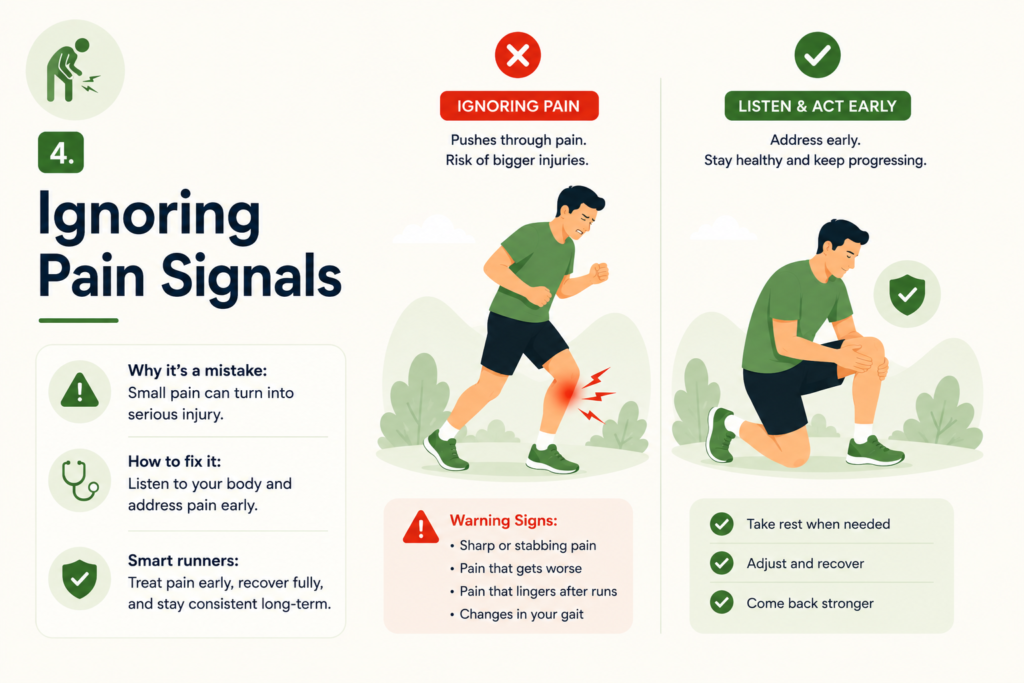
Soreness vs Injury (Know the Difference)
- Soreness
Feels like tightness or dull ache
Shows up after the run or next day
Eases as you move - Injury-type pain
Sharp, specific, and uncomfortable while running
Gets worse if you continue
Doesn’t go away with movement
The problem is, most beginners treat both the same.
They either ignore everything or panic too early.
Where It Goes Wrong
You feel a sharp discomfort and tell yourself:
- “It’ll go away”
- “I just need to push through”
Sometimes it doesn’t.
And pushing through that kind of pain is what turns a small issue into something that stops you completely.
What Actually Works
- Learn to pause
Stopping early is better than being forced to stop for weeks - Adjust intensity
Slow down, shorten the run, or switch to walking - Don’t chase the plan blindly
Your body matters more than the schedule
Listening to your body doesn’t make you weak.
It keeps you consistent.
And consistency is what actually builds progress.
5. Comparing Yourself to Others
This one doesn’t look like a mistake at first.
You see someone running longer, faster, more consistently. It feels motivating for a moment.
Then it starts messing with your head.
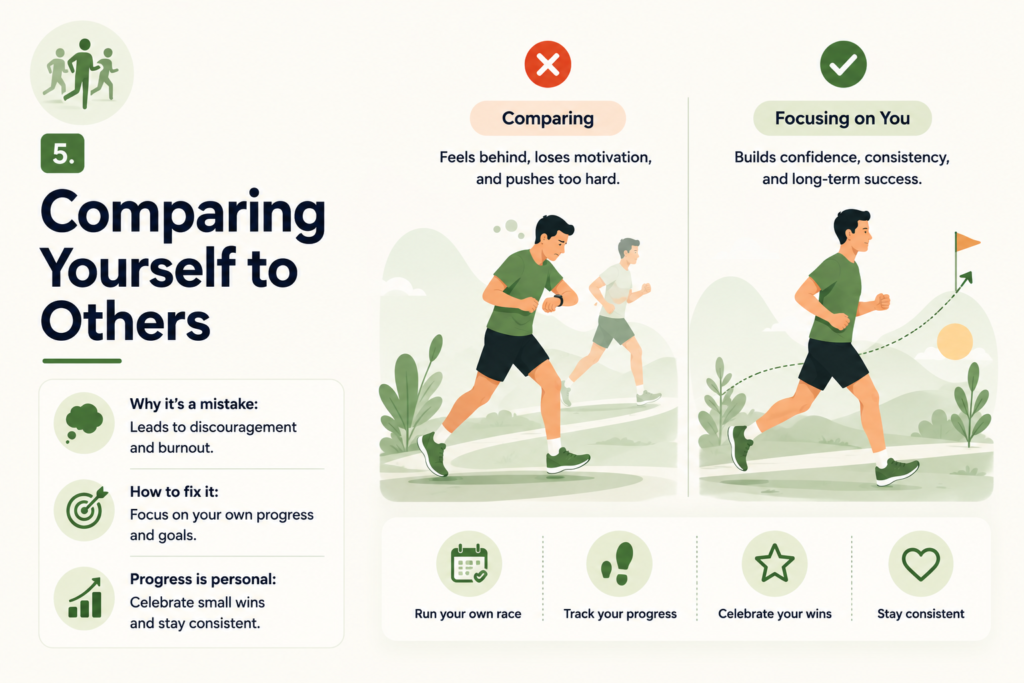
Social media rarely shows the full picture. You don’t see where they started, how long they’ve been running, or how slow their early runs actually were.
You just see the result.
And that creates pressure.
Where It Goes Wrong
You start adjusting your runs based on someone else:
- Running faster than your current level
- Pushing longer than you’re ready for
- Feeling behind even when you’re progressing
That’s how simple runs turn into frustrating ones.
The problem isn’t comparison itself.
It’s comparing without context.
What Actually Works
- Track your own progress
Look at how your last run felt, not someone else’s pace - Focus on consistency
Showing up regularly matters more than how fast you go
Running improves quietly.
If you stay consistent, your pace, endurance, and confidence will follow.
You don’t need to match anyone else’s timeline.
6. Not Following a Structured Plan
This is easy to overlook.
You go out and run whenever you feel like it. Some days you run longer, some days shorter. Sometimes you push, sometimes you take it easy.
It feels flexible. But over time, it leads to one thing.
No real progress.
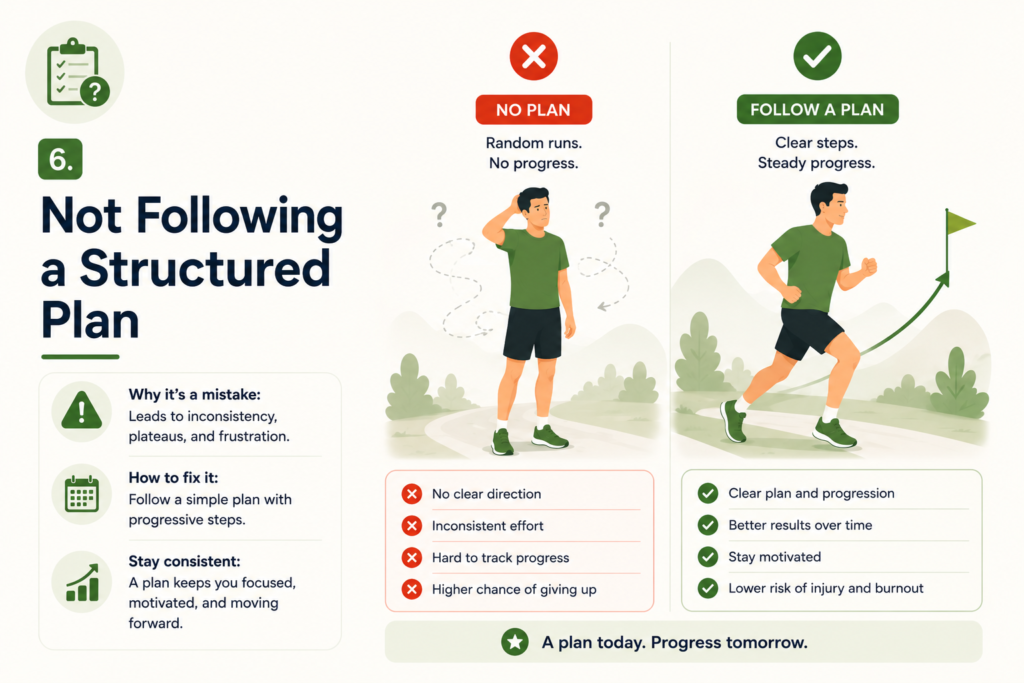
Random runs lead to random results. There’s no clear progression, so your body doesn’t know what to adapt to. One day is too easy, the next is too hard, and nothing builds consistently.
That’s why it starts feeling like you’re stuck.
What Actually Works
- Follow a simple beginner running plan
Not something complex. Just a basic structure you can repeat every week - Use the walk-run method
It gives you controlled progression without overwhelming your body
You don’t need a perfect plan. You just need one you can stick to.
Because once your runs have structure, progress stops feeling random.
7. Overcomplicating Running Early
I made this mistake before I even started properly.
Spent more time reading about running than actually running.
Shoes, cadence, breathing patterns, foot strike. It felt like there was a “right way” to do everything, and I needed to figure it all out first.
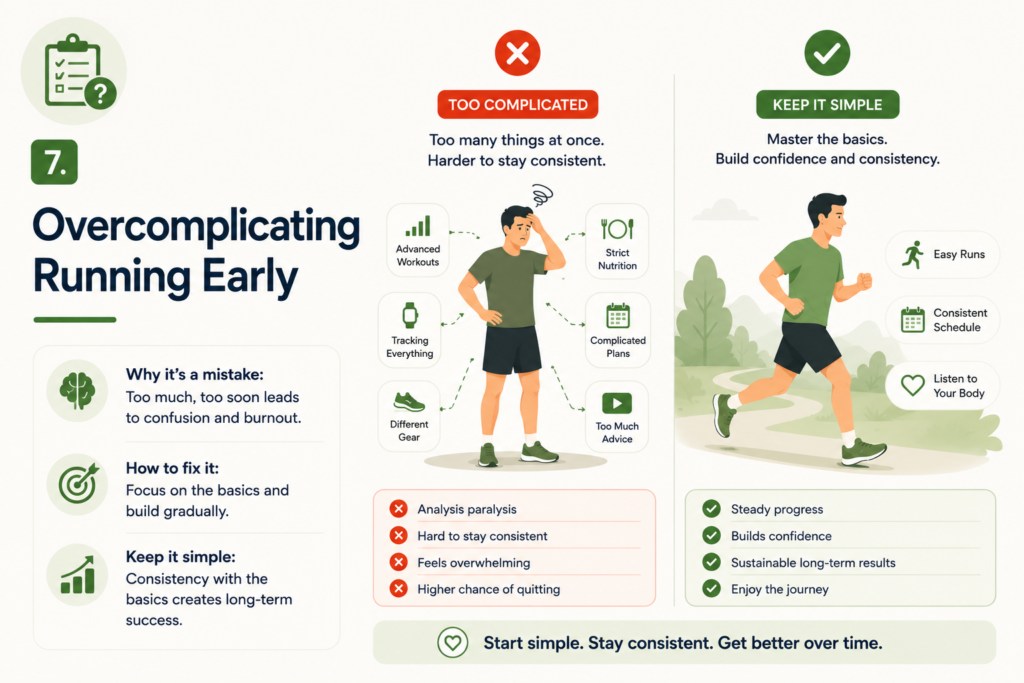
So when I finally went out, I wasn’t just running.
I was thinking:
- Am I landing correctly?
- Am I too slow? Too fast?
- Is my breathing wrong?
Within minutes, it stopped feeling natural.
That’s what overcomplicating does. It takes something simple and turns it into something you hesitate to do.
Where It Goes Wrong
- Gear obsession
Waiting for the perfect shoes or setup before starting - Technique overload
Trying to fix form, breathing, and pace all at once
Both feel like progress.
Neither actually helps in the beginning.
What Actually Works
- Keep it simple
I started making progress when I stopped trying to optimize everything and just went out with whatever I had - Focus on movement
Run slow, stay relaxed, and let your body figure things out over time
Running started feeling easier the moment I stopped trying to “do it right” and just kept doing it.
That shift matters more than any tip you’ll read.
What Beginner Runners Should Focus On Instead
Most running tips for beginners try to add more.
More drills, more techniques, more things to “fix.”
That’s not what you need right now.
You need fewer things, done consistently.
What Actually Matters
| Focus Area | What It Means | What Most People Do | What You Should Do |
| Consistency | Showing up regularly | Run randomly, skip often | Run 3–4 times a week, no matter what |
| Slow Pacing | Running under control | Start too fast | Run slower than feels necessary |
| Gradual Progression | Small increases over time | Try to improve too quickly | Increase time or effort slightly each week |
| Recovery | Letting your body adapt | Skip rest days | Treat rest as part of the plan |
How This Feels in Real Life
From experience, once you get these right, everything changes quietly.
You stop dreading runs. Your breathing feels more controlled. You don’t feel exhausted after every session.
And most importantly, you keep going.
That’s the difference. Not doing more. Doing the right things, consistently.
How to Avoid These Running Mistakes (Simple Rules)
If you strip everything down, avoiding most running mistakes doesn’t require more effort.
It requires a few rules you don’t break.
- Slow down: Most problems start with pace. If your breathing spikes within the first minute, you’ve already gone too fast. A simple check: if you can’t say a few words without gasping, slow down. It might feel too easy at first, but that’s what lets you last longer and actually build endurance.
- Follow a plan: Running randomly feels flexible, but it keeps you stuck. One hard day, one easy day, one skipped day, nothing connects. Even a basic structure like a walk-run routine or fixed running days gives your body something to adapt to. That’s where progress comes from.
- Don’t skip rest: This is where most beginners try to “do more” and end up doing less over time. If your legs feel constantly heavy or your runs are getting harder, it’s usually not effort you’re missing, it’s recovery. Taking a rest day at the right time keeps your next run better, not worse.
- Stay consistent: This is the one that ties everything together. You don’t need perfect runs. You don’t need long runs. You don’t need fast runs. You just need to keep showing up. Missing one day is fine. Letting that turn into a pattern is where things break.
The Real Advantage
Most people know these rules.
They just don’t follow them consistently.
If you do, you won’t need to worry about most beginner running mistakes.
Your runs will feel smoother, your progress will feel steady, and most importantly, you’ll keep going long enough to actually improve.
The Reality: You Will Make Some Mistakes
Even if you follow a plan, read everything right, and try to do it properly, you’ll still make a few running mistakes.
Not because you’re careless.
Because you’re learning something your body hasn’t done before.
And most of these mistakes won’t feel obvious.
You won’t think, “I’m doing something wrong.”
You’ll think:
- “Today just felt harder”
- “Maybe I’m not improving”
- “Something feels off”
That’s how it shows up.
What Mistakes Actually Look Like (In Real Runs)
It’s not dramatic.
It’s subtle patterns:
- You run slightly faster than usual because you feel good → next run feels worse
- You skip one rest day because you’re motivated → legs feel heavier for the next few sessions
- You push through a small discomfort → it lingers longer than expected
Individually, these don’t seem like a big deal.
But stack them for a week, and running starts feeling harder instead of easier.
That’s where most people lose confidence.
Where People Go Wrong
The mistake isn’t making errors.
It’s how you respond to them.
- One bad run → “I’m not improving” → skip the next one
- Slight pain → ignore it → turns into something bigger
- Feeling off → push harder → makes it worse
This is how small issues turn into stopping completely.
What Actually Works
- Treat each run as feedback, not judgment
If something feels off, it’s a signal to adjust, not quit - Correct early, not perfectly
Slow down, take an extra rest day, shorten the run
Small corrections are enough - Get back to your baseline quickly
Don’t try to “fix everything” at once
Just return to your normal pace and structure
The Shift That Makes the Difference
From experience, the runners who improve are not the ones who avoid mistakes.
They’re the ones who don’t let mistakes turn into patterns.
They notice, adjust, and move on.
Running is not about getting every session right.
It’s about staying consistent long enough that small mistakes don’t matter.
And once you understand that, you stop overthinking every run and just keep going.
Conclusion: Fix the Basics, Running Becomes Easier
Running doesn’t get easier because you push harder.
It gets easier when things start clicking.
When your pace feels controlled without thinking about it. When you don’t question every run. When showing up feels normal instead of something you have to convince yourself to do.
That shift doesn’t come from doing more.
It comes from removing what was getting in your way.
Once you do that, progress feels less forced. You stop second-guessing every step and start trusting the process a bit more.
And even if things feel off again at some point, which they will, you don’t need to overcorrect.
Just reset.
Go back to a simple run, let it feel easy, and build from there.
That’s how you keep moving forward without burning out.
FAQs
Q. What are the most common running mistakes beginners make?
A. The most common running mistakes include running too fast, skipping rest days, ignoring early pain signals, and not following a structured plan. These don’t seem serious at first, but they gradually make running feel harder and less sustainable.
Q. How do I avoid injury when starting running?
A. Keep your runs controlled and don’t rush progression. Start with a walk-run approach, give your body time to recover, and pay attention to how your legs feel after each session. Most injuries happen when you increase intensity too quickly or ignore discomfort.
Q. Why do I get tired so quickly when running?
A. This usually comes down to pacing. Beginners often run faster than their current fitness level allows, which leads to early fatigue. Slowing down and using intervals helps your body adapt and improves endurance over time.
Q. Should beginners run every day?
A. No, running every day early on often leads to fatigue and inconsistency. Running 3–4 times a week gives your body enough time to recover while still building momentum.
Q. What is the correct pace for beginner runners?
A. A good pace is one where you can stay in control of your breathing. You should be able to speak a few words without gasping. If you feel out of breath too early, slow down.
Leave a Reply