
AMost people don’t fail at running.
They fail in the first two weeks.
That phase where everything feels harder than expected. Your breathing is off, your legs feel heavy, and it doesn’t feel natural at all. Most beginners take that as a sign to stop.
It’s not.
You don’t need stamina to start running. You build it by showing up, even when it feels uncomfortable.
In fact, according to the World Health Organization, 1 in 4 adults worldwide do not meet recommended physical activity levels, highlighting that consistency, not capability, is the real challenge.
That’s exactly what this guide is built to solve.
This 30 days running plan is designed for complete beginners. If you’re starting from zero or following a couch to running plan, this will help you build consistency first, and stamina naturally after.
No pressure to perform. No expectation to run perfectly.
Just a simple way to start, stick with it, and keep going past the point where most people quit.
Who This 30-Day Running Plan Is For
This 30-day beginner running plan is not built for runners.
It’s built for people who are starting from scratch.
If you’ve ever tried to run and stopped within a minute, felt out of breath too quickly, or didn’t know how to continue, this is for you.
This plan works if you:
- Are starting running from zero with no prior running experience
- Can’t run continuously yet without stopping
- Are getting back into fitness after a long break
You don’t need a base level of stamina to begin. That’s what this plan helps you build.
Whether you’re looking for a running plan for beginners with no experience or a simple couch-to-running plan for beginners, the goal here is not performance.
It’s consistency.
Because once you can show up regularly, everything else improves.
What You Need Before You Start (Keep It Simple)
Before you begin this beginner running plan, don’t overprepare.
Most people delay starting because they think they need the perfect setup.
You don’t.
You only need a few basics:
- Comfortable shoes
Not expensive, not specialized. Just something you can move in without discomfort - 20–30 minutes
That’s enough for every session in this plan. No long workouts required - Realistic expectations
It will feel hard in the beginning. That’s part of the process, not a sign to stop
That’s it.
The goal here is to remove friction so you can start immediately.
Because the easier it is to begin, the more likely you are to keep going.
How This Beginner Running Plan Works
Most beginner plans fail because they either push too fast or stay too vague.
This beginner running schedule avoids both.
It’s built on one simple idea: your body adapts if you give it time and repeat the right level of effort.
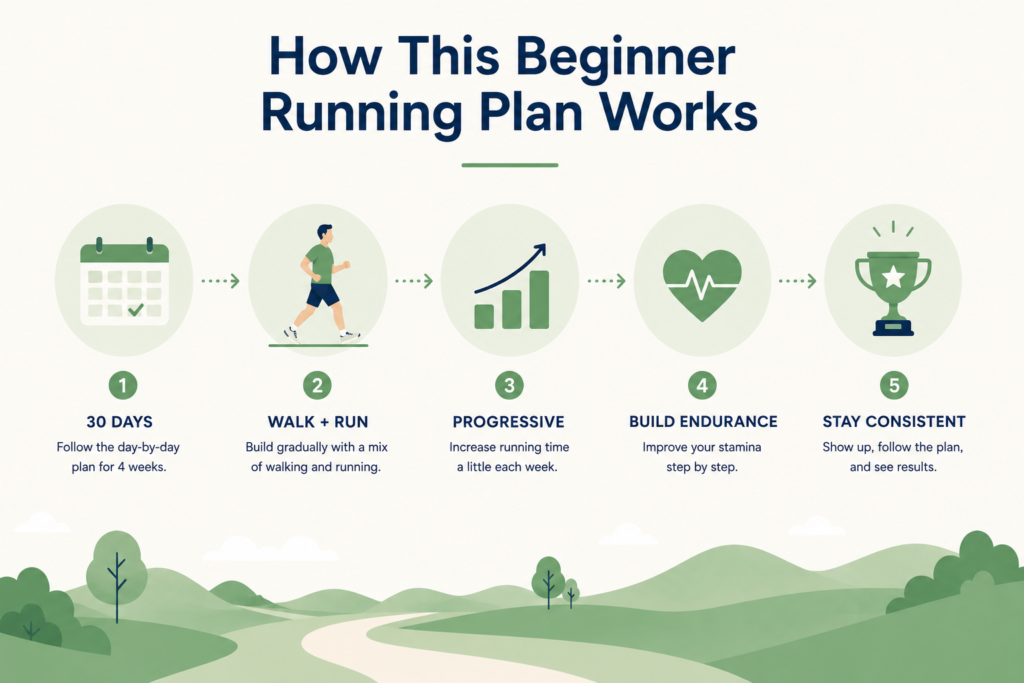
4 Weeks of Structured Progression
This isn’t random.
Each week has a clear role:
- Week 1 → get used to movement
- Week 2 → build basic endurance
- Week 3 → extend running time
- Week 4 → reduce reliance on walking
You’re not trying to improve everything at once. You’re layering capacity week by week.
Walk-Run Method as the Base
Instead of forcing continuous running, this plan uses controlled intervals.
You run, you recover, you repeat.
This is what allows beginners to go from struggling at 1 minute to handling longer efforts without quitting. It removes the early “shock” that makes most people stop.
3–4 Runs Per Week
More is not better here.
Running every day sounds disciplined, but for a beginner, it usually leads to soreness, fatigue, and eventually skipping sessions.
This plan gives you:
- Enough frequency to build a rhythm
- Enough recovery to actually improve
- Helps you build discipline that lasts
That balance is what keeps you consistent.
Focus: Consistency Over Speed
This is where most people go wrong.
They try to run faster as soon as they feel slightly better.
That’s exactly what slows progress down.
In this plan:
- Pace is intentionally slow
- Progress comes from time, not speed
- Showing up matters more than performance
From experience, once you stop chasing speed, running becomes easier to repeat.
And once you can repeat it, you improve without forcing it.
That’s how this plan works.
Simple structure. Controlled effort. Repeatable progress.
The 30-Day Beginner Running Plan (Week-by-Week)
This beginner running plan is not about pushing hard.
It’s about building something you can actually repeat for 30 days.
I’ve seen this pattern play out multiple times, including in my own runs. The people who improve are not the ones who push the hardest. They’re the ones who don’t quit early.
Each week has a purpose. If you rush it, you’ll feel it. If you follow it, it works quietly in the background.
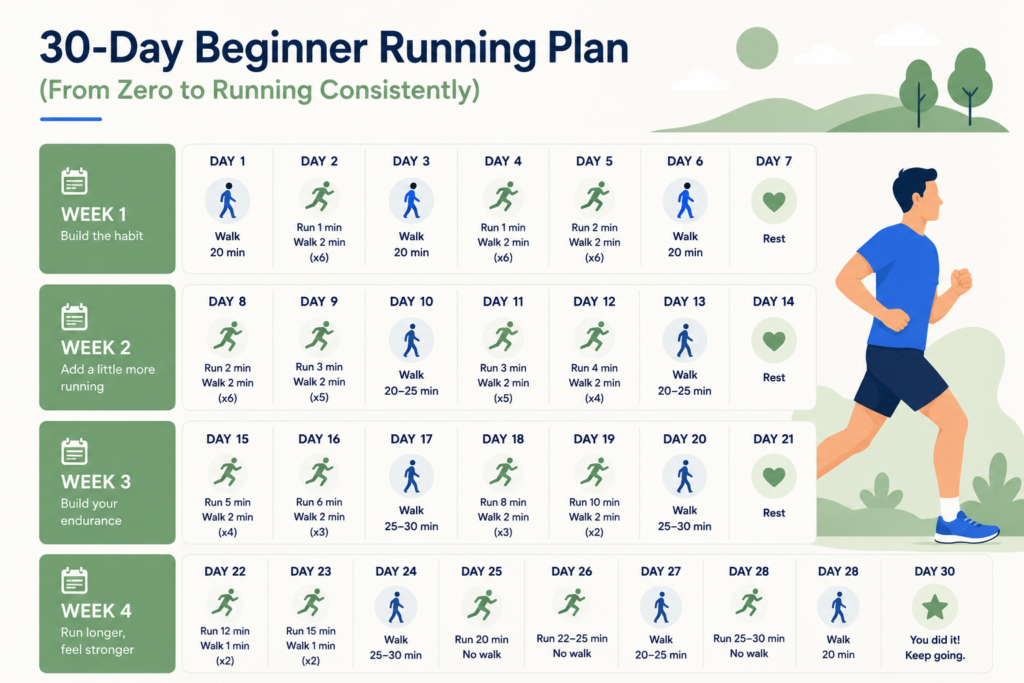
Week 1: Start Without Quitting
Structure:
- 1 min run + 2 min walk
- Total: 20 minutes
- 3–4 sessions this week
Goal: Show up. That’s it.
This week feels harder than it should.
Not physically, but mentally.
You’ll feel out of breath within seconds. You’ll keep checking the time. And you’ll question if you’re doing it right because it doesn’t feel smooth.
That’s normal.
What helped me here:
- Don’t run “forward”, run “easy”
Think of it as moving, not performing - Pick a fixed route instead of running randomly
It reduces mental friction - End your run feeling like you could do more
If you finish each session slightly unsatisfied, you’re doing it right.
Week 2: Build Basic Endurance
Structure:
- 2 min run + 2 min walk
- Total: 20–25 minutes
Focus: Breathing control
This is where something small shifts.
You’re still tired, but you’re not overwhelmed anymore.
Your breathing starts settling into a rhythm, even if it’s not perfect.
What most people get wrong here: They feel slightly better and start running faster.
That’s a mistake.
What actually works:
- Keep your pace almost “too slow”
- Focus on controlled breathing, not distance
- Use your walk breaks fully. Don’t rush them
A small trick that helps: Try syncing your steps with your breath. Not perfectly, just loosely. It reduces panic and makes running feel more controlled.
This week is where endurance starts building, even if it doesn’t feel like it yet.
Week 3: Increase Running Time
Structure:
- 3–5 min run + 1–2 min walk
- Total: 25–30 minutes
Focus: Stay relaxed while running longer
This is the turning point.
You’ll notice you’re not counting every second anymore.
You’re still working, but it doesn’t feel chaotic.
What changes here:
- Your recovery improves
- Walk breaks feel shorter
- Running starts feeling “possible”
What helped me most in this phase:
- Relax your shoulders consciously
Tension builds faster than fatigue - Keep your stride short
Long strides = faster fatigue - Don’t look at pace at all
You’re not trying to prove anything yet.
You’re building capacity.
Week 4: Run More, Walk Less
Structure:
- Start with 10–15 min continuous run
- Extend toward 20 minutes
- Short walk breaks if needed
Goal: Confidence + control
This week is less about your body and more about your mind.
You can run longer now. But your brain will still tell you to stop early.
That’s the final barrier.
What actually matters here:
- Start slower than you think
- Don’t chase a “perfect run”
- Allow short breaks without feeling like you failed
One thing that made a big difference for me:
Instead of thinking “I have to run 20 minutes”, think:
“I’ll just keep going until I need a break.”
That removes pressure completely.
And most of the time, you’ll go longer than you expect.
What This 30-Day Running Plan Actually Builds
By the end of these 4 weeks:
- You can handle 20+ minutes of running
- Your breathing feels controlled
- Running doesn’t feel intimidating anymore
You’re not just following a 30 days running plan.
You’re breaking the biggest barrier, starting and sticking with it.
And that’s what most people never get past.
What Running Will Feel Like (Week-by-Week Reality)
Most plans tell you what to do.
Very few tell you what it’s going to feel like when you’re actually out there.
That gap is where most people quit.
Because when your experience doesn’t match your expectation, you assume something is wrong.
Nothing is.
Here’s what running actually feels like across these 4 weeks.
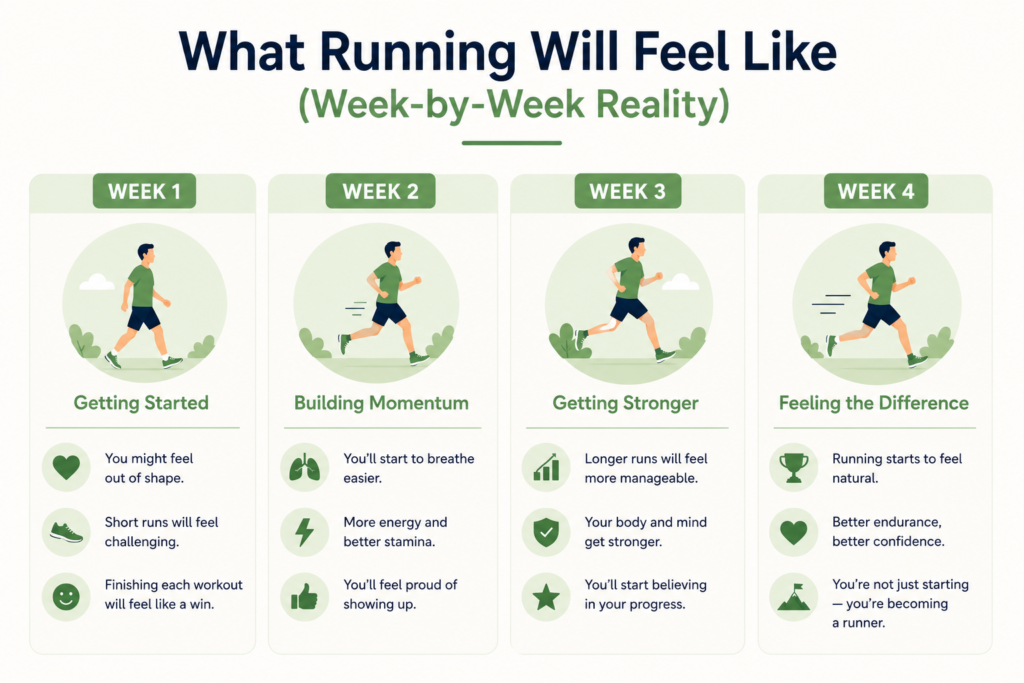
Week 1: Breathless
This is the reality check.
You start running, and within seconds, your breathing spikes. Your legs feel heavier than expected, and even short intervals feel long.
What catches most people off guard is not the effort, it’s how uncomfortable it feels so quickly.
You’ll think:
- “I should be able to do more than this.”
- “Why is this so hard?”
What’s actually happening:
Your body isn’t used to this type of effort yet. Your lungs, muscles, and rhythm are all out of sync.
What matters here:
Don’t judge your ability in Week 1. Just complete the sessions.
Week 2: Manageable
You’re still getting tired.
But something changes.
The panic reduces.
Your breathing is still heavy, but it doesn’t feel out of control. You recover faster during walk breaks, and the runs don’t feel as chaotic.
This is a subtle shift, but it’s important.
Most beginners miss it because they’re expecting a big improvement.
It’s not big.
It’s controlled.
What matters here:
Stay patient. This is where endurance starts building quietly.
Week 3: Rhythm
This is where running starts making sense.
You’re not counting every second anymore. You begin to settle into a pace, and your body starts cooperating instead of resisting.
You’ll notice:
- Your breathing finds a pattern
- Your steps feel more natural
- Walk breaks feel shorter
It’s still effort, but it’s no longer overwhelming.
This is the phase most people never reach, simply because they quit earlier.
What matters here:
Don’t speed up. Protect the rhythm.
Week 4: Confidence
You’re not guessing anymore.
You know what your pace feels like. You know when to slow down. And you know you can continue even when it gets slightly uncomfortable.
The biggest shift here is mental.
You stop fearing the run.
Instead of thinking “Can I do this?” you start thinking “I’ve done this before.”
That’s confidence.
Not perfect runs. Not fast runs.
Just knowing you can show up and get through it.
Why This Matters
Most beginner guides skip this completely.
They give you a running training plan, but not the experience that comes with it.
And when things feel harder than expected, people assume:
- They’re not fit enough
- They’re doing it wrong
- Running isn’t for them
None of that is true.
Once you understand what each week is supposed to feel like, you stop overreacting to discomfort.
And when you stop overreacting, you stay consistent.
That’s the difference.
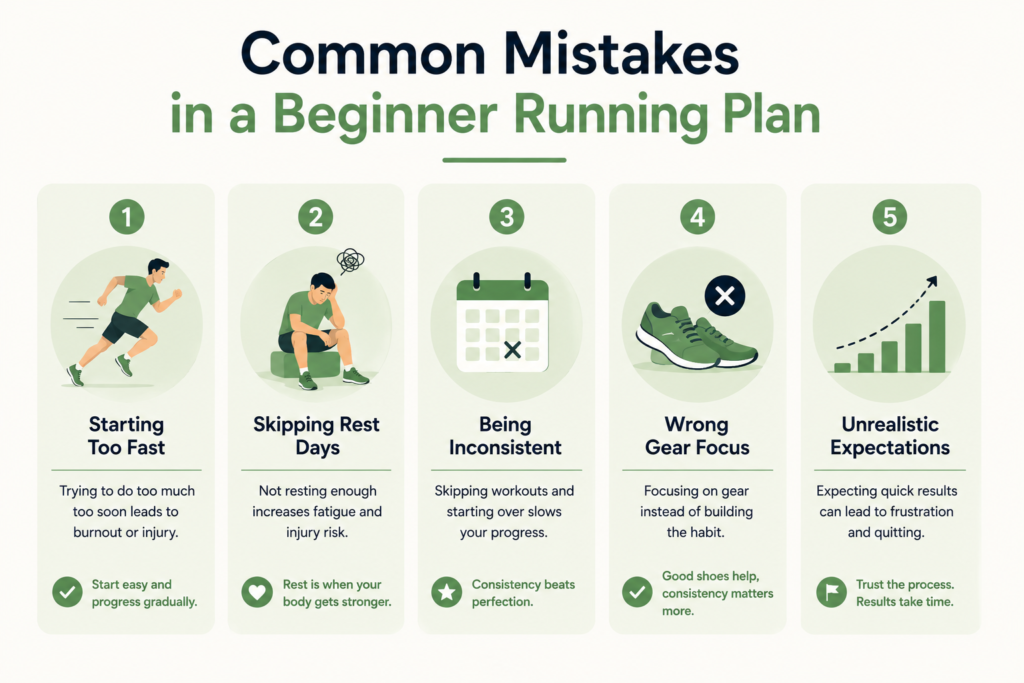
Common Mistakes in a Beginner Running Plan
Most running training plan failures don’t come from a lack of effort.
They come from doing a few things wrong, repeatedly.
These common running mistakes feel small in the moment, but they’re exactly what breaks consistency.
Running Too Fast
This is the most common one.
You feel good for a day or two, so you push harder. Run faster. Try to “improve.”
Then suddenly:
- Breathing gets out of control
- Runs feel harder again
- You start dreading the next session
Running faster doesn’t build endurance early.
Running slower does.
What works instead:
Stay at a pace where you feel in control, even if it feels too easy.
Skipping Rest
Skipping rest feels productive.
It’s not.
Your body doesn’t improve during the run. It improves after it.
Without recovery:
- Soreness builds up
- Energy drops
- Motivation fades
Eventually, you skip not just a rest day, but entire sessions.
What works instead:
Treat rest days as part of the plan, not a break from it.
Trying to “Upgrade” Too Early
This usually happens in Week 2 or 3.
You feel slightly better and think:
- “I can run longer today”
- “Let me skip the walk breaks”
- “I’ll push for more”
That jump feels good once.
Then it catches up.
What works instead:
Stick to the plan even when it feels easy. Progress works because it’s gradual.
Comparing With Others
This one is subtle, but it kills momentum.
You see someone running longer, faster, more consistently.
And suddenly your progress feels slow.
But you don’t see:
- Their starting point
- Their experience
- Their pace
Comparison makes you push when you shouldn’t.
What works instead:
Measure against your previous run, not someone else’s.
The Real Problem
None of these mistakes look serious.
But together, they create one outcome:
You stop showing up.
And that’s the only thing that actually matters in a beginner running plan.
Avoid these, and everything else becomes easier.
The Only Rule: Don’t Overcomplicate It
Most people don’t fail because running is hard.
They fail because they make it harder than it needs to be.
You don’t need:
- Gear obsession
Expensive shoes, gadgets, or perfect setups won’t make you consistent - Perfect form
Your body learns as you run. Trying to “fix everything” early just creates hesitation - Pressure to perform
You’re not training for a race. You’re building a habit
The simpler you keep it, the easier it is to show up again tomorrow.
And that’s the only thing that matters right now.
Conclusion: Start Your 30-Day Running Plan Today
If you’ve been thinking about starting, this is it.
You don’t need more research. You don’t need a better plan.
This beginner running plan is enough.
Start today:
- Run for 1 minute
- Walk for 2 minutes
- Repeat for 20 minutes
That’s your first session.
No waiting for the “right time.”
At ThinkTrainBuild, this is exactly what we focus on.
Not extreme routines. Not perfect systems.
Just simple actions you can repeat:
- Think clearly
- Train consistently
- Build something that lasts
Your first run is not about performance.
It’s about starting.
FAQs
Q. Can I go from couch to running in 30 days?
A. Yes, you can go from a complete beginner to running consistently in 30 days. You may not run long distances yet, but you’ll build enough stamina and confidence to handle 20+ minutes of running.
Q. How long should I run each day as a beginner?
A. Start with 20 minutes using a run-walk approach. Over time, increase your running intervals while keeping the total session between 20–30 minutes.
Q. Is a 30-day running plan enough to build stamina?
A. Yes, a well-structured 30 days running plan helps you build a base level of endurance. You won’t be advanced, but you’ll have enough stamina to continue progressing.
Q. How many rest days should beginners take?
A. Beginners should take at least 2–3 rest days per week. Recovery is essential for improving endurance and avoiding injury.
Q. What is the best beginner running schedule?
A. The best schedule includes 3–4 running days per week, combined with rest or light activity days. Consistency matters more than intensity.
Leave a Reply