
▼
- Losing your voice to AI isn’t the same as writing badly. It can read perfectly clean and still not sound like you
- Your voice is made of specific, checkable habits, not a vague feeling, which means you can audit it directly instead of guessing
- Writing down your own “voice fingerprint” before you edit with AI gives you something concrete to check every draft against later
- Feeding AI a sample of your own writing works better than describing your style in words, models match text better than they match adjectives
- The clearest sign of drift is a piece that reads fine on screen but sounds like nobody in particular the moment you read it out loud
- Voice drift compounds. Each AI-touched piece nudges your own baseline a little, which is why the fingerprint needs to come from writing done before or without AI
A few months into writing with AI in the loop, I noticed something odd. Nothing I was publishing was wrong exactly. Grammar was clean, structure made sense, points landed where they should. But when I went back and read an old post next to a new one, they didn’t sound like the same person wrote them. The new stuff was smoother. Easier to read in a generic sense. It just wasn’t as much me.
That’s a different problem from writing that’s badly done. Bad writing is easy to spot, it’s confusing, it rambles, it says nothing. This wasn’t that. Every sentence checked out. The problem was quieter than that. It’s voice drift, and it happens one edit at a time, so slowly that you don’t notice it until you stack two pieces side by side and the gap is obvious.
I run this entire site, all three pillars, with AI somewhere in almost every post. So this isn’t a “should you use AI” question for me anymore. It’s a “how do you use it without it quietly rewriting who you are on the page” question. This post is about catching that drift early and doing something about it before it becomes the new normal for how you sound. It’s a narrower problem than the general workflow question, which I’ve already covered in my beginner’s guide to AI for writers. That post is about using AI well across the whole writing process. This one is specifically about protecting your AI writing voice, the one thing that process can quietly cost you if you’re not watching for it.
Bad Writing and Voice Drift Are Not the Same Problem
It’s easy to assume that if a sentence reads well, the AI pass did its job. Readability is the thing everyone checks for, because it’s the easiest thing to check. Does it flow. Is it clear. Does it make sense on a first read. Most editing, AI-assisted or not, stops right there. But readability and voice are two completely different measurements, and a piece can score well on one and fail the other without you noticing, because nothing about it looks broken.
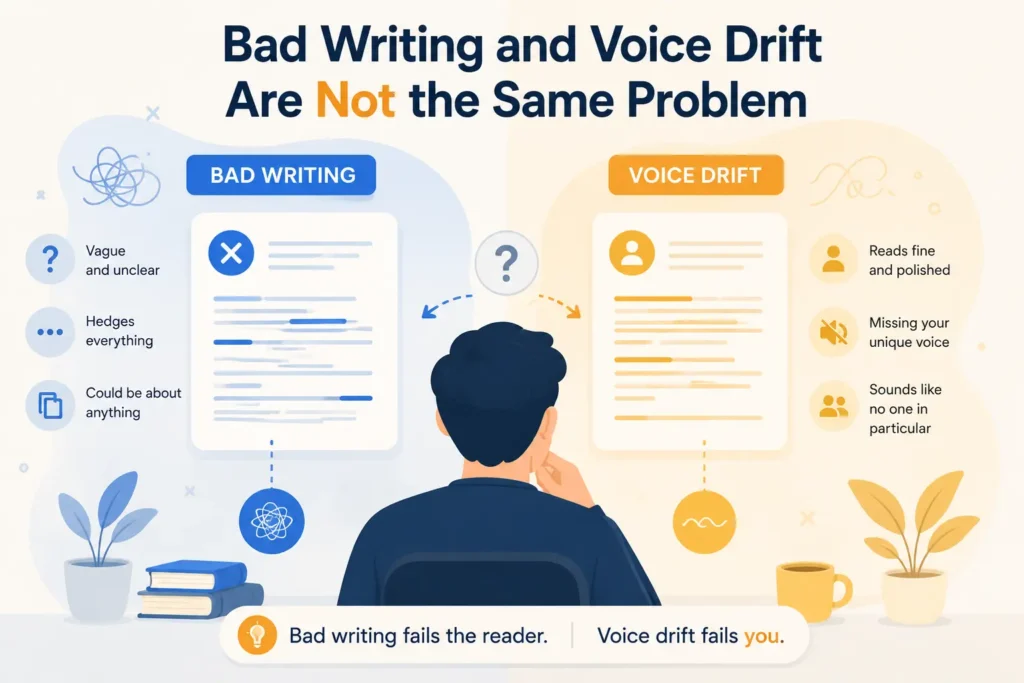
A quick way to tell the two apart:
- Bad AI writing announces itself. It’s vague, it hedges everything, it could be about your topic or twelve other topics with a few words swapped out
- Voice drift is quieter. The content is still specific, still accurate, still useful. What’s missing isn’t information, it’s texture
- Bad writing fails the reader. Voice drift fails you. A first-time visitor won’t notice. Anyone who’s read enough of your work to know how you sound will
- Bad writing gets caught in a normal edit pass. Voice drift survives a normal edit pass, because “does this read well” and “does this sound like me” are different questions
From my experience
I’ve worked as a professional content writer and strategist for the past 10 years, and I’ve been using AI for writing tasks for close to four, well before most of the current tools existed in their current form.
The pattern I’ve seen across dozens of writers I’ve worked with, and in my own writing, is that voice drift almost never shows up as a single bad edit you can point to. It shows up as a slow average. Piece twelve doesn’t sound wildly different from piece eleven.
But piece twelve next to piece one is a different writer entirely, and usually nobody flagged it along the way because every individual step looked like an improvement.
A few things I’ve noticed that don’t get talked about much:
- Drift accelerates with volume, not with laziness. The writers who publish the most, using AI to keep pace, are usually the ones drifting fastest, precisely because the editing has to happen quickly and quick edits default to the safest, most generic version of a sentence
- It’s asymmetric by content type. Opinion-heavy or personal writing drifts fast, because AI has no stake to protect and no personal history to draw from. Reference or how-to content drifts slower, because the information itself constrains the phrasing more
- The writers who resist it best aren’t the ones editing least. They’re the ones who edit with a specific reference point in mind, a known sample of their own past writing, rather than editing against a general sense of “does this sound okay”
That last point is really the whole argument of this post. “Sounds okay” is a low, forgiving bar, and AI clears it easily almost every time. “Sounds like something I specifically would write” is a much narrower target, and it’s the one that actually protects the thing you’re trying to protect.
What a Voice Actually Is, in Specific Terms
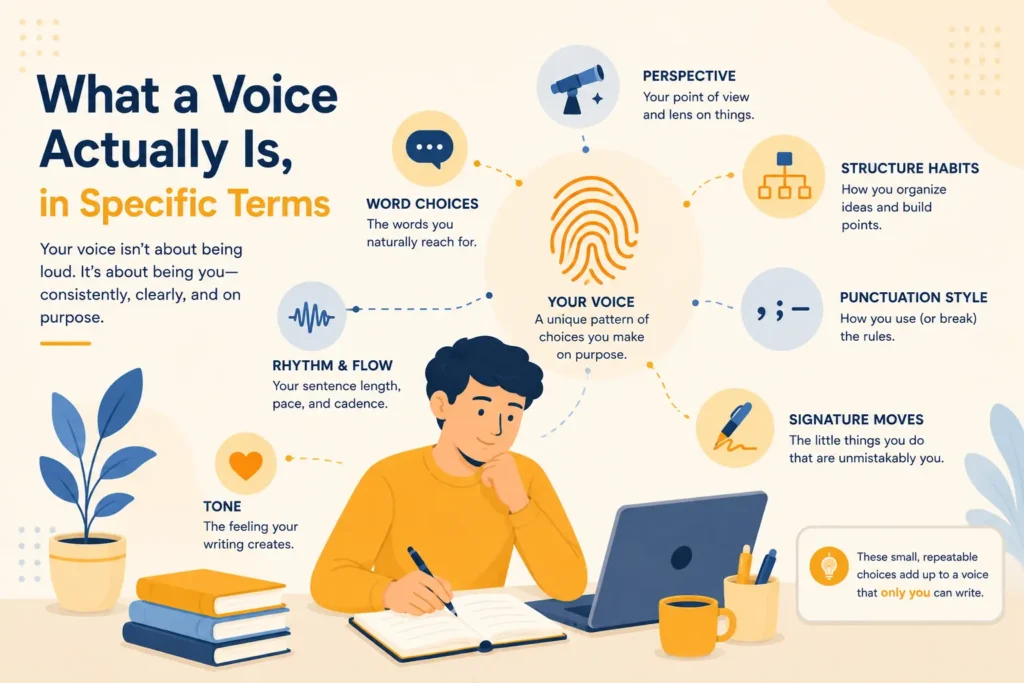
“Find your voice” is one of those instructions that sounds meaningful and tells you almost nothing about what to do. An AI writing voice problem isn’t something you can chase directly, because it’s not a single thing. It’s a bundle of small, specific habits that happen to add up to something recognizable.
Linguists have a term for this: an idiolect, the language patterns unique to one person. A 2026 stylometry study comparing human and AI-written essays found that human writers show a genuinely wide range of individual style across a set of measurable features, while AI-generated text kept collapsing toward a narrow, repeatable pattern regardless of topic or prompt. The gap wasn’t subtle. Human writing varied by author far more than it varied by subject matter, and AI writing did the opposite.
What that means practically: your voice isn’t a mood, and it isn’t something you either “have” or don’t. It’s measurable. Which means you can stop trying to feel your way toward it and start checking for it directly.
The specific dials that make up a voice:
- Sentence rhythm, how much your sentence lengths vary from one to the next, not just their average length
- Certainty, whether you tend to state things directly or qualify them
- Vocabulary tics, the specific words and phrases you reach for without thinking about it
- Opening moves, whether you tend to start a paragraph with a claim, a question, an image, or something else entirely
- Where you stop, whether you let a thought resolve neatly or leave it a little open
| Dial | Your Voice, Probably | AI’s Default |
|---|---|---|
| Sentence rhythm | Uneven on purpose, short lines land hard between longer ones | Consistently medium length, rarely very short or very long |
| Opinions | States a position, willing to be wrong | Presents multiple sides, rarely commits |
| Sign-off words | A handful of specific phrases you reach for without noticing | Rotates through a broad, neutral vocabulary |
| Endings | Sometimes trails off or lands on an unfinished thought | Wraps every section with a tidy closing line |
From my experience: the dial I see writers lose first, almost every time, is sentence rhythm. It’s the easiest one for AI to smooth over, because uneven rhythm often looks like an inconsistency to a model rather than a deliberate choice, so it gets “corrected” by default unless you specifically tell it not to. Certainty is usually second. A hedge you wrote on purpose, because you genuinely weren’t sure, gets edited into a confident claim because confident claims read as stronger writing. The model isn’t wrong to flag it. It’s just optimizing for a different thing than your voice.
This is also why the next section matters. Once you know these are the specific things that make up your voice, you can write them down for yourself before you ever open an AI tool, and check for them directly instead of relying on a gut feeling that AI is very good at satisfying without actually protecting.
Build Your Own Voice Fingerprint Before You Touch AI
This is the one exercise worth doing before opening any AI tool, workflow, or prompt template. It takes about fifteen minutes and turns “does this sound like me” from a gut check into something you can actually verify against a list.
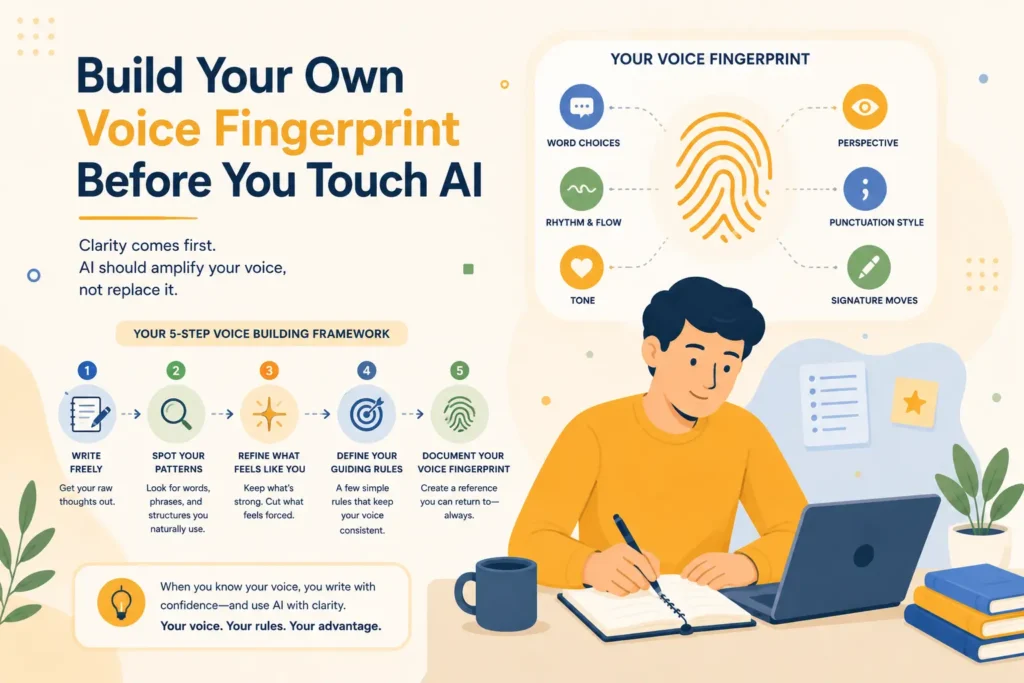
The logic is simple. You now know voice comes down to five specific dials: rhythm, certainty, vocabulary tics, opening moves, and how you end a thought. A fingerprint is just those five dials, filled in with your own actual patterns instead of general theory.
Once it exists, every future draft gets checked against it directly, instead of against a feeling that’s easy for a smooth AI edit to satisfy without earning it.
How to Build It
Pull up three or four pieces you wrote before AI was part of the process, or anything you’re confident sounds unmistakably like you. Read them back slowly and write down, in plain terms, what you notice. Not “conversational tone,” that’s too vague to check against later. Specific things:
- Words or phrases that show up often, even ones that feel like verbal tics
- Whether sentences tend to run long or get cut short, and where that tends to happen
- How paragraphs usually open, with a claim, a question, a scene, something else
- Whether opinions get stated flatly or softened
- Anything that never happens in your writing, no exclamation points, no rhetorical questions, whatever the specific absence is
Five or six lines is enough. This isn’t meant to be exhaustive, it’s meant to be checkable in under a minute.
Where This Comes From, and Why It Works
The instinct to write this down came from noticing how much easier it was to catch drift in someone else’s work than in my own, simply because I wasn’t the one who’d written the reference sample.
A fingerprint list does the same thing artificially: it gives you an outside reference point for your own writing, so you’re comparing a new draft against a fixed thing instead of against whatever your ear happens to be tuned to that day, which shifts more than most writers realize.
Keep the list somewhere close while you write. When a draft comes back from an AI pass, the question stops being open-ended. It becomes five or six specific checks, and specific checks are much harder to accidentally skip than a vague sense of whether something reads fine.
Getting AI to Match a Voice, Not Just Adjust a Tone
Asking a model to sound “more human” or “more casual” gets you its idea of human or casual, which is its own kind of generic, just a different flavor of it. Tone is one adjustable setting. Voice is five specific, interlocking habits, and no single instruction captures all five at once. Getting a genuine match takes a different approach: giving the model something concrete to hold onto instead of an adjective to interpret.
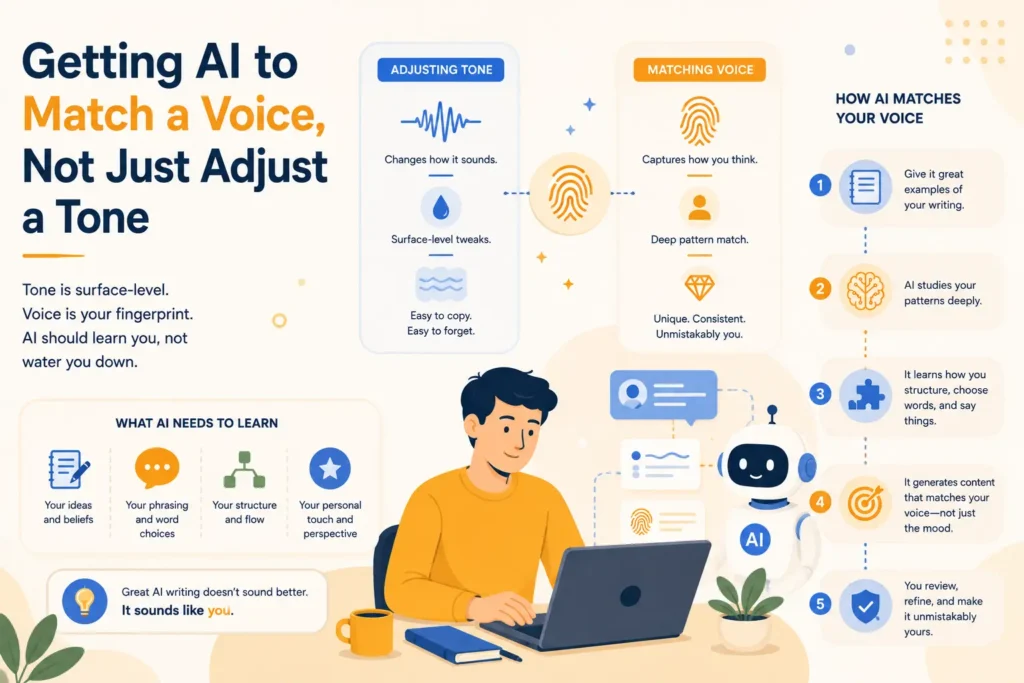
The fingerprint list from the last section is the starting point. But a list of traits described in words still asks the model to translate description into execution, and translation is exactly where genericness creeps back in. The more reliable move is pairing the list with an actual sample of writing, so the model is matching text against text rather than text against a description of text.
What Actually Works
- Pasting an old paragraph alongside the new draft and asking the model to match its rhythm specifically, not just its overall tone
- Asking it to flag which lines sound least like the reference sample, rather than asking it to fix them outright. Flagging keeps the decision with the writer, fixing hands it over
- Naming a specific tic directly, a sentence that tends to end short, a word that gets overused, instead of describing a general style
- Asking for a version with sentence lengths made deliberately more uneven, since the default move is almost always to smooth everything toward the same length
- Requesting the edit stop short of resolving every hedge into a confident statement, since that’s one of the first things to go under a normal pass
Why the Order of Operations Matters
None of this works particularly well if the underlying draft was written by AI in the first place. A fingerprint-matching edit can only preserve a voice that’s already present on the page somewhere. It can’t manufacture one from a blank prompt. The most dependable pattern is writing a rough version in your own words first, however unpolished, and treating every AI pass after that as a match-and-check step against the fingerprint rather than a generation step. That single ordering choice does more to protect voice than any single prompt phrasing, because it changes what the model has to work with from the start.
The Mistakes That Are Specific to Losing Your Voice
Most advice about AI and writing quality covers the same handful of general mistakes: relying on AI too much, skipping edits, writing vague prompts. All true, all worth avoiding, and all already covered elsewhere. None of them explain why a well-edited, carefully-prompted piece can still end up sounding like nobody in particular. That happens through a narrower set of mistakes, ones that erase voice specifically, often while everything else about the piece is holding up fine.
| Mistake | Why It Happens | Quick Fix |
|---|---|---|
| Smoothing out sentence rhythm | Even-length sentences read as “clean,” so edits drift toward uniformity by default | Reintroduce a short, blunt line every few sentences on purpose |
| Letting AI resolve your uncertainty | A hedge written on purpose gets tightened into a confident statement, since confidence reads as stronger writing | Keep the actual level of certainty, even where it’s messier |
| Absorbing the model’s phrasing over time | Enough exposure to AI-edited drafts starts leaking into first drafts written without any AI involvement at all | Check new first drafts against the fingerprint list too, not just AI-edited ones |
| Trusting a clean read on screen | Drift is often invisible silently and completely obvious the moment it’s read aloud | Read the final draft out loud before publishing, without exception |
| Editing every piece against the same reference | A fingerprint built once and never revisited stops matching how a writer’s voice naturally shifts over time | Refresh the sample every few months with recent, unedited writing |
The last one tends to surprise people. A voice isn’t static, it moves as a writer’s thinking and interests move, and a fingerprint built a year ago can start protecting an old version of someone rather than the current one. The fix isn’t complicated. It just means the fingerprint needs occasional updating, the same way any reference point does.
A Sixty-Second Check Before You Hit Publish
This last part is the actual AI writing voice check, and it’s the payoff for everything above. Once the fingerprint exists, the check takes less time than reading this paragraph.
Read the piece out loud, start to finish. Rhythm that’s gone flat, certainty that isn’t really there, an opening line that wouldn’t survive being said to someone’s face, all three surface immediately in speech and almost never on a silent read.
Against the fingerprint, four quick questions: Is the rhythm still uneven, or has it settled into one length? Would the opening line actually get said out loud the way it’s written? Is there at least one plainly stated point instead of a hedge? Does anything sound like it could’ve come from any writer, not this one specifically?
Two or three misses doesn’t mean the piece is bad. It means it’s not quite finished yet, a five-minute fix rather than a rewrite.
Leave a Reply