

▼
- Distraction is often a design problem, not a character flaw, because apps and notifications are built to pull your attention
- You can improve focus without quitting social media by changing where your phone sits and when you check it
- Attention responds to practice, so a few minutes of daily training builds it over weeks, not overnight
- Structured work blocks beat open-ended stretches where you plan to “focus later”
- If focus problems are persistent and affect daily life, speaking to a professional is a better move than pushing harder
You sit down to work with a clear plan. Twenty minutes later, you’re scrolling on your phone, three tabs deep into something unrelated, and the task you started with hasn’t moved. This guide shows you how to improve focus without quitting your phone or rebuilding your life.
It’s a common experience, and it doesn’t mean you’re lazy or broken. Gloria Mark, a psychologist at the University of California, Irvine, has spent two decades tracking how office workers use their computers, and her data shows the average time spent on a single task has steadily declined. Her work counts how often people switch between tasks rather than measuring their ability to sustain focus. In other words, the pattern is about how we work now, not about something wrong with you.
If you want to improve focus, three things matter most: shaping your environment so distractions have less pull, training your attention in small daily doses, and working in structured blocks instead of open-ended stretches. None of it requires quitting social media or rebuilding your life.
Attention works like any other skill. It responds to conditions and it responds to practice. This guide covers why focus is so hard right now, how to tell a discipline problem from something else, and the specific changes that work, ending with a 7-day plan you can start tomorrow.
Why It’s So Hard to Focus Right Now
Before fixing anything, it helps to know what you’re up against. Most advice skips this part and jumps straight to tips, which is why it tends to fall flat.
Why Do You Get Distracted So Easily?
Three things stack against you at once.
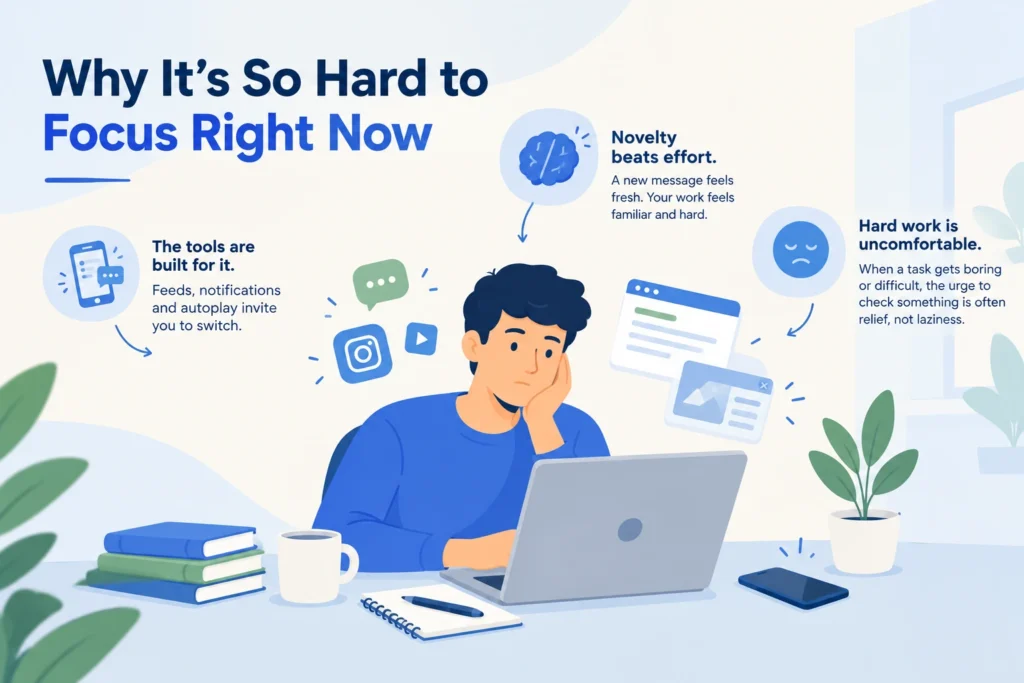
- The tools are built for it. Feeds, notifications, and autoplay all invite you to leave what you’re doing, and there’s always another one waiting.
- Novelty beats effort. A new message offers something fresh. Your report offers something familiar and hard. In the moment, fresh usually wins.
- Hard work is uncomfortable. When a task gets boring or difficult, the urge to check something is often relief, not laziness. Anyone who has tried to sit still for a meditation session has felt how quickly the mind reaches for an exit.
This matters because it changes the fix. If distraction were only a willpower problem, you’d need more willpower. Since it’s mostly about conditions and habit, you can change the conditions instead.
Is Your Attention Span Really Getting Shorter?
It can feel that way, and there’s a reason. Constant switching trains you to expect a new input every few seconds, so a single task starts to feel slow by comparison.
But a short burst of attention on a feed doesn’t mean you’ve lost the ability to concentrate. Most people can still lose hours to a good book, a film, or a long run. The capacity is still there. What has changed is how often your environment interrupts it.
That’s good news, because environments can be changed, and attention responds to practice.
Focus vs Concentration: What’s the Difference?
The two words overlap in everyday use, but a useful distinction helps here.
- Concentration is holding your attention on one thing right now.
- Focus is the wider skill of choosing what deserves your attention across a stretch of time, and ignoring the rest.
You can concentrate hard for two minutes and still not be focused on what matters that day. Some fixes in this guide train concentration, like meditation and single-tasking. Others protect focus, like environment changes and work blocks. You’ll need both.
Does Multitasking Hurt Your Focus?
For demanding work, yes. What feels like doing two things at once is usually switching between them quickly, and every switch costs you a little of your place in each task.
Writing a report while answering messages isn’t two tasks running side by side. It’s one task interrupted again and again, and both come out worse for it. The work also feels busier, which is why multitasking can seem productive while you’re doing it.
Not every pairing is a problem. A light, automatic activity next to another one, like walking while listening to something, is fine. Trouble starts when both tasks need your thinking.
A simple rule: if two things both need thought, do them one at a time. Batch the small ones, such as replies and quick admin, into a single window so they don’t cut into your main work.
What Does a Distraction Actually Cost?
A quick glance rarely costs a quick glance. When you check a message mid-task, the check itself is short. Getting back is the expensive part.
Once you switch, you have to remember where you were, what you were about to do, and why it mattered. Often one check leads to another, and by the time you return, the thread has gone cold.
What you lose isn’t only time. You lose your place in the task, your train of thought, and the momentum that made the first few minutes productive.
Which raises a fair question: if this is mostly about conditions, is it still a discipline problem at all? That’s the next section.
Is It a Discipline Problem or Something Else?
When focus slips, most people blame themselves first. It’s the most common conclusion and often the wrong one.

Why Willpower Gets the Blame
Willpower is the easiest explanation because it’s the only variable that feels like yours to control. So after a scattered day, the story becomes “I should have tried harder.”
But trying harder rarely fixes a setup that works against you. If your phone sits next to your keyboard, your inbox is open, and your task is vague, even a very disciplined person will drift. Discipline helps you stay on track. It can’t do the job of a good environment.
A Quick Way to Tell the Difference
Ask yourself these questions the next time you lose focus:
- Did I know exactly what I was supposed to be doing?
- Was my phone or a notification within reach?
- Was the task unclear, too big, or boring?
- Was I tired, hungry, or stressed?
If you answered yes to any of these, the problem is likely your setup or your state, not your character. Fix those first. If you want to work on the discipline side too, my guide to building discipline covers habits that hold up over time.
Other Things That Quietly Drain Focus
Sometimes the issue sits outside your work habits entirely. Poor sleep is the most common one, and it’s easy to underestimate. Long stretches of stress, low mood, and constant worry also make it harder to concentrate, and no productivity system fully makes up for them.
Before you overhaul your routine, check the basics: sleep, food, movement, and what’s weighing on your mind. Fixing a rough sleep pattern can do more for your focus than any app.
Could It Be ADHD? When to Talk to a Professional
Trouble focusing has many causes. ADHD is one that people often wonder about, and it can only be assessed by a qualified professional, not a checklist or a blog post.
Consider speaking to a doctor or psychologist if:
- Your difficulty with focus has been there for as long as you can remember
- It affects several areas of life at once, such as work, relationships, and daily tasks
- It hasn’t improved after you’ve fixed your environment and sleep
- It comes with persistent anxiety, low mood, or exhaustion
This isn’t a diagnosis, and I’m not suggesting anything is wrong with you. It’s simply that a professional can look at things a routine can’t. Getting checked is a practical step, not an admission of failure.
Fix Your Environment Before You Try to Improve Focus
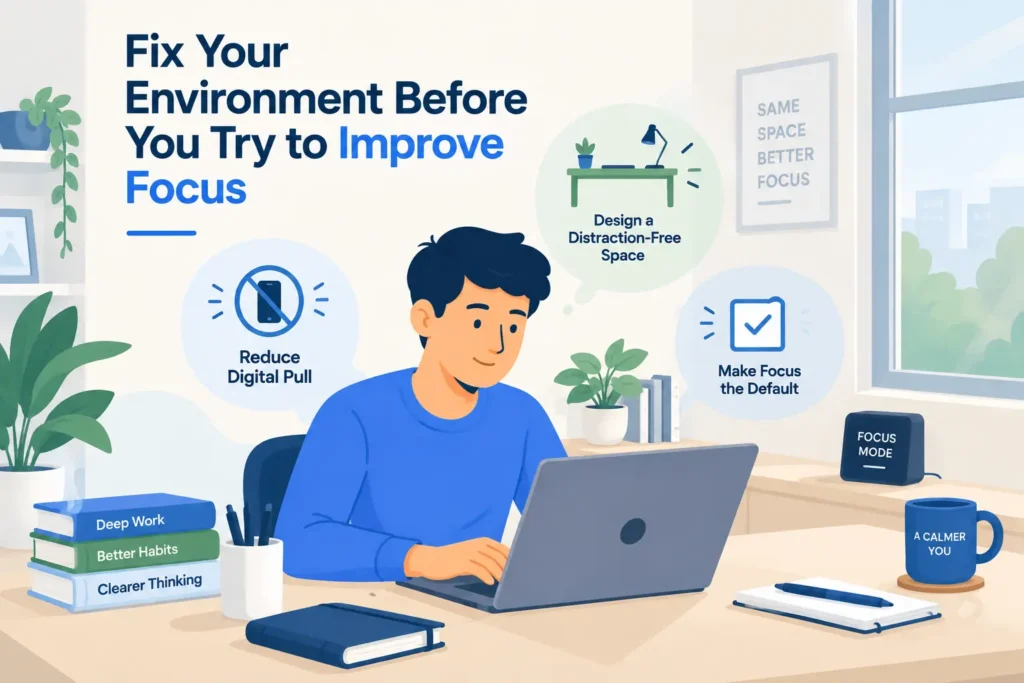
If you want to improve focus, start with your surroundings, not your mindset. Changing what’s around you is faster than changing how you think, and it works even on days when motivation is low. The aim is simple: make distraction take effort and make focus the easy option.
You don’t need to do everything below. Pick one or two changes, keep them for a week, and only then add more.
How to Stop Getting Distracted by Your Phone
Your phone wins mostly because it’s close and effortless to pick up. The goal is to add friction, so reaching for it becomes a decision instead of a reflex.
- Add distance. Another room is best. Across the desk is the minimum. Out of sight matters as much as out of reach, since a phone lying face up still pulls at you.
- Remove the easy entry points. Move social and video apps off your home screen and into a folder several swipes away. Log out after each use so opening one takes extra steps. Many people also find that switching the screen to grayscale during work hours makes feeds less tempting.
- Set limits that take effort to break. A limit you can dismiss in one tap won’t hold. Choose one that needs a passcode or a deliberate extra step, and have someone else set the code if you trust yourself less at 4 pm than at 9 am.
- Keep it silent, not just muted. Face down, vibration off. If you’re worried about missing an important call, allow calls from a short list of people and silence everything else.
- Give the urge somewhere to go. You’ll still feel the pull. When you do, write down what you wanted to check on a paper list and keep working. Look at the list during your break.
How to Focus When Working From Home
Home has no natural cues that say “work mode,” so you have to build them.
- Choose a fixed spot. Even a corner of a table works, as long as you use it only for work during focus hours. Avoid the bed and the sofa, which your body associates with rest.
- Create a start ritual. A short, repeatable sequence tells your mind the session has begun. For example: make tea, clear the desk, close every unrelated tab, and write the one task you’ll do first on a sticky note. Keep it under five minutes so it doesn’t turn into procrastination.
- Set boundaries with people around you. A closed door, headphones, or a simple sign works. Share your focus hours in advance and tell them when you’ll be free, so you aren’t pulled out of guilt.
- Contain household pulls. Laundry, dishes, and the fridge feel urgent when a task is hard. Keep a “later” list for chores and treat them as scheduled breaks, not interruptions.
- Decide when you stop. An end time protects your focus during the day, because the work no longer feels endless. Finish with a short shutdown step, such as noting tomorrow’s first task, then close the laptop.
How to Focus With Constant Notifications
Most notifications aren’t urgent. They feel that way because they arrive without warning. Start by sorting them into three groups:
- Keep: people trying to reach you directly and anything time-critical, such as a call from family or your manager
- Batch: email, team chat, and most messaging apps, checked at set times
- Kill: badges, banners, promotional alerts, news, shopping, and game apps
Then put structure around the batch group:
- Set check windows. Three or four fixed times across the day, for example mid-morning, after lunch, and late afternoon. Between them, close the apps completely instead of minimizing them.
- Signal your status. Use a focus or do-not-disturb status on chat tools so colleagues know you’re in a block and when you’ll reply.
- Agree on what “urgent” means. With your team or clients, decide how truly urgent matters reach you, such as a phone call, and that everything else can wait for your next window. A clear rule is easier for people to respect than a silent struggle.
- Test the fear of missing out. If you worry something will go wrong, try the new routine for three days and notice what actually breaks. Most people find very little does.
Set Up Your Screen and Desk
Your phone isn’t the only source of pull. Your computer and desk matter too.
- One task, one window. Close every tab that isn’t tied to what you’re doing now. If you want to keep something for later, bookmark it or paste it into a list.
- Use full-screen mode for writing and reading, so other apps stay out of sight.
- Separate work and leisure. Use different browser profiles, or at least stay logged out of social accounts during focus hours.
- Clear the physical desk. Keep only what the task needs, plus water.
- Keep a parking-lot note. Leave a blank page beside you for stray thoughts like “email Sam” or “check that price.” Writing it down lets you drop the thought without acting on it mid-task.
Once your environment supports you, the next step is training attention itself. Before that, one small action: pick one change from this section and set it up today.
Train Your Attention Like a Muscle
Fixing your environment removes the obstacles. Training builds the capacity underneath. It works like lifting weights: small, regular sets beat the occasional heroic effort, and the first sessions feel awkward. You don’t need much time. You need consistency.

Does Meditation Improve Focus?
Meditation is practice at one specific skill: noticing that your mind has wandered and bringing it back. That moment of noticing and returning is the repetition, the same way one lift is a rep in the gym.
This changes how you judge a session. A sitting where your mind wandered thirty times and you came back thirty times is a good workout, not a failure. The common belief that meditation means emptying your head is what puts most beginners off.
Be realistic about what to expect. It isn’t a quick fix, and it works best alongside the environment changes above. What many people notice over time is a shorter gap between drifting and catching themselves, in meditation and in the middle of a work task. That gap is the skill you’re building.
If you’re new to the practice, my guide to meditation covers the basics in more depth.
A 5-Minute Meditation for Focus
Follow these steps exactly the first few times, then adjust.
- Sit upright on a chair or cushion with your feet flat and your hands resting. Set a timer for five minutes so you aren’t checking the time.
- Close your eyes, or rest your gaze on a spot on the floor.
- Take three slow breaths, making each exhale a little longer than the inhale.
- Let your breathing return to normal. Choose one place to feel it, such as your nostrils, chest, or belly, and stay with that spot.
- Count each exhale silently from 1 to 10, then start again at 1. If you lose count, go back to 1 without comment.
- When your mind wanders, silently note “drifting” and return to the breath. Skip the self-criticism.
- When the timer ends, open your eyes slowly and take one more breath before you pick up your phone.
A few tips that help it stick:
- Attach it to something you already do, like right after your morning tea or just before your first work block.
- Five days a week beats one long session on Sunday.
- Expect your mind to wander many times. That’s the exercise, not a sign you’re doing it wrong.
Other Focus Exercises
You don’t have to meditate to train attention. Try any of these:
- Single-task for 15 minutes. Pick one task, one window, and a timer. Nothing else is allowed in. Add five minutes each week or so.
- Read without your phone in the room. Start with ten pages of a book or a long article, with notifications off.
- Walk or run without audio. Ten to twenty minutes, paying attention to your footsteps, breathing, and surroundings. It’s a good way to practise staying with one thing when there’s no input to grab onto.
- Do one everyday task slowly. Washing dishes or making tea, with your full attention on each step.
- Wait without reaching for your phone. In a queue, in a lift, or while the kettle boils. These small gaps train your tolerance for boredom.
- Do a two-minute end-of-day check. Write one line on when your mind drifted most and what triggered it.
How Long Does It Take to Rebuild Your Attention Span?
There’s no fixed timeline. It depends on your sleep, your stress, how much of your day is spent switching, and how consistent you are. Anyone who promises a specific number of days is guessing. Here’s a rough guide for setting expectations:
- The first one to two weeks: you notice your mind drifting more often, which can feel like you’re getting worse. You aren’t. You’re seeing what was already happening.
- Around a month: starting a task feels easier, and you return faster after a slip.
- Two to three months: longer stretches of steady work feel more natural, and your environment habits feel routine rather than forced.
Setbacks will happen, especially after bad sleep, travel, or a stressful week. Restart small instead of trying to make up for lost time. If motivation is what keeps fading, my post on how to stay consistent when motivation fades goes deeper. And track progress by how quickly you come back, not by how rarely you drift.
Training builds the capacity, but your body has a say in how well it works. That’s next.
Sleep, Movement, and Food: The Body Side of Focus
Many of the most natural ways to improve focus have nothing to do with apps. A tired, dehydrated body that hasn’t moved all day makes every other tip in this guide harder to follow.

Sleep: The Base Layer
When sleep is short, attention is often the first thing to slip. Starting tasks feels harder, your mind drifts sooner, and the phone looks more appealing. No app makes up for that.
- Keep a steady wake-up time, even on weekends, as far as your life allows.
- Wind down screens and heavy work in the hour before bed.
- Charge your phone outside the bedroom.
After a bad night, protect your day instead of fighting it. Do your hardest task in your sharpest hour, keep work blocks short, and go easy on caffeine later on. If poor sleep is a long-running pattern, it’s worth raising with a doctor.
Movement
Sitting for hours makes the mind restless. Moving is one of the quickest ways to reset it.
You don’t need a workout. A short walk between work blocks, standing during calls, or a few minutes of stretching before you start can all help. Many people also find that a walk or run earlier in the day makes it easier to settle at the desk afterwards. If you want a routine to build on, my guide on how to run longer shows how to build up steadily.
Food, Water, and Caffeine
Long gaps without eating or drinking often show up as irritability and drift, and it’s easy to blame your attention instead. Keep water at your desk, and eat something with protein or fibre before a long block, not just something sugary.
Caffeine helps some people and makes others jittery, and late doses can cost you sleep. Notice how you feel an hour after your usual cup and adjust the timing to suit you.
Breaks That Rest Your Mind
A break spent on your phone isn’t a break. Your mind is still taking in new input, so you come back no fresher than you left.
Better options are to stand up, drink water, look out of a window, walk to another room, or take a few slow breaths. Take five minutes after each block and a longer one after two or three. Rest done well is part of the work, not a reward for finishing it.
With your body backing you up, the next question is how to organize your work so you can use it.
Structure Your Work for Deep Focus
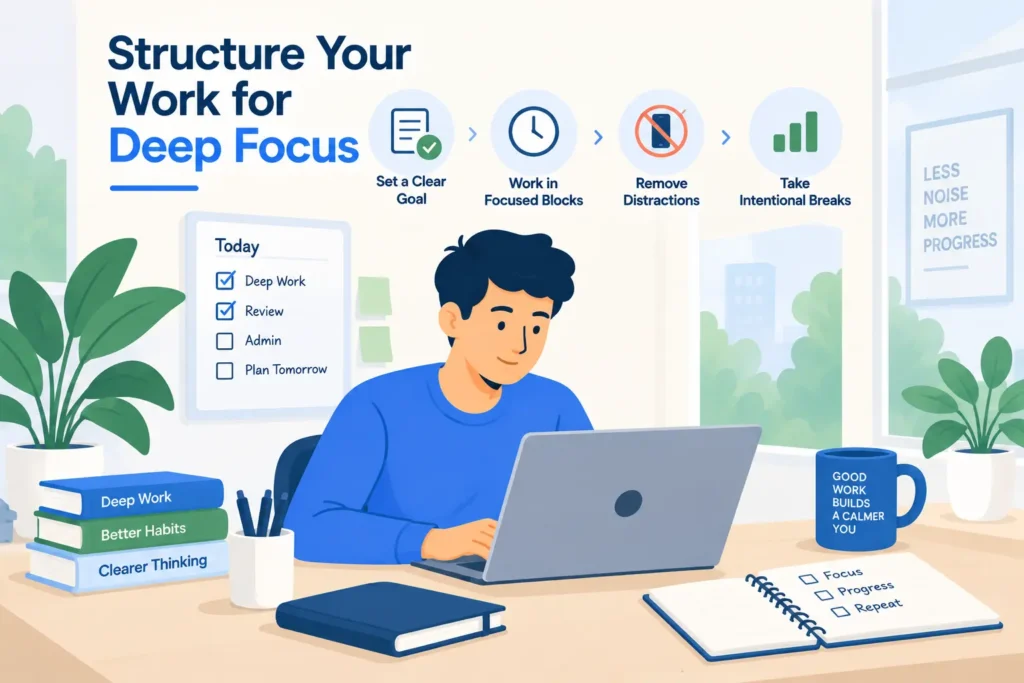
Environment and training help, but deep focus also needs a container. Without one, you sit down with an open-ended “work on the report,” and your mind negotiates its way out. Structure gives your attention a start, an end, and a clear target.
Deep Work for Beginners
Deep work is a stretch of uninterrupted effort on something demanding. You don’t need four hours. Start with one block of 60 to 90 minutes a day, ideally when your mind is sharpest.
Here’s how to run a block:
- Decide the outcome first. “Draft the first two sections” beats “work on the article.”
- Run your start ritual. Clear the desk, close unrelated tabs, and put your phone out of reach.
- Set a timer and work on that one task only.
- Keep a parking-lot note beside you for stray thoughts and things you need to check later.
- Stop when the timer ends. Take a real break away from screens.
- Write one line on what you finished and what comes next, so tomorrow’s start is easy.
A few tips for beginners:
- Begin with 30 to 45 minutes if 90 feels too long, then extend gradually.
- Put the block in your calendar like a meeting, so it isn’t the first thing to be given away.
- Protect your best hours. For some people that’s early morning, for others mid-afternoon.
- One block a day, done consistently, beats three blocks once a week.
- Judge a block by whether you stayed with the task, not by how brilliant the output was.
Pomodoro vs Time Blocking
These are the two most popular ways to structure focus, and they solve different problems.
Pomodoro means working in short timed sprints, commonly 25 minutes, followed by a 5-minute break, with a longer break after four rounds.
- Works well for starting tasks you’re avoiding, for work you can break into small pieces, and for people who get restless in long stretches
- Weakness: the timer can cut you off just as you’ve settled in
Time blocking means assigning tasks to specific blocks in your calendar, so your day has a plan before it begins.
- Works well for people juggling many demands and for protecting deep work slots
- Weakness: plans slip when meetings or surprises arrive, so you need buffer time between blocks
If you’re interrupted often, you don’t have to choose. Use time blocking to reserve focus slots in your day, and use short Pomodoro-style sprints inside them when starting feels hard. Shorter sprints also recover better from interruptions than a plan that depends on 90 clear minutes.
| Factor | Pomodoro | Time Blocking |
|---|---|---|
| How it works | Short timed sprints (commonly 25 minutes) followed by 5-minute breaks | Tasks are assigned to set blocks in your calendar before the day starts |
| Best for | Starting tasks you’re avoiding and work that splits into small pieces | Juggling several demands and protecting deep work slots |
| Typical session length | 15 to 50 minutes, adjustable | 60 to 120 minutes |
| Planning needed | Very little, just a timer and one target per sprint | More, since you plan the whole day or week in advance |
| If you’re interrupted often | Easier to restart, since a broken sprint costs only a short stretch | Harder, because one disruption can push back the whole plan |
| Main weakness | The timer can cut you off just as you’ve settled in | Plans slip unless you leave buffer time between blocks |
| Good first step | Pick one task and run a single sprint today | Block one 60 to 90 minute slot in tomorrow’s calendar |
Why Pomodoro Stops Working, and What to Change
If Pomodoro worked for a week and then fell apart, one of these is usually why.
- The timer breaks your flow. When you’re absorbed, ignore the alarm and continue until a natural stopping point. Use the timer to start, not to stop.
- Breaks turn into scrolling. Make breaks physical: stand up, drink water, stretch, or look out of a window. Keep your phone out of the break.
- The task is too vague. “Work on project” gives your mind nowhere to land. Give each sprint a specific target.
- 25 minutes doesn’t fit. Try 15 minutes for tasks you dread, and 45 to 50 for demanding work.
- Interruptions keep breaking sprints. Note the interruption on your parking-lot list and restart the sprint from zero instead of counting a broken one.
- You treat it as a rulebook. It’s a tool. Adjust the lengths until it suits your work.
Structure helps most when life cooperates. The next section covers what to do when it doesn’t.
How to Focus When Life Doesn’t Cooperate
Most focus advice assumes a quiet room and a clear head. Real days rarely offer either. This section covers the situations where your setup is imperfect and your mind is crowded, and what to do anyway.
How to Focus With a Busy Mind
A busy mind isn’t a lack of focus. It’s a full inbox in your head, with every open loop asking for attention at once. You can’t concentrate on one thing while your mind is guarding twenty others.
Try a brain dump before you start:
- Set a timer for two to five minutes.
- Write down everything that’s on your mind: tasks, worries, half-formed ideas, errands, things you’re afraid to forget. Don’t organize, and don’t judge.
- Circle the one item that matters most for the next work block.
- Move anything that needs a decision or a deadline onto your calendar or to-do list.
- Close the page and start your block. Everything else is written down and will still be there afterwards.
Two more habits help:
- Keep the parking-lot note open during work, so new thoughts have somewhere to go.
- Take three slow breaths before you begin, with longer exhales, to settle your body before your mind.
If worry, not tasks, is what’s filling your head, writing it down still helps, but a short walk or talking it through with someone may help more.
How to Focus on Studying and Long Reading
Studying is hard on attention because the material is dense, the reward is far off, and passive reading feels productive when it isn’t. The fix is to make the session active and short enough to hold.
- Start with a question. Before you read a section, write what you want to learn from it. Your mind reads differently when it’s hunting for an answer.
- Work in chunks. Study for 25 to 45 minutes, then take a short break away from screens.
- Read in pieces, then close the book. After each page or section, recall the main points in your own words without looking. It feels harder, and it holds attention far better than rereading.
- Keep the phone in another room. Even a silent phone within reach invites a quick look.
- Rotate subjects. If one topic drains you, switch to another after a break instead of forcing through.
- Use paper for hard material. Notes by hand and printed pages give fewer chances to wander.
- Study at consistent times. A regular slot builds a habit that needs less effort to start.
If you’re stuck in a long article or a dense report, break it into sections, set a timer for each, and note one takeaway before moving on.
How to Stop Doomscrolling and Regain Focus
You’ve lost 20 minutes to a feed, and now your task feels heavy. The instinct is to feel guilty and push on. A short reset works better.
- Stop and put the phone away, out of reach, before you do anything else.
- Stand up and move for two minutes. Walk, stretch, or drink some water. Your body helps clear your head.
- Take three slow breaths and notice that the scrolling urge is passing.
- Shrink the task. Choose the smallest next step, such as opening the document and writing one sentence.
- Set a 10-minute timer and work on that step only. Momentum usually returns once you’ve started.
- Skip the guilt. It wastes energy you need for the next block.
If it happens often, note what led you to the phone. Boredom, a hard task, and fatigue are common triggers, and each has a different fix.
How to Improve Focus Without Quitting Social Media
For many people, quitting isn’t realistic. Social media may be part of their job, their friendships, or how they learn. You can keep it and still protect your attention by setting rules.
- Set fixed windows. Check two or three times a day, for example after lunch and in the evening, and keep it out of your focus blocks.
- Never open it as a reflex. Before you tap, ask what you want to do there. If you can’t answer, close it.
- Remove it from your home screen and turn off all non-essential notifications.
- Curate your feed. Unfollow accounts that leave you drained or restless, and follow ones that give you something you’d use.
- Use it deliberately. Decide in advance whether you’re there to post, reply, or learn, and leave when that’s done.
- Keep the first and last hour free. Screens first thing in the morning and right before sleep tend to set a scattered tone for the day.
- Do a weekly check. Look at your screen time, notice the pattern, and adjust one rule.
Why Do You Lose Focus After 10 Minutes?
If your focus keeps collapsing early in every session, there’s usually a cause you can find and fix. Run through this list:
- The task is vague or too big. Break it into a step you could finish in one sitting.
- It’s too hard, or too easy. Too hard creates avoidance. Too easy creates boredom. Adjust the difficulty or add a small challenge.
- You’re tired, hungry, or dehydrated. Check your basics before blaming your attention.
- Your phone is within reach. Move it, as covered earlier.
- Your head is crowded. Do a brain dump first.
- You haven’t had a break. If you’ve been at it for hours, the problem is fatigue, not discipline.
- You’re avoiding something uncomfortable. Notice the feeling, name it, and do two minutes of the task anyway.
- It’s the time of day. Save demanding work for your sharpest hours.
If the problem stays no matter what you change, and it has been there for a long time, that’s the point where speaking to a professional makes sense, as covered earlier.
Now let’s pull everything into a plan you can start tomorrow.
A 7-Day Plan to Improve Focus
One small change per day is enough. Keep each change going as you add the next, so by Day 7 you’re running the full system. Each step takes 15 minutes or less to set up. Choose a week that’s fairly ordinary, not one with travel or a big deadline, and note your starting point first: on a normal day, how often do you reach for your phone, and how long can you stay on one task?
Day 1: Move Your Phone
Put your phone in another room for your first work block, ideally 45 to 60 minutes.
- Switch it to silent before you leave it, and tell anyone who needs you urgently how else to reach you.
- Keep a piece of paper on your desk. Each time you feel the urge to check it, make a tick mark and write what you wanted to look up.
- At the end of the block, read the list and check only what still matters.
Watch for: the urge is strongest in the first ten minutes, then fades. The tick marks show you how automatic the habit is.
Day 2: Clean Up Notifications
Open your notification settings and sort every app into three groups: keep, batch, and kill.
- Keep: direct calls and messages from a short list of people.
- Batch: email, team chat, and messaging apps, checked at fixed times.
- Kill: badges, banners, news, shopping, and game alerts.
Then choose your check windows, for example mid-morning, after lunch, and late afternoon. Close these apps fully between windows.
Watch for: the temptation to keep “just in case” alerts. Keep only what would cause real harm if it waited two hours.
Day 3: Build a Start Ritual
Create a short sequence you repeat every time you begin focused work. It should take under five minutes.
- Clear your desk of anything the task doesn’t need.
- Close every unrelated tab and app.
- Write the single task you’ll do first on a sticky note.
- Take three slow breaths, then start your timer.
Do the same steps in the same order. The repetition is what turns it into a signal.
Watch for: rituals that grow into procrastination. If yours passes five minutes, cut a step.
If you’d like to build this into your mornings, my post on a morning routine shows one way to do it.
Day 4: Try the 5-Minute Meditation
Do the counting-breath practice from the training section before your first work block.
- Sit upright, set a five-minute timer, and count each exhale from 1 to 10.
- When your mind drifts, note it and return to 1.
- Afterwards, take one more breath before picking up any device.
Watch for: judging the session by how calm you felt. Judge it by how many times you noticed and came back. Ten returns is a good session.
Day 5: Run One Deep Work Block
Now combine what you’ve built. Choose one demanding task and run a 45 to 60 minute block.
- Define the outcome first, such as “draft the introduction,” not “work on the article.”
- Run your start ritual, keep your phone out of the room, and keep a parking-lot note beside you.
- Work until the timer ends, then take a break away from screens.
- Write one line on what you finished and what comes next.
Watch for: the urge to quit around the 15-minute mark. That’s usually where the work gets difficult, not a sign the block is failing.
Day 6: Do a Brain Dump
Spend five minutes writing down everything on your mind: tasks, worries, errands, half-formed ideas.
- Don’t organize while you write.
- Afterwards, circle the one item that matters most tomorrow.
- Move anything with a date onto your calendar and the rest onto a single list.
- Then run a second deep work block, shorter this time, and notice whether starting felt lighter.
Watch for: turning the dump into a new to-do list you’ll never finish. The point is to empty your head, not to plan your life.
Day 7: Review and Reset
Look back at the week and decide what stays.
- Which change made the biggest difference to your focus?
- Which one felt like too much effort, and can you shrink it?
- What was your best hour this week, and what was different about it?
Pick two habits to carry forward and drop or modify the rest. Then place your next deep work block in your calendar.
Some days will go badly, and that’s normal. If you miss one, don’t restart the week. Pick up at the next day.
Your Weekly Review Question
At the end of the week, ask yourself: When did I stay with one task the longest, and what was different about that moment?
Your answer points to the conditions that work for you, whether that’s the time of day, the room, the type of task, or how well you’d slept. Build your next week around them.
Your First Step to Improve Focus Starts Today
A distracted world makes focus harder, but it doesn’t make it out of reach. To improve focus, work on three things together: shape your environment so distraction takes effort, train your attention in small daily doses, and structure your work so each session has a clear start, end, and target.
You don’t need to change everything at once. One habit, kept for a week, does more than a full overhaul abandoned by Thursday. Slips will happen, so measure progress by how quickly you come back, not how rarely you drift.
Once your focus is steadier, the right tools can help you get more from those hours. My guide to using AI for writers covers how.
Start today: put your phone in another room, pick one task, and work on it for 25 minutes.
FAQs
Q. Can you really improve focus, or is it fixed?
A. You can improve it. Focus isn’t a fixed trait. It responds to your environment, your sleep, your habits, and regular practice. Most people see the biggest early gains from removing distractions, such as moving the phone and cutting notifications, and then build on that with short daily training like a five-minute breathing practice.
Q. Is my attention span getting shorter?
A. It can feel that way, because constant switching trains you to expect a new input every few seconds, and single tasks then feel slow. But that’s a habit, not a lost ability. Most people can still stay absorbed in a good book, a film, or a long run. Changing your environment and practising sustained attention brings the ability back.
Q. What’s the fastest way to reset focus before work?
A. Put your phone out of reach, clear your desk, and write down the one task you’ll do first. Then take three slow breaths and start a timer for 25 minutes. If your head feels crowded, spend two minutes writing down everything on your mind before you begin. The whole reset takes about five minutes.
Q. How long does it take to improve concentration?
A. There’s no fixed timeline. It depends on your sleep, your stress, how much of your day is spent switching between tasks, and how consistent you are. Many people notice starting tasks feels easier within a few weeks, and steadier focus over a couple of months. Track progress by how quickly you return after a slip, not by how rarely you drift.
Q. Do focus apps actually work?
A. They can help, but only as part of a wider setup. App blockers and timers add friction, which is useful, but they’re easy to override if the underlying habit stays the same. Use them alongside a phone-free workspace, batched notifications, and clear tasks. If an app becomes another thing to manage, drop it.
Q. Should I see a doctor about focus problems?
A. Consider it if the difficulty has been there for as long as you can remember, affects several areas of your life, or hasn’t improved after you’ve fixed your environment and sleep. Also consider it if it comes with persistent anxiety, low mood, or exhaustion. A doctor or psychologist can look at causes a routine can’t, and getting checked is a practical step, not a failure.
Leave a Reply