
How to Run Longer Without Getting Tired: A Beginner’s Guide to Endurance
Two minutes in, your lungs are on fire and your legs feel like they’re made of wet sand. You slow to a walk, annoyed, wondering how anyone runs for 30 minutes straight without collapsing.
Here’s the part that surprised me most when I started training endurance seriously: it’s rarely a fitness problem. It’s a pacing problem. A 2026 review in the peer-reviewed journal Medicina, analyzing 37 studies on distance-running pacing, found that runners who paced themselves evenly consistently outperformed those who started fast and faded, the exact pattern most beginners fall into without realizing it.
Most beginners burn out early because they’re running too fast, too soon, breathing wrong, and treating every run like a race against themselves.
Learning to run longer isn’t about gritting your teeth and pushing harder. It’s about slowing down enough that your body can actually sustain the effort, then building from there. This guide breaks down exactly how to improve endurance step by step, no advanced training plan or prior fitness required.
A quick note before we go further: if you can’t yet run continuously for 10-15 minutes, start here instead, this guide picks up once you’ve got that foundation and want to extend it.
Why You Get Tired So Fast When Running (The Real Reason)
Before any technique or plan helps, you need to understand what’s actually happening in those first few minutes. Because once this clicks, everything else in this guide makes a lot more sense.
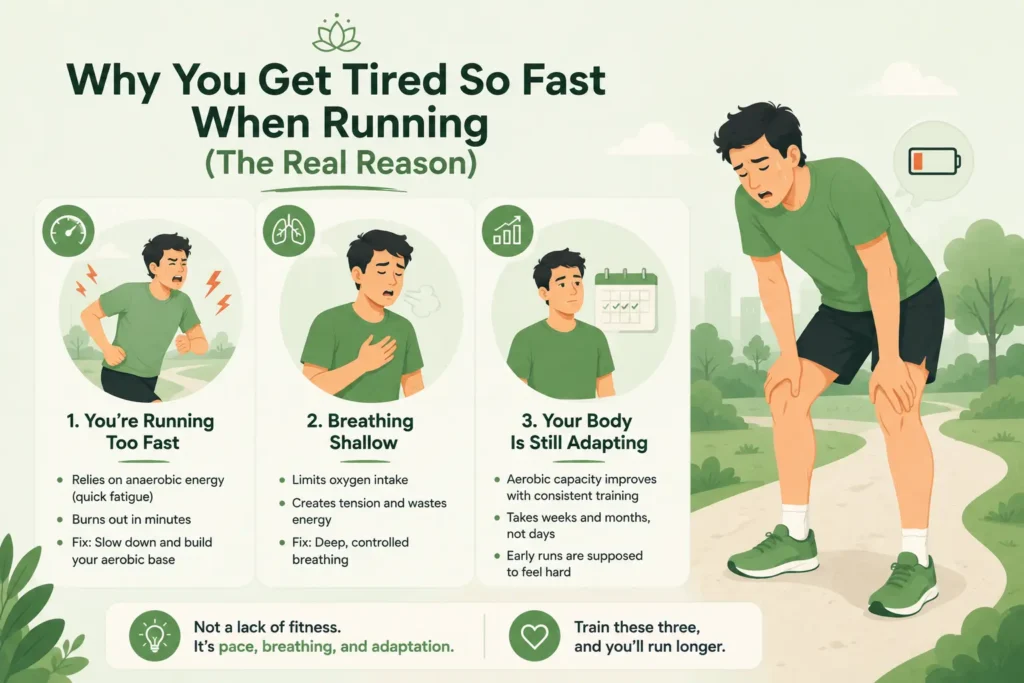
You’re Running Too Fast for Your Fitness Level
This is the number one reason beginners gas out early, and almost nobody realizes it’s happening in the moment.
Most new runners start at a pace that feels “normal,” usually because it’s the pace they see other people running at, or the pace that feels like actual exercise. The problem is that pace is almost always too fast for an untrained aerobic system to sustain.
- Running too fast forces your body to rely on anaerobic energy (short bursts, quick fatigue) instead of aerobic energy (steady, sustainable)
- This is why you can sprint for 30 seconds easily but can’t hold that same effort for 5 minutes
- The fix isn’t willpower. It’s slowing down enough that your aerobic system, not your anaerobic system, is doing the work
Breathing Shallow Instead of Deep
Most beginners breathe from the chest, short, quick breaths that never fully fill the lungs.
- Shallow breathing limits oxygen intake right when your muscles need more of it
- It also tightens the chest and upper body, which wastes energy on tension you don’t need
- Deep, controlled breathing (more on this in the breathing section below) gets more oxygen in with less effort, delaying that “I can’t breathe” feeling
Your Body Hasn’t Adapted to the Demand Yet, and That’s Normal
This one isn’t a mistake, it’s just biology.
- Your aerobic capacity, how efficiently your body uses oxygen, improves with consistent training over weeks and months, not days
- Early runs are supposed to feel hard. That’s not a sign you’re unfit, it’s a sign your body hasn’t adapted yet
- Research on previously untrained beginners shows measurable aerobic improvements appearing within the first 3 months of consistent training, with continued gains through the first year
Put these three together, and the picture becomes clear: getting tired fast isn’t a character flaw or a fitness ceiling. It’s pace, breathing, and adaptation, three things you can directly train, starting with the very next section.
The Talk Test: The Simplest Way to Run Longer
If you remember nothing else from this guide, remember this one test. It’s the single fastest fix for beginners who gas out early, and it costs nothing to try on your very next run.
What the Talk Test Is and How to Use It
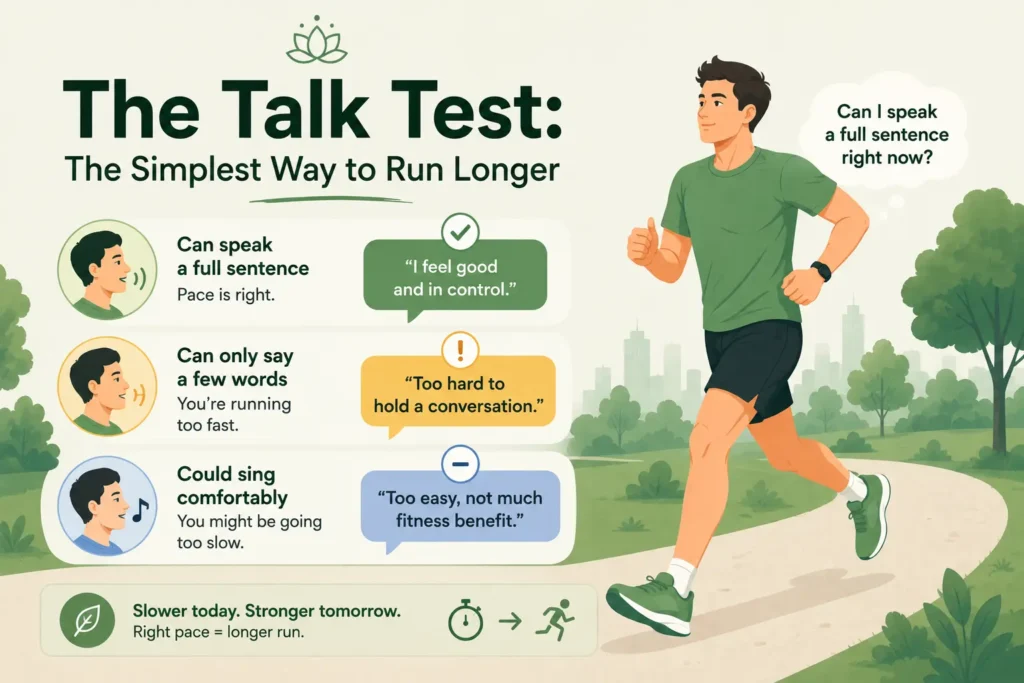
The talk test is exactly what it sounds like: while running, try to speak a full sentence out loud.
- If you can comfortably say a full sentence, your pace is right for building endurance
- If you can only get out a few words before gasping, you’re running too fast
- If you could comfortably sing, you’re probably going too slow to build much fitness at all
That’s the entire test. No heart rate monitor, no pace calculator, no app required.
You already know your easy pace if you’ve been running a while, this isn’t new information. What matters here is that the pace that felt right at minute 15 often creeps up without you noticing by minute 30, and that’s usually exactly where the wall hits. I still run the talk test check mid-run, ten years in, precisely because pace drift is invisible until you’re already gasping.
Why Slowing Down Helps You Run Farther
This feels backwards the first time you try it. Slower should mean weaker, right?
It doesn’t work that way.
- Running at “talk test” pace keeps you in your aerobic zone, the energy system built for sustained effort, not short bursts
- Your body burns fat and oxygen efficiently at this pace, instead of burning through limited anaerobic fuel in minutes
- Most beginners who slow down by even 30-45 seconds per kilometer immediately find they can run twice as long without stopping
The uncomfortable truth: if you’re gasping for air two minutes into every run, you’re not building endurance, you’re just repeatedly hitting a wall. Slowing down isn’t giving up. It’s the actual mechanism that lets you run farther.
Once this pace feels natural, everything in the next section, the run-walk method, becomes far easier to stick with.
How to Improve Endurance Step-by-Step
This is the actual system. The one that takes you from “tired after two minutes” to comfortably running longer, without any of it feeling like a fight. No magic pace, no gear, just a progression I’ve watched work for basically everyone who sticks with it.
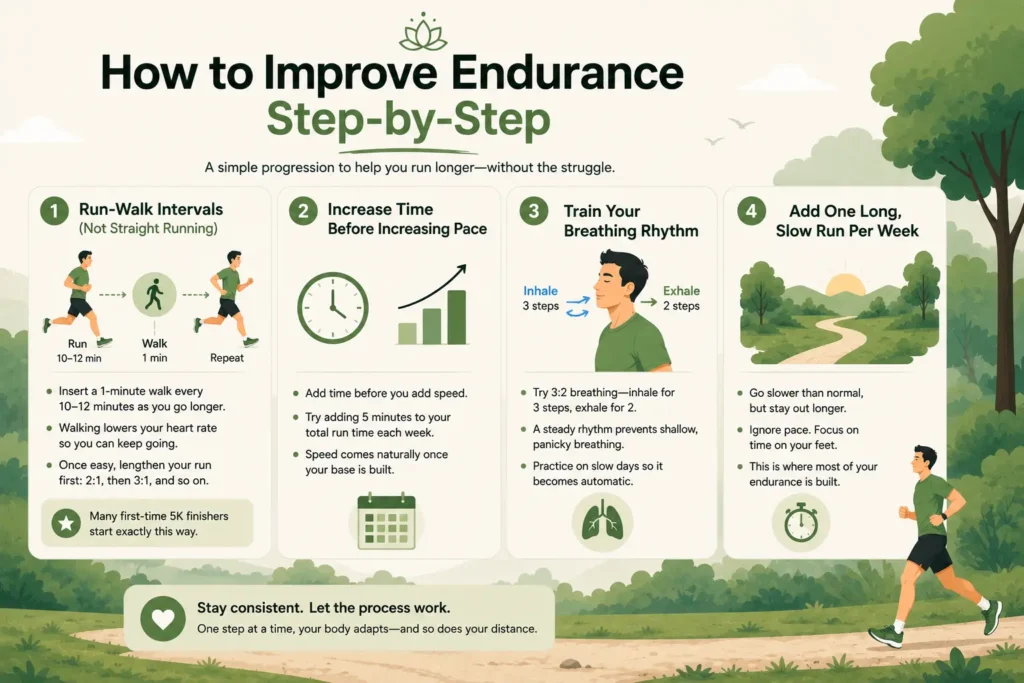
Step 1: Run-Walk Intervals (Not Straight Running)
If you’re already running 15-20 minutes straight, the run-walk method isn’t about starting; it’s about safely adding distance without adding strain.
- Insert a 1-minute walk every 10-12 minutes once you’re pushing past your current comfort zone, then shrink that walk break as the new distance feels normal
- The walking isn’t you failing at running. It’s your heart rate coming back down so the next minute doesn’t wreck you
- Once that feels easy, stretch the running side before you touch the walking side. 2 minutes run, 1 minute walk. Then 3:1. Let it grow slowly
A lot of first-time 5K finishers get there exactly this way, run-walk, run-walk, until one day the walking part just isn’t needed anymore.
Step 2: Increase Time Before Increasing Pace
The second you feel comfortable, you’ll want to run faster. I get it. Don’t, not yet.
- Add time before you add speed. Always in that order
- Try adding 5 minutes to your total run time each week instead of trying to shave seconds off your pace
- Speed shows up on its own once your aerobic base is actually built. Chase it early and you’re just setting yourself up for shin splints or burnout. I’ve watched both happen to people who skipped this
Step 3: Train Your Breathing Rhythm
Nobody tells beginners that breathing is a skill, not just something that happens automatically.
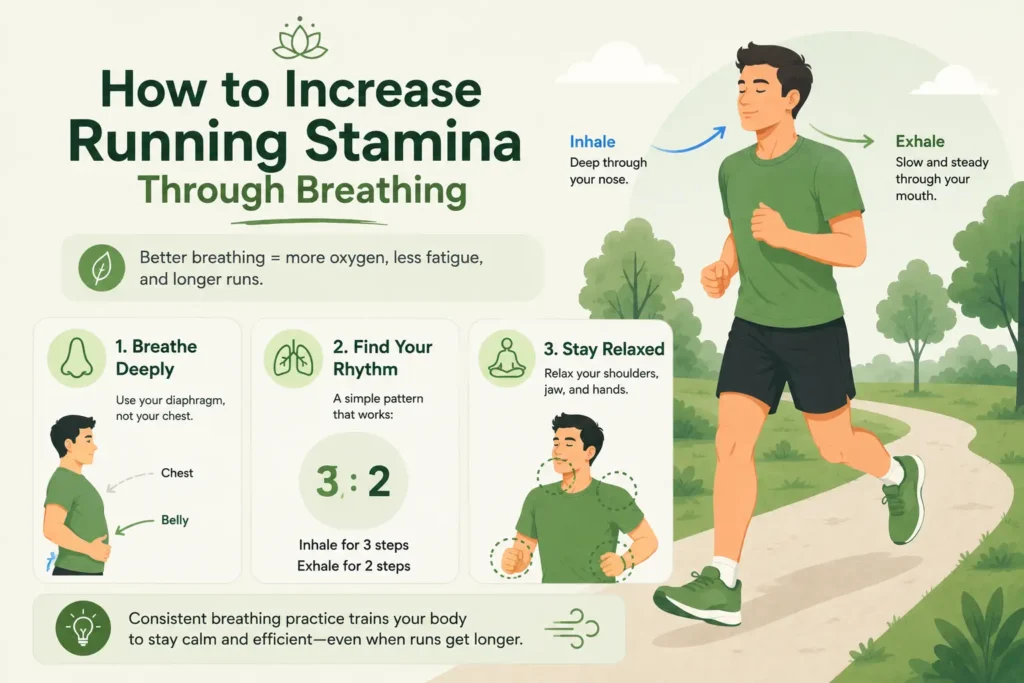
- Try syncing breath to steps, inhale for 3 steps, exhale for 2. Sounds fussy at first, gets automatic fast
- A steady rhythm keeps you out of that shallow, panicky breathing that makes you feel like you’re suffocating at minute three
- Practice this on your slow days. At speed, there’s no mental bandwidth left to think about it
Step 4: Add One Long, Slow Run Per Week
Out of everything in this guide, this is the one people skip, and the one that matters most.
- Once a week, go slower than normal, but stay out longer than usual
- Forget pace completely on this run. The only job is time on your feet
- This is genuinely where most of your endurance gets built. Not the fast days. This slow, unglamorous one
Stack these four for a few consistent weeks and something shifts. Running longer stops being something you push through and starts being something your body just does without asking permission.
How to Increase Running Stamina Through Breathing
Breathing feels automatic, so most runners never think to train it. That’s a mistake. Get this right and you’ll notice it’s often your breathing giving out before your legs do, not the other way around.
Nose vs. Mouth Breathing
There’s a lot of noise online about “nose breathing only” for runners. Here’s what actually holds up.
- At easy, talk-test pace, nose breathing alone is often enough, it slows you down naturally and forces a more controlled rhythm
- Once effort picks up, mixed breathing (in through the nose, out through the mouth, or both through the mouth) becomes necessary. Your body needs more oxygen than your nose alone can deliver
- Forcing pure nose breathing at a hard pace just makes you feel like you’re suffocating for no real benefit. Use it as a pacing tool on easy days, not a rule to force at all speeds
Rhythmic Breathing Patterns
This is the part that actually changes how a run feels, syncing breath to footstrikes instead of breathing randomly.
- A common starting pattern is 3:2, inhale for 3 steps, exhale for 2
- The odd-numbered pattern matters more than it sounds like it should. It alternates which foot you exhale on, which some research suggests reduces repetitive impact stress on one side of the body
- On harder efforts, this often shifts to 2:1, still rhythmic, just faster
- Start practicing this on an easy run or even while walking, it feels awkward for the first few sessions, then becomes background noise you don’t have to think about
Once breathing rhythm stops being something you’re managing and becomes something your body just does, that’s usually when a run starts feeling noticeably easier, even at the same pace as before.
Building Aerobic Capacity: What It Means for Beginners
This term gets thrown around a lot in running content without much explanation. Here’s the plain-language version, and why it matters more than almost anything else in this guide.
What Aerobic Capacity Actually Is
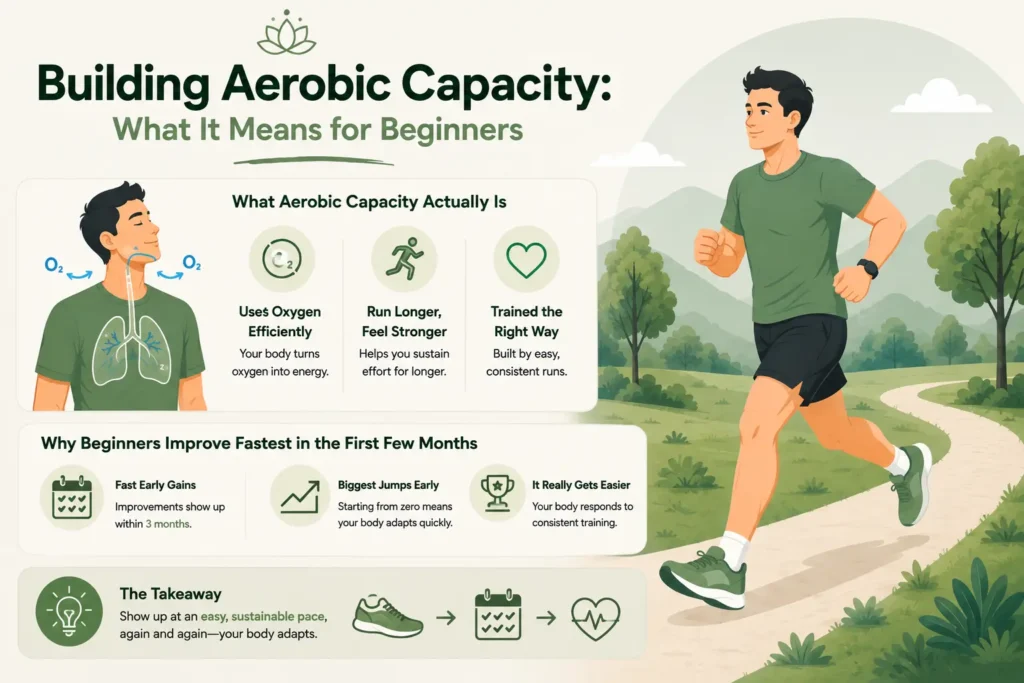
Strip away the jargon, and aerobic capacity is just this: how efficiently your body uses oxygen to produce energy while you run.
- A higher aerobic capacity means your body can sustain effort longer before switching to the anaerobic system, the one that fatigues fast and forces you to slow down or stop
- This is trained specifically by running at that easy, talk-test pace, not by running hard
- It’s also why two runners can look equally fit but one gasses out in minutes while the other cruises, their aerobic systems are trained differently, not their willpower
Why Beginners Improve It Fastest in the First Few Months
Here’s the encouraging part most guides leave out: if you’re new to running, you’re in the best possible position to make fast progress.
- Research following previously untrained adults through a year of consistent aerobic training found measurable improvements showing up within the first 3 months, with gains continuing steadily through the full year
- The biggest jumps happen early, precisely because there’s so much room to adapt when you’re starting from zero
- This means the “it gets easier” feeling beginners chase isn’t wishful thinking, it’s a documented, physiological response to consistent, easy-paced training
The takeaway here connects directly back to the talk test and the run-walk method: aerobic capacity isn’t built by occasional hard efforts. It’s built by showing up at an easy, sustainable pace, again and again, and letting your body do what it’s already wired to do.
Common Mistakes That Slow Your Progress
A few specific traps that undo the progress from everything above. Easy to fix once you know they’re happening. These build on the common beginner mistakes covered here, specific to endurance, not general running errors.
| Mistake | Why It Happens | Quick Fix |
|---|---|---|
| Starting too fast | Adrenaline and fresh legs make the first minute feel deceptively easy | Use the talk test from minute one, not after you’re already out of breath |
| Skipping the walk breaks | Walking feels like “not really running,” so beginners push through instead | Treat walk intervals as part of the workout, not a failure to push past |
| Increasing pace and distance together | Progress feels slow, so it’s tempting to push both at once | Increase time or distance first. Add pace only once that feels easy |
| Shallow, chest-only breathing | Nobody’s ever taught to breathe deliberately while running | Practice rhythmic breathing (3:2) on easy runs until it’s automatic |
| Skipping the weekly long, slow run | It feels unimpressive compared to a fast, short run | Protect this run above all others. It’s where most endurance is actually built |
| Running the same pace every single day | No variation feels simpler, but it caps progress | Mix easy days and one slightly longer effort weekly, not the same run on repeat |
A 4-Week Beginner Plan to Run Longer
No guesswork here, just a week-by-week progression built on everything above: run-walk intervals, the talk test, and one protected long run per week.
| Week | Starting Point | Goal | Focus |
|---|---|---|---|
| Week 1 | 15-20 min continuous | Add 5 min via one 1-min walk break mid-run | Test extending past your current comfort zone |
| Week 2 | 20-25 min | Add another 5 min | Shrink the walk break, let it get shorter |
| Week 3 | 25-30 min | Add one longer weekend run (35-40 min) | Practice sustained talk-test pace over new distance |
| Week 4 | 30-35 min | Push toward 40-45 min on long run day | Notice how much smaller the “wall” feels now |
Sticking to this pace even when it feels too slow is really a discipline problem in disguise, same as everything else worth building.
Running Endurance Tips Beginners Often Miss
A few practical details that don’t fit neatly into a step-by-step plan, but genuinely change how sustainable running feels. Small things, easy to overlook, worth building in early.
- Hydrate before you’re thirsty. By the time you feel thirsty mid-run, you’re already behind. A glass of water 30-60 minutes before running does more than anything you drink during a short beginner run.
- Sleep affects endurance more than most people realize. A rough night’s sleep doesn’t just make you tired, it directly impacts how efficiently your body uses oxygen the next day. If a run feels unusually hard, check your sleep before you question your fitness.
- Softer terrain is easier on effort, not just joints. Grass, dirt trails, or a track absorb impact that concrete and asphalt don’t. Early on, this can be the difference between finishing a run feeling fine and finishing it wrecked.
- Warm up for 3-5 minutes before you start “running.” A brisk walk or slow jog gets blood flowing and loosens muscles before you ask them to work harder. Skipping this is a big reason early minutes feel disproportionately brutal.
- Eat something small if it’s been more than 3 hours since your last meal. Running on completely empty makes everything harder than it needs to be, even at an easy pace. A small, simple snack 30-60 minutes out is usually enough.
- Track effort, not pace, for the first several weeks. Checking your watch mid-run for pace numbers pulls focus away from the talk test and tends to push people to speed up when they shouldn’t. Effort first, numbers later.
None of these replace the core system covered earlier, run-walk, talk test, weekly long run. They just remove the small frictions that make an otherwise solid plan harder to stick with than it needs to be.
FAQs
Q. How long does it take to run longer without stopping?
A. Most beginners notice a real difference within 3-4 weeks of consistent run-walk training, going from needing frequent walk breaks to running continuously for 10-15 minutes. Full, uninterrupted 5K distance typically takes 6-8 weeks for someone starting from zero, though this varies based on starting fitness and how consistently you train. The talk test and weekly long run matter more here than any fixed timeline.
Q. Should beginners run every day to improve endurance?
A. No, 3-4 sessions a week is enough to build real endurance, and running daily as a beginner often leads to burnout or injury before adaptation has a chance to happen. Rest days aren’t wasted time, they’re when your aerobic system actually adapts to the training stress. More isn’t better here, consistent is better.
Q. What’s a good beginner pace to build stamina?
A. Whatever pace lets you comfortably pass the talk test, speak a full sentence without gasping. This will be slower than most beginners expect, often uncomfortably slow at first. That’s correct. Pace should be dictated by effort and breathing, not by a number on a watch or what feels “fast enough” to count as exercise.
Q. Is walking during a run okay when building endurance?
A. Yes, and it’s not just okay, it’s the actual method that works best for most beginners. Run-walk intervals let you accumulate more total time on your feet with less risk of burning out early, which is exactly what builds aerobic capacity. Plenty of people who now run continuously for long distances started with run-walk intervals and gradually reduced the walking portion over weeks.
Leave a Reply