
▼
-
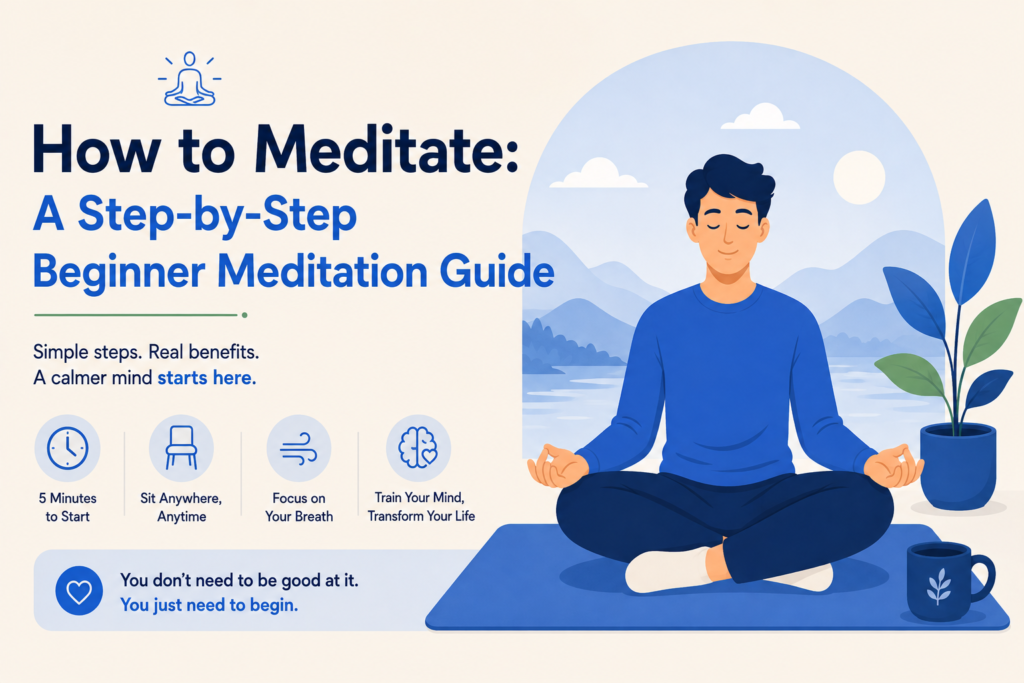
- Meditation trains attention, it doesn’t eliminate thoughts
- Almost no setup needed: 5 minutes, a seat, a timer
- Start at 5 minutes, not 20
- Anchor on your breath, notice the wander, return
- Consistency beats session length or feeling “calm”
- Backed by Harvard: nearly 50 clinical trials show real benefits
You sit down. Close your eyes. And within ten seconds, you’re thinking about what to make for dinner.
This is what actually happens when most people try meditation for the first time. Not the calm, empty-minded stillness they saw in a YouTube thumbnail. Just… thoughts. Random ones. Followed by the frustrated realization that you’re “doing it wrong.”
Here’s the part nobody tells beginners: that moment, the one where you notice your mind wandered, is not a failure. It’s the entire practice. Meditation isn’t about achieving a blank mind. It’s about training your attention to notice when it drifts, and gently bringing it back. Every single time you do that, you’re doing it correctly.
This guide skips the incense and the 45-minute silent retreats. It’s a simple, step-by-step system for learning how to meditate, one that takes five minutes to start and doesn’t require an app subscription, a cushion, or any prior experience.
What Meditation Actually Is (And Isn’t)
I’ve been meditating for 10 years now, and it took me embarrassingly long to unlearn this myth: meditation is not about emptying your mind. Nobody’s mind goes silent. Mine still wanders daily, even a decade in.
What meditation actually is, is attention training. You pick a focus point, usually your breath, and every time your mind drifts (it will, constantly), you notice and bring it back. That noticing-and-returning is the entire rep. It’s not a mistake, it’s practice.
You also don’t need to feel calm for it to be working. Some of my best sessions, the ones that actually shifted something, felt restless the whole way through. A Harvard Medical School review of nearly 50 clinical trials found mindfulness meditation measurably eases anxiety, depression, and pain, not from any single peaceful session, but from consistent practice over time. The benefit comes from showing up, not from how the sitting feels.
What You Need to Start (Spoiler: Almost Nothing)
Ten years of meditating and I still don’t own a cushion. No app subscription, no incense, no dedicated room in the house. When people ask what they need to get started, I think the honest answer kind of disappoints them: almost nothing. And I think that’s part of why so many beginners never actually start. They’re waiting to feel “ready,” like there’s a setup checklist to clear first, when really the only thing standing between them and their first session is sitting down.
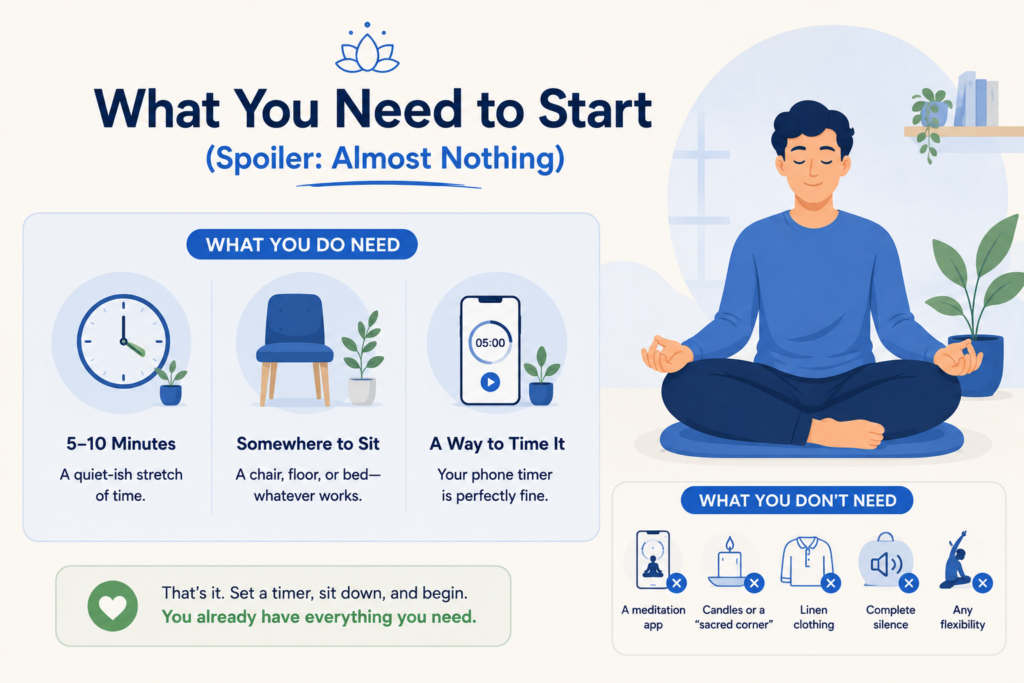
Here’s what actually matters, and what doesn’t.
A Quiet-ish 5–10 Minutes
Not silence, just a stretch of time where nobody’s going to tap you on the shoulder. I’ve done this in parked cars between errands, on flights with my hoodie pulled over my eyes, once in a stairwell before a meeting I really didn’t want to walk into calm. Waiting around for the perfectly silent moment is just procrastination that’s learned to dress itself up as mindfulness.
Somewhere To Sit
A chair works. So does the floor, your bed, the arm of a couch if that’s what’s around. I used to think posture mattered a lot more than it actually does. The only rule that’s held up over a decade is this: upright enough that you don’t drift off, comfortable enough that you’re not spending the whole session negotiating with your lower back. Cross-legged on a cushion. A dining chair does the exact same job.
A Rough Sense Of Time Passing
Your phone’s built-in timer is fine. You don’t need a singing bowl app or a yearly subscription to know when five minutes are up. If the default alarm’s too jarring, most phones let you pick a softer chime, that’s genuinely the only “upgrade” worth thinking about this early.
What You Don’t Need
No matter what a wellness influencer’s morning routine video implies:
- A meditation app
- Candles or a “sacred corner”
- Linen clothing
- Dead silence
- Any flexibility whatsoever
None of it moves the needle when you’re starting out.
I did eventually buy a cushion, somewhere around year three. Not because it made the practice work better, but because my knees started complaining on hard floors. That’s the honest order things happen in, you don’t earn the gear by preparing for it, you earn it by sitting down enough times that your body starts asking for upgrades.
If you’re waiting to feel equipped before you begin, I’ve got good news: you already are. Set a timer. Sit down. That’s the whole barrier to entry.
How to Meditate: Step-by-Step for Beginners
This is the part people actually came here for. Here’s exactly how I still do it, ten years in, stripped down to the version that works whether it’s day one or day 3,000.
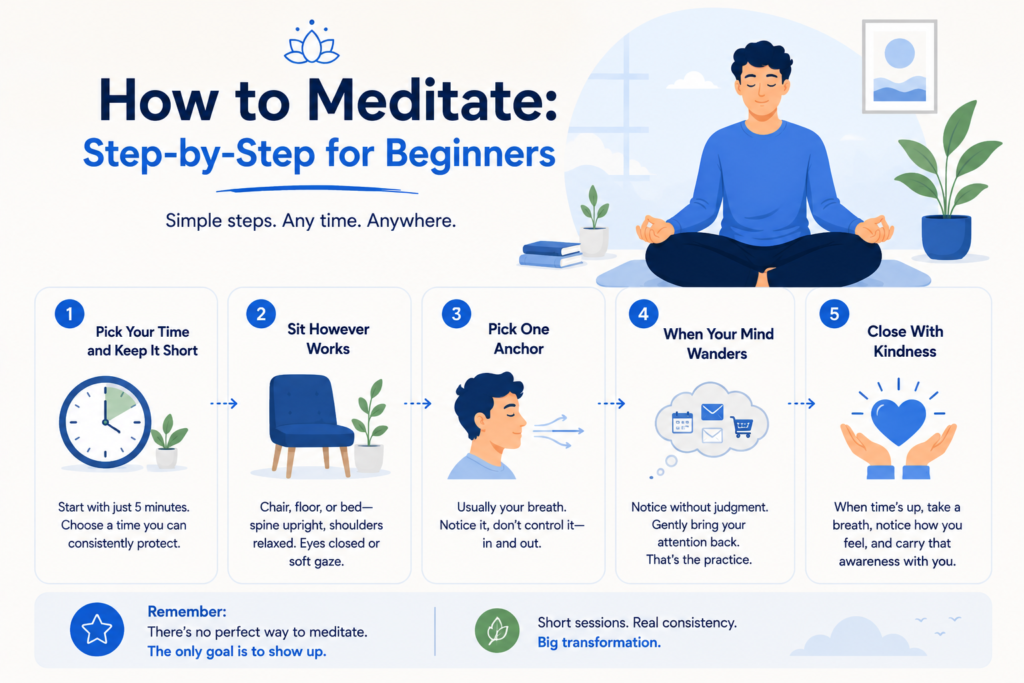
Step 1: Pick Your Time and Keep It Short
Five minutes. Not twenty, not “as long as it takes to feel calm.” Five. I still start most sessions at five minutes, even now, because a short session you actually do beats a long one you keep postponing.
The unconventional bit nobody mentions: pick a time you’ll actually protect, not the “correct” time. Every guide says meditate at sunrise. I meditate whenever a gap shows up.
- Sunrise sessions look great in wellness content, but they’re useless if you keep sleeping through your alarm
- Consistency of doing it matters more than consistency of when
- I’ve meditated at 6 AM, at 11 AM in a parked car, and once at 9 PM after a bad day, all counted
Step 2: Sit However Works
Chair, floor, bed, doesn’t matter. Spine reasonably upright, shoulders not hunched around your ears, hands resting wherever’s comfortable.
- Eyes closed works for most sessions
- A soft, unfocused gaze at the floor works if closing your eyes makes you drowsy
- One thing most guides won’t tell you: I keep one eye slightly open some mornings on purpose. Just enough light gets in that I don’t accidentally fall back asleep
- Staying awake counts more than looking the part
Step 3: Pick One Anchor
Usually your breath. Not controlling it, just noticing it, the air coming in, the air going out.
- Some days I count each exhale up to ten, then start over
- Other days, especially when my head’s loud, I anchor to something physical instead: the feeling of my feet on the floor, or where my hands rest on my knees
- Breath isn’t sacred, it’s just convenient because it’s always there
- Use whatever your attention actually sticks to, not whatever the app tells you to use
Step 4: Notice the Wander, Then Return
It will wander. Probably within the first thirty seconds. This isn’t a glitch in the process, it is the process. Each time you catch the drift and return to your breath, that’s one rep.
- The unconventional part: I silently name where my mind went, “planning,” “replaying,” “random,” before returning
- Naming the type of thought pulls you out of it faster than just noticing “I drifted” in a vague way
- Ten years in, I still lose count of how many times this happens in one session
- Some days it’s five times, some days it’s fifty. Neither means the session worked or didn’t
Step 5: End Without Grading Yourself
No session is “good” or “bad” based on how quiet your mind was. When the timer goes off, take one slightly deeper breath, open your eyes, and let it be done.
- No debrief needed, no scoring the session
- What I’ve stopped doing over the years: asking myself “did that work?” right after. That question ruins more meditation habits than restlessness ever does
- You’re not auditioning for calm, you’re just doing the rep
That’s the entire mechanism. Everything else in meditation, every technique, every tradition, every app feature, is some variation built on top of these five steps.
Beginner Meditation Techniques Worth Trying
Once the five basic steps feel familiar, you’ll probably want more than “watch your breath” on repeat. Here are the techniques I’ve actually stuck with over the years, not the ones that just sound good in an app description.
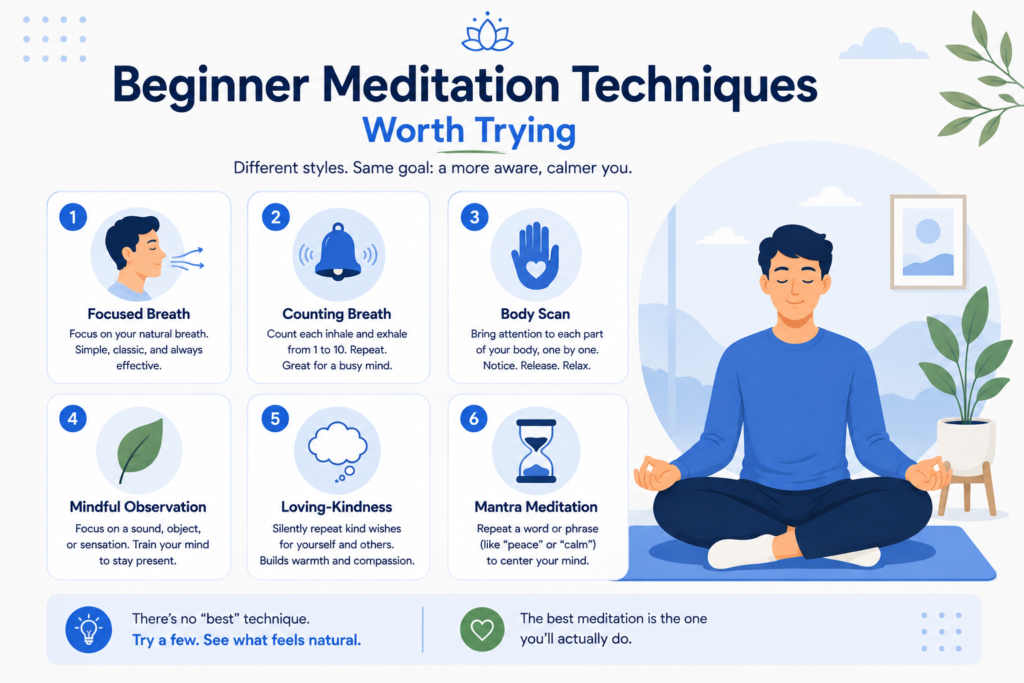
Breath-Focused Meditation (Start Here)
This is the one I taught myself first, and it’s still the one I come back to on hard days.
- Just watch the breath, in and out, no counting needed if you don’t want it
- Best for beginners because it needs zero setup and works anywhere
- If your mind is especially loud, add a soft count on the exhale (1 to 10, then restart)
- It’s boring by design. Boring is what makes it work
Body Scan Meditation
Less about the mind, more about noticing physical tension you didn’t know you were holding.
- Start at your feet, slowly move attention up through your body
- Notice tightness without trying to immediately relax it, just notice first
- I use this one specifically before bed, it’s the one technique that reliably makes me sleepy, which is a feature, not a bug, at night
- Doesn’t work as well for me in the morning, tends to make me drowsy when I need to be alert
Counting Meditation (For a Racing Mind)
The unconventional favorite. Most guides bury this one, but it’s the single most useful tool I’ve given people who say “meditation doesn’t work for me.”
- Count each breath, 1 on the inhale, 2 on the exhale, up to 10, then restart at 1
- If you lose count, and you will, that’s the whole exercise working. Just restart at 1, no judgment
- Works especially well on anxious or scattered days when breath-watching alone isn’t enough of an anchor
- I still use this one before anything stressful, a hard conversation, a flight, a big presentation
Guided vs. Silent Meditation
The debate people overthink way more than necessary.
- Guided (an app or voice walking you through it) is a fine place to start, there’s no purity test here
- Silent meditation is what I do 90% of the time now, mostly because I’ve internalized the steps enough that a voice feels like noise
- My honest advice: start guided if silence makes you anxious, drop the guide once you know the structure by heart, usually a few weeks in
- Neither one is “more legitimate.” The goal is the rep, not the method
None of these need to be chosen forever. I still rotate between breath-focused and counting depending on the day. Pick one to start, and let the others come later once the basic mechanism, notice and return, is second nature.
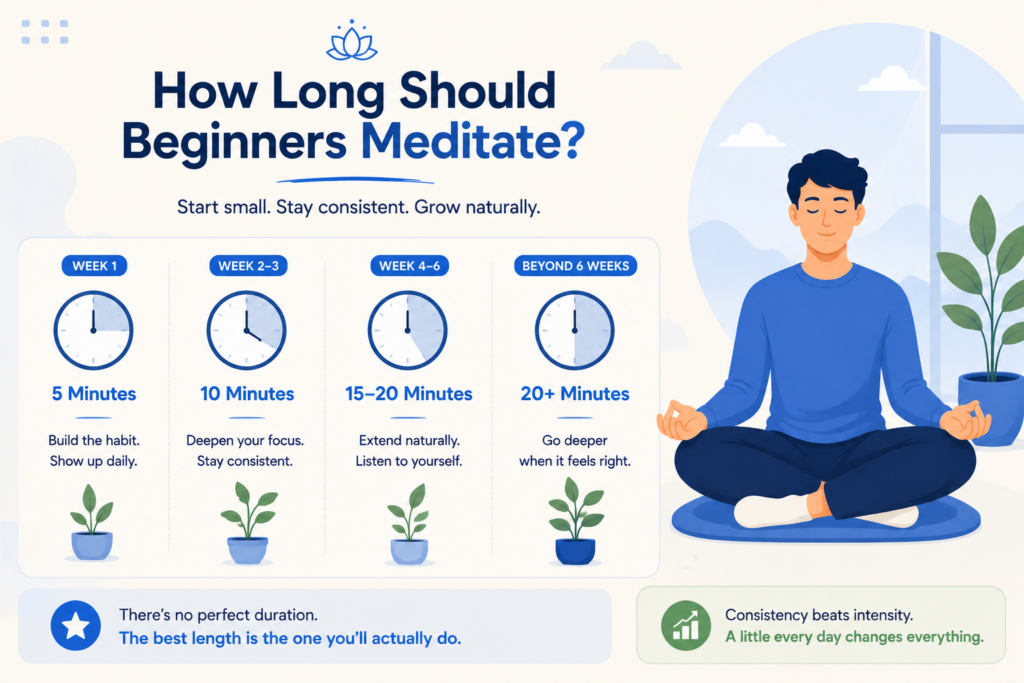
How Long Should Beginners Meditate?
Everyone wants to jump to 20 minutes because that’s what “serious” meditators seem to do. Don’t. Here’s the actual progression that’s held up over ten years, for me and for most people I’ve nudged into this practice.
Why 5 Minutes Beats 20 Minutes You’ll Skip
A 20-minute session sounds more impressive. It also gets skipped constantly, because 20 minutes feels like a commitment, and “I don’t have 20 minutes today” is an easy excuse to reach for.
- Five minutes is short enough that “I don’t have time” stops being a valid excuse, even on bad days
- The goal early on isn’t depth, it’s frequency. You’re building the habit of sitting down, not the ability to sit for a long time
- Unconventional take: I actually think most long-term meditators overestimate how much their session length matters, and underestimate how much just showing up daily does
- A 5-minute session done 300 days a year beats a 20-minute session done 40 days a year, by a wide margin
If you’ve ever started a habit strong and then watched it quietly die by week three, you already know what motivation-based systems do over time. Five minutes daily works precisely because it doesn’t depend on motivation showing up.
A Realistic Week-by-Week Progression
This is roughly the pace I’d recommend if you’re starting from zero. Not a rigid rulebook, just a sane default.
- Week 1–2: 5 minutes daily. Nothing else. Just get the sitting-down part automatic
- Week 3–4: 7–10 minutes, only if 5 feels genuinely easy, not because a schedule says so
- Month 2: 10–15 minutes, still flexible, still allowed to drop back to 5 on hard days
- Month 3 onward: wherever feels sustainable, for me that’s usually landed around 12–15 minutes most days, occasionally longer on weekends
One thing I didn’t expect after a decade: I rarely meditate longer than 15 minutes even now. The wellness-influencer version of this practice, hour-long sessions, silent retreats, isn’t a requirement for the benefits most people are actually looking for. It’s a different, more intense pursuit that most beginners don’t need and shouldn’t chase early.
If you ever feel like you “should” be meditating longer, that feeling is usually comparison, not a real signal that five or ten minutes stopped working.
A Simple 7-Day Meditation Starter Plan
No theory in this section, just a plan you can literally follow starting tomorrow morning. This is close to the actual progression I’d give a friend who kept saying “I want to try meditation” and never did.
| Day | Duration | Technique | What to Focus On |
|---|---|---|---|
| Day 1 | 3 minutes | Breath-focused | Just sit and notice the breath. No counting, no technique. Prove you can sit still for 3 minutes without quitting |
| Day 2 | 3 minutes | Breath-focused | Same as Day 1. Repetition matters more than progression this early |
| Day 3 | 5 minutes | Breath + soft count (1–10, restart) | Most people notice their mind is louder than expected here. That’s normal, not a setback |
| Day 4 | 5 minutes | Breath + soft count | Same technique, one day longer. Consistency over novelty |
| Day 5 | 5 minutes | Body scan | Not for variety’s sake, useful to learn early that different techniques feel different, so you’re not stuck assuming breath-focus is “the” way |
| Day 6 | 7 minutes | Whichever felt best so far | A small stretch, not a big jump. Testing whether you can extend without it feeling like a chore |
| Day 7 | 5 minutes | Your choice | Spend 1 extra minute (not meditating, just thinking) reflecting: which day felt easiest, which felt hardest, did you skip any |
One unconventional note that doesn’t fit in a table: skipping a day this week is fine and expected. The plan isn’t broken if you missed Day 4. What matters is whether you came back.
By day 7, you’re not going to feel like a changed person, and that’s fine. Ten years in, no single week has ever felt transformative. What this week actually builds is proof that you can show up small and consistent, which is the entire skill meditation is quietly training underneath the breathing.
If sharper concentration is your main goal, the same daily practice can help you improve your focus for work too.
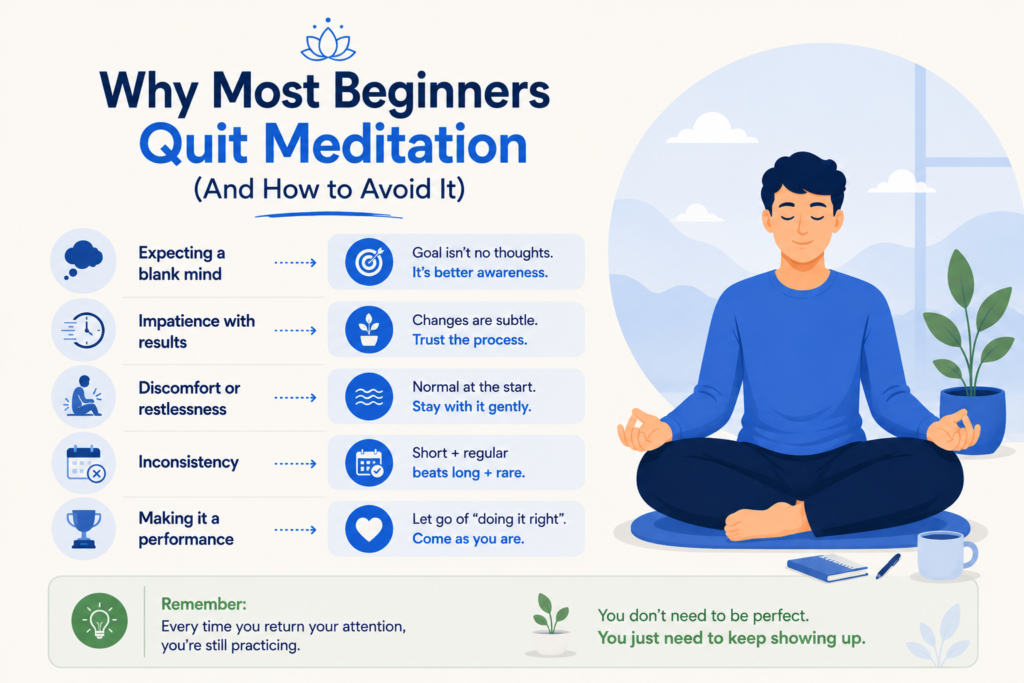
Why Most Beginners Quit Meditation (And How to Avoid It)
If you’ve made it through the 7-day plan and felt like you were failing half the time, good. That means you were actually doing it right. Here’s what usually kills the habit after week one, and what’s worked for me over ten years of not quitting.
The “Empty Your Mind” Myth
This is the number one reason people quit in the first three days. They sit down expecting silence, get thoughts instead, and decide they’re “bad at meditating.”
- Your brain generates thoughts. That’s its job. Asking it to stop is like asking your lungs to stop breathing so you can relax
- A wandering mind isn’t a failed session, it’s the material you’re working with
- The fix isn’t trying harder to be blank. It’s lowering the expectation entirely before you sit down
Expecting Instant Calm
The second-fastest way to quit: treating every session like it should feel peaceful, and getting discouraged when it doesn’t.
- Some of my most restless sessions, ten years in, have been the ones that mattered most. I just didn’t feel it that day
- Calm is a sometimes-side-effect, not the goal. If you chase the feeling, you’ll quit the first time it doesn’t show up
- Unconventional truth nobody says out loud: plenty of “successful” meditation sessions feel boring or mildly annoying the whole way through. That’s not a red flag
Starting With Sessions Too Long
The third killer, and the one I see most often with beginners who research too much before starting.
- Reading that “real” meditators do 20–45 minutes daily makes 5 minutes feel like cheating. It’s not
- Long sessions you dread doing lose to short sessions you actually do, every time, over months
- If you’re not sure how long to start with, the answer is always shorter than you think. You can always add time later, you can’t get back the weeks you didn’t practice because the bar felt too high
The Pattern Underneath All Three
Every reason beginners quit comes from the same root: judging the session instead of just doing it. This is the same trap that kills most habits, not just meditation, chasing motivation instead of building a system that doesn’t rely on how you feel that day. The moment you stop grading whether a sitting was “good,” the urge to quit mostly disappears on its own. That’s not a technique. It’s just the shift that actually needs to happen.
Common Beginner Mistakes (Quick Fixes)
A few more specific traps beyond the big three above. These are the small, practical ones I see people trip on constantly, easy to fix once you know they’re happening.
| Mistake | Why It Happens | Quick Fix |
|---|---|---|
| Forcing a blank mind | Confusing meditation with “thinking about nothing” | Let thoughts pass through. Your only job is to notice and return, not prevent thoughts from showing up |
| Judging “bad” sessions | Treating a restless sitting as a failed one | Drop the scorecard. A restless session still counts as a rep, same as a calm one |
| Meditating at inconsistent times | Waiting for the “right” moment instead of a fixed one | Anchor it to something that already happens daily, right after brushing your teeth, right before coffee |
| Wrong environment expectations | Believing you need total silence to start | Quiet-ish is enough. I’ve done full sessions with traffic noise outside a car window |
| Quitting after one hard week | Assuming difficulty means it’s not working | Difficulty in week one is normal, not a signal to stop. Most people’s hardest week is the first one |
| Comparing progress to others | Seeing someone else’s “calm” and assuming yours should match | Nobody’s mind behaves the same. Ten years in, my sessions still vary wildly day to day, that’s normal, not a red flag |
The pattern behind almost every mistake on this list is the same one from the last section: judging the process instead of just repeating it. Fix that mindset, and most of these mistakes solve themselves without needing a separate fix for each one.
FAQs
How do I know if I’m meditating correctly?
If you sat down, noticed when your mind wandered, and brought your attention back, even once, you did it correctly. There’s no version of meditation where a wandering mind means you’re failing. Ten years in, my mind still wanders in every single session. That’s the practice, not a sign you’re doing it wrong.
What’s the best time of day to meditate?
Whatever time you’ll actually protect. Mornings work well because they happen before the day’s chaos starts, but I’ve had consistent stretches meditating at lunch, in the evening, even in a parked car mid-afternoon. Consistency of doing it matters far more than consistency of timing.
Can meditation help with anxiety and stress?
Research supports this. A Harvard Medical School review of nearly 50 clinical trials found mindfulness meditation measurably eases anxiety, depression, and pain, built through consistent practice, not any single session. It’s not an instant fix, but the effect is real and well-documented.
Do I need an app to meditate?
No. Apps can help beginners who want a guided voice at first, but they’re not required. I haven’t used one in years. A timer and five quiet minutes are enough to do everything this guide covers.
How long until meditation starts working?
There’s no universal timeline, but most people notice small shifts, slightly less reactive to stress, slightly more aware of wandering thoughts, within a few consistent weeks. The deeper changes build slowly over months, not days. Don’t judge week one. Judge month three.
Leave a Reply