
▼
- Procrastination is a way of avoiding an uncomfortable feeling. It has little to do with laziness or poor time management.
- The decision to delay happens in the few seconds before you start, so that’s where the fix has to work.
- Boredom, perfectionism and overwhelm are different problems. Each needs a different fix.
- Starting is the hard part. Make the first step so small it feels silly to skip.
- Time blocking works better when you schedule the start of a task, not the whole thing.
- Stopping for good doesn’t mean never slipping. It means knowing exactly what to do right after you slip.
There’s a task on your list right now that has been sitting there since Monday. You’ve pushed it to tomorrow three times. Every time you moved it, you felt a small flash of relief, and every time the task got a bit heavier.
I know that task. Mine is usually a piece of writing with a vague brief, and I will clear an entire inbox before I open the document.
Most advice on how to stop procrastination treats it as a willpower problem. Try harder. Wake up earlier. That works for about two days, which is probably why you’re still looking.
Psychologists who study the habit read it differently. Research discussed by the American Psychological Association describes procrastination as a struggle to manage difficult emotions, and not a sign of laziness or bad time management.
That matches what I’ve seen. The place to look is the few seconds before you avoid something. What you feel in that gap decides whether you start or reach for your phone, and almost nobody pays attention to it.
One honest note before we go further. Permanently doesn’t mean the urge to put things off goes away. It won’t, and I’d be lying if I told you otherwise. It means you have a system that still gets you started on the days you’re tired, bored, or dreading the work.
So that’s what we’ll build here: first the reasons you delay, then the fixes that match them.
What Procrastination Really Is (And What It Isn’t)
Procrastination is putting off something you meant to do, knowing the delay will cost you. All three parts matter. You intended to do it, you chose to wait, and some part of you knew waiting would make things worse.
That last part separates it from ordinary delay. Plenty of waiting is sensible:
- Moving a task because something more urgent came up is prioritising.
- Holding off on a decision until you have the facts is patience.
- Stopping because you’re exhausted is recovery.
None of those leave a bad taste. Procrastination does. If there’s a low hum of guilt while you do the other thing, you already know which one it is.
It also has very little to do with being idle. Some of my most productive-looking afternoons have been pure avoidance: a tidy desk, a cleared inbox, a reorganised folder, and the one piece of work that mattered left untouched. Staying busy is the most convincing way to procrastinate, because it feels like work while you’re doing it.
There’s a difference in degrees worth knowing too. Everyone delays the occasional unpleasant job. Chronic procrastination is when the pattern runs through most areas of your life, week after week, and starts costing you sleep, money, or other people’s trust. The fixes in this guide help with both kinds. If yours is the chronic kind, read the later section on when it points to something else.
For now, hold on to one idea. What you’re dodging is rarely the task itself. It’s the feeling that comes with the task.
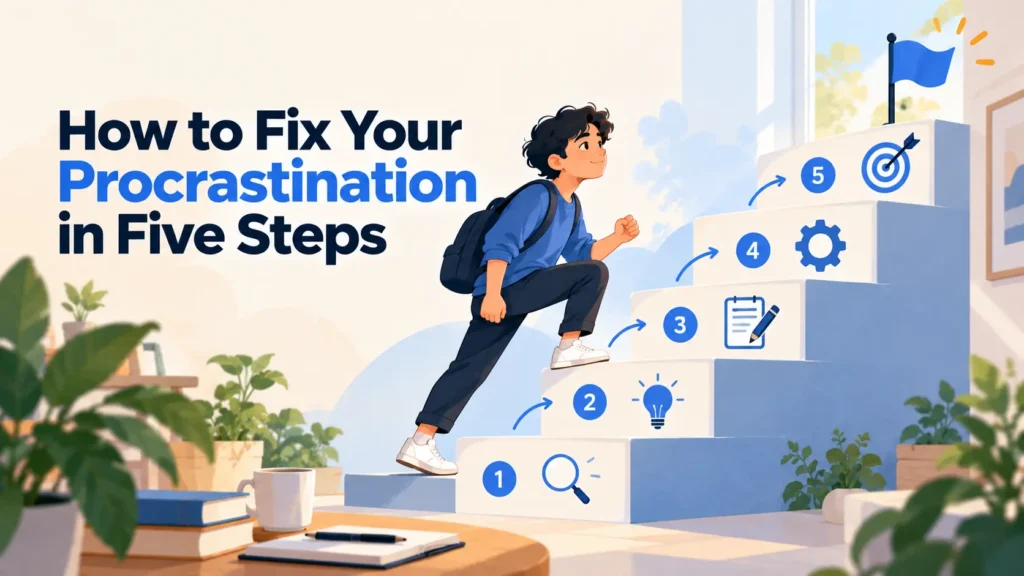
How to Fix Your Procrastination in Five Steps
Before we get into why it happens, here’s the full process in one place. Everything after this section explains why these steps work and how to adjust them when they don’t.
You can run all five in about fifteen minutes, on any task you’ve been avoiding.
Step 1: Catch the Swerve
Procrastination rarely feels like a decision. You sit down to start, and a moment later you’re checking messages or making tea. The swerve happens so fast you miss it.
So the first job is to notice it. The next time you find yourself doing something other than the task, say it plainly: I was about to start, and I turned away. Don’t lecture yourself. You’re only collecting evidence.
Meditation trains the same skill. You don’t stop the mind from wandering. You get quicker at noticing that it has.
Step 2: Name What You’re Avoiding
Ask one question: what about this task feels bad? The answer is usually one of these.
- It’s boring.
- I don’t know where to begin.
- I’m afraid I’ll do it badly.
- It’s so big I can’t see the end.
- I resent having to do it at all.
Pick the one that fits best. Naming the feeling takes some of the force out of it, and it tells you which fix to reach for. A boring task and a frightening task need different handling, and we’ll match them up later in the guide.
Step 3: Shrink the First Step Until It Feels Silly
Don’t plan the whole task. Find the first physical action and make it tiny.
- “Write the report” becomes “open the file and type the heading.”
- “Sort out my taxes” becomes “put the three documents in one folder.”
- “Go for a run” becomes “put on my shoes and step outside.”
If the step still makes you hesitate, it’s too big. Cut it again.
Step 4: Give It a Time and a Place
A task with no start time gets done “later,” and later never arrives. Decide when and where you’ll take that first tiny step, and be specific: 9:30, at the desk, phone in the other room.
You aren’t scheduling the whole job. You’re scheduling the start.
Step 5: Stay for Ten Minutes, Then Decide
When the time comes, do the tiny step and keep going for ten minutes. The urge to quit will show up, usually in the first two or three. Let it be there and keep working.
At ten minutes you’re free to stop. Most days you won’t want to, because the dread was attached to starting and you’ve already started. On the days you do stop, you’ve still done ten minutes more than yesterday.
That’s how to stop procrastinating on a single task. To overcome procrastination as a pattern, you need to know what sets yours off, which is where we go next.
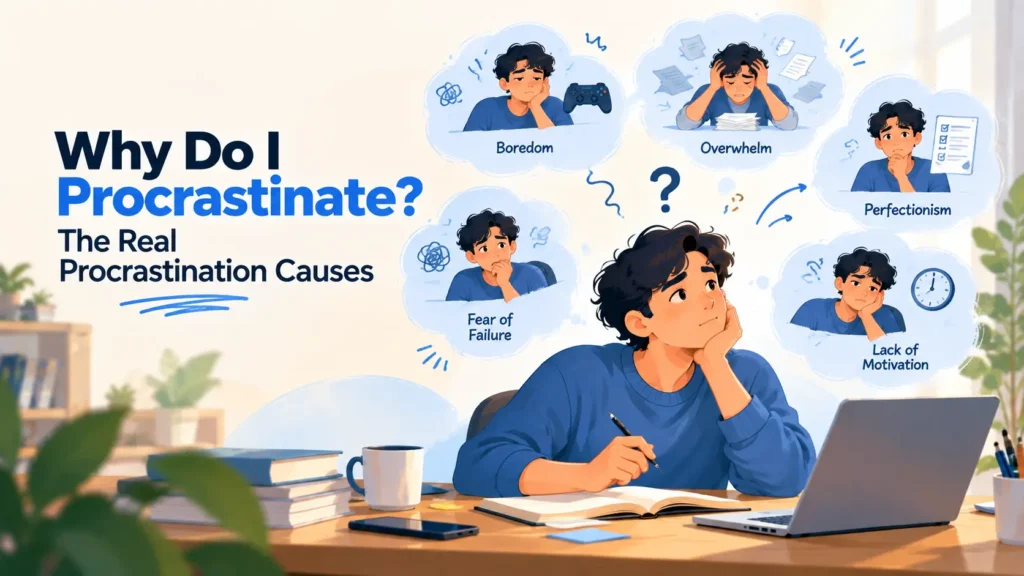
Why Do I Procrastinate? The Real Procrastination Causes
“Why do I procrastinate when I know better?” is the question underneath all of this. The main procrastination causes have very little to do with how organised you are. They come from how a task makes you feel in the moment before you begin.
The Feeling Comes First
Think about the last thing you put off. Before you turned away from it, there was a flicker of something unpleasant. Dread, boredom, confusion, a tightness about being judged. It lasted a second or two.
Then you did something else, and the feeling went away.
That relief is the whole mechanism. Your brain learned that avoiding the task makes the bad feeling stop, and it learned quickly because the reward is instant. The cost arrives later and lands on a future you who feels like somebody else’s problem.
This is why calendars and to-do apps don’t fix it on their own. They organise your time. They do nothing about the two seconds of discomfort that send you elsewhere.
Overwhelm works the same way. When a task feels too large to hold in your head, the discomfort is stronger, so the pull to escape is stronger.
Task Resistance and the Traits That Trigger It
Not every task sets this off. I can avoid a tax form for a month and happily draft an article with a clear brief before breakfast. Task resistance, which researchers often call task aversion, builds around jobs with particular traits:
- Boring. Nothing about it holds your attention.
- Unclear. You can’t tell what the first step is or what finished looks like.
- Difficult. It asks for more effort or skill than feels comfortable.
- Distant. The payoff or the deadline is weeks away.
- Pointless. It doesn’t connect to anything you care about.
- Imposed. Someone else decided you had to do it.
The more of these a task has, the harder you’ll resist it. One that’s boring, unclear and far off is almost guaranteed to slide.
Most of these traits can be changed. An unclear task can be made clear in five minutes. A distant one can be given a nearer checkpoint. You can’t always make a job pleasant, but you can usually remove one or two of the things that make it repellent.
Perfectionism and Fear of Failure
Some tasks get avoided for the opposite reason. They matter too much.
If the work will be judged, or it’s tied to how you see yourself, starting carries a risk. As long as you haven’t begun, the version in your head stays excellent. Once you write the first clumsy paragraph, you have evidence it might not be.
Perfectionism and fear of failure both feed on that gap. They tend to show up as:
- researching far past the point of usefulness
- rewriting the opening again and again
- waiting until you feel ready
- leaving it so late that a rushed result has a built-in excuse
The last one deserves a second look. A deadline scramble protects you. If the work turns out poor, you can blame the clock and leave your ability out of it. This catches writers constantly, and I’m no exception.
Procrastination vs Laziness
People who procrastinate call themselves lazy all the time. The two are different, and mixing them up makes the problem worse.
Laziness is not wanting to make the effort and being fine with that. Procrastination is wanting to do the thing, intending to do it, and feeling bad the whole time you don’t. A lazy person isn’t lying awake at 1 a.m. thinking about the report.
Procrastinators often work extremely hard, too. They do it at the last minute, under pressure, or on everything except the task that matters.
The label matters because of where it leads. If you believe you’re lazy, the answer seems to be more self-criticism. That adds one more bad feeling to a task that already has too many, and you’re more likely to avoid it tomorrow.
Treat it as a response to discomfort, and the question changes. “What’s wrong with me?” becomes “what is it about this task?” The second one has an answer you can act on.
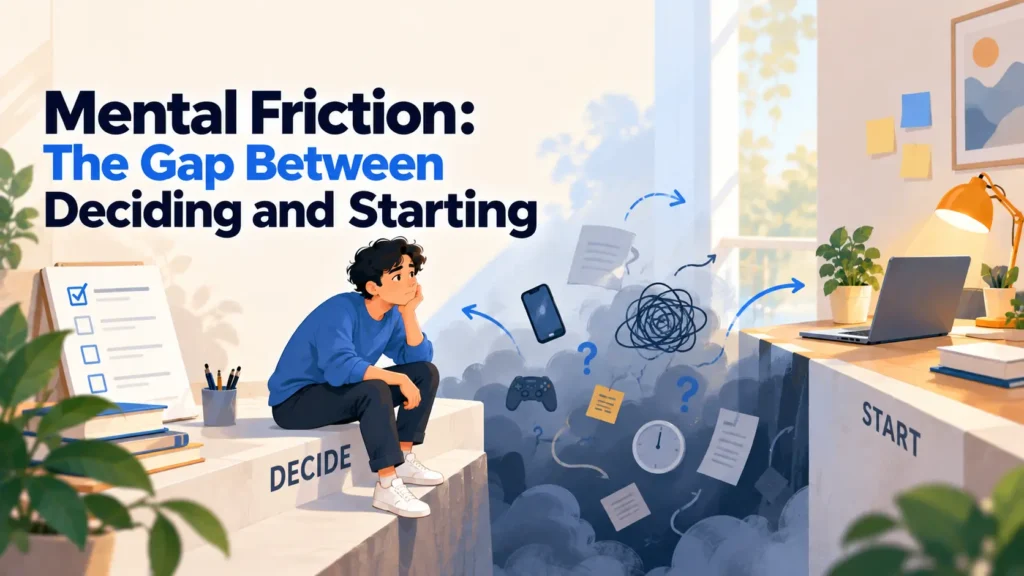
Mental Friction: The Gap Between Deciding and Starting
Feelings explain why a task repels you. Mental friction explains why you still don’t start after you’ve decided to.
It’s the small pile of effort sitting between “I’m going to do this” and doing it. Each piece is trivial. Together they’re enough to tip you back toward something easier.
Running taught me this before work did. On mornings when my shoes, watch, and clothes were laid out the night before, I ran. On mornings when I had to hunt for clean socks, I often didn’t. My motivation was the same both days. There were just more steps between me and the door.
Where Friction Hides
It’s rarely in the task itself. It’s in everything you have to find, do, or decide before the task can begin.
- An undecided first step. “Work on the proposal” isn’t an action. Your brain has to work out what it means every time you look at it.
- Setup cost. Files to locate, logins to remember, a document buried four folders deep.
- Too many choices. Three tasks of equal weight and no rule for which goes first.
- Missing information. You need a number from someone and haven’t asked.
- Unfinished thinking. You haven’t decided what you want to say, so writing it feels impossible.
- An easy exit nearby. The phone on the desk, twelve open tabs, a chat window blinking.
The last one works in reverse. Friction on the task pushes you away, and the lack of friction on the distraction pulls you in. You’re fighting both at once.
Overwhelm is often friction in disguise. A project that feels enormous is frequently one where nothing has been decided yet, so every part of it demands thinking at the same time.
A Five-Minute Friction Check
When a task has been stuck for more than two days, stop trying to do it. Spend five minutes on these questions first.
- Can I state the first action in one sentence that starts with a verb?
- Is everything I need for that action already open or within reach?
- Am I waiting on anyone? If so, have I asked?
- Do I know what “done for today” looks like?
- What’s the easiest distraction within arm’s reach, and can I move it?
Write the answers down. Usually, one of them exposes the real blockage, and it’s often smaller than you expected.
Then fix that one thing and nothing else. Send the email asking for the number. Open the file and leave it on screen. Put the phone in another room.
Reducing mental friction won’t make a dull task interesting. It makes starting cost less, and for most stuck tasks that’s enough.
Find Your Pattern Before You Pick a Fix
Most lists of ways to overcome procrastination hand you twenty tactics and leave you to guess. That’s why so many fail on contact. A timer does nothing for someone frozen by fear of failure, and breaking a task into pieces won’t help when the real problem is that it bores you senseless.
So before you reach for a technique, work out which kind of avoidance you’re dealing with. You did the groundwork in step 2, when you named what felt bad about the task. Now match it.
| Trigger | How it shows up | What to try |
|---|---|---|
| Boredom | You start, then drift within minutes | Work in short timed bursts, or pair the task with music or a podcast you enjoy |
| Unclear task | You open the file, stare at it, and close it | Write the first action as one sentence and decide what “done for today” means |
| Overwhelm | You can’t choose where to begin, so you begin nowhere | List the parts, pick the smallest, and ignore the rest until tomorrow |
| Perfectionism | Endless research, rewriting the opening | Set a time limit and aim for a deliberately rough first pass |
| Fear of failure | You leave it until the deadline forces you | Show an early version to one person you trust |
| Resentment | You do everything else first as a quiet protest | Do it first thing to clear it, or ask whether the scope can be cut |
| Distant deadline | “Plenty of time” until there isn’t | Set a checkpoint for this week and tell someone the date |
| Low energy | You’re avoiding everything, not only this task | Rest first, then take the smallest step you can |
Most people have one or two patterns behind the bulk of their delays. Mine are unclear tasks and perfectionism. Boredom rarely stops me. Yours will be different, and it helps to know which.
If you can’t tell, keep a note for a week. Each time you catch yourself avoiding something, write down the task and the trigger in a few words. By Friday the pattern is usually obvious.
The same task can also change triggers. A report might be unclear on Monday and frightening by Thursday, once the deadline is close. When a fix stops working, check the trigger again before you blame yourself.
And if a task has several triggers at once, which is common with strong task aversion, deal with clarity first. You can’t shrink or schedule a step you haven’t defined.
Procrastination Tips for the Moment You Want to Bail
The five steps give you the process. These procrastination tips are for when it wobbles: you’ve sat down, the task is in front of you, and every part of you wants to be somewhere else. If you’ve wondered how to stop procrastinating once you’re already at the desk, this is the section.
Pick the one that fits your trigger. You don’t need all of them.
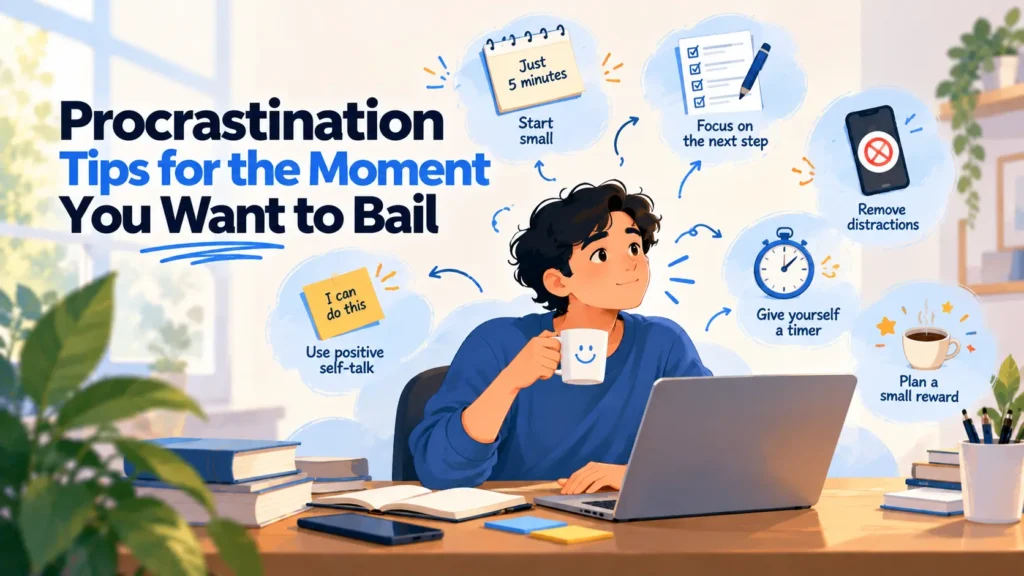
Use the 2-Minute Rule to Get Moving
The 2-minute rule comes in two versions, and both are useful.
The first is for small jobs. If something takes under two minutes, do it the moment it appears: reply to the simple message, file the receipt, book the appointment. A lot of background guilt comes from these, and clearing them costs almost nothing.
The second is for big jobs. Scale the task down to a version that takes two minutes and do only that. Two minutes of outlining. Two minutes of sorting receipts into piles.
It differs from shrinking the first step in one way. The limit is on time, so it works even when you can’t find a neat first action but can promise yourself a hundred and twenty seconds.
Best for: boredom, overwhelm, low energy.
Lower the Bar for the First Pass
If perfectionism is your trigger, the task isn’t too big. Your standard for the first attempt is too high.
So change the assignment. You’re writing a bad version of the report that nobody will see.
- Give the file an ugly name. “Rough notes” is easier to open than “Final proposal.”
- Set a short timer and don’t delete anything until it rings.
- Leave gaps. Type “fix this later” and move on.
- Save the judging for a separate sitting.
I write almost every first draft this way. The draft is usually poor, and that’s fine. A poor draft can be fixed and a blank page can’t.
Best for: perfectionism, fear of failure.
Remove the Escape Route
Task resistance needs somewhere to go. If the exit is one tap away, you’ll take it before you notice deciding to.
Put mental friction to work for you by adding it to the distraction.
- Put the phone in another room. Face down on the desk doesn’t count.
- Close every tab that isn’t the task.
- Log out of the sites you drift to, so getting back in takes effort.
None of this depends on self-control. You’re making the easy option slightly less easy, which is often enough to keep you in the chair through the first few minutes.
If you start fine but can’t stay on the task, the problem has shifted, and you’ll get more from learning how to improve your focus.
Best for: boredom, distant deadlines.
Work Alongside Someone
Some tasks only get done when another person is present. A witness changes how the moment feels, and there’s no shame in using that.
- Sit with a friend or colleague who’s also working, in person or on a video call. You don’t need to talk.
- Tell someone what you’ll finish by a specific time, and message them when it’s done.
- For work that scares you, send an early version to one person. Once it’s been seen, the dread of it being seen loses its grip.
Best for: fear of failure, resentment, distant deadlines.
Ride Out the Urge
Step 5 asked you to let the urge to quit be there and keep working. Here’s how to do that when the urge is strong.
Stop typing and keep your hands where they are. Notice where the urge sits in your body, which is usually the chest, stomach or jaw. Breathe slowly and watch it without doing what it asks.
It rises, peaks and fades, often within a minute or two. Years of meditation taught me that an urge is only a sensation, and sensations pass when you don’t feed them.
Then go back to the sentence you were on.
For anyone trying to beat procrastination, I think this is the most useful skill there is. It gets easier with practice, and learning how to meditate trains exactly this.
Best for: every trigger.
Time Blocking for People Who Ignore Their Calendar
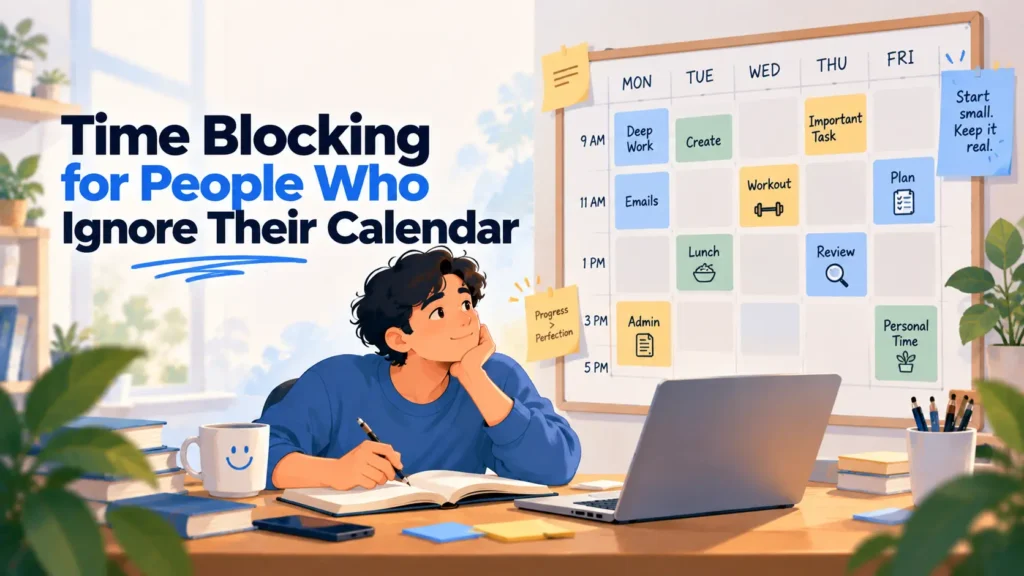
Time blocking means giving each task a fixed slot in your day, the way you’d schedule a meeting. It’s good advice, and for anyone who procrastinates it tends to collapse by Tuesday.
I’ve built tidy, colour-coded weeks and ignored them completely. The method was fine. I was using a version designed for people who don’t have a starting problem.
Why Standard Time Blocking Fails
The usual approach has three weak points.
- The blocks are too big. “Write report, 9 to 12” is three hours of the exact thing you’re avoiding. One look at it is enough to send you elsewhere.
- The plan assumes a perfect day. Every hour is filled, so one overrun or interruption knocks out everything after it.
- A missed block feels like failure. Once the 9 a.m. slot is gone, the plan seems ruined and you write off the day.
The third does the most damage. A schedule that turns one slip into a lost day feeds the guilt that drives the avoidance.
Block the Start, Not the Whole Task
Change what goes in the calendar. Schedule the first fifteen minutes of a task and leave the rest open.
“Write report, 9 to 12” becomes “9:00, open the report and draft the first heading.” A commitment that small is hard to dread and hard to argue with.
Once you’re in, you’ll usually keep going. If you don’t, you still kept the appointment, and that matters more than it sounds. Every kept block makes the calendar a little more believable, and a calendar you believe is one you follow.
A few rules help:
- Put your most avoided task in the first block of the day, before email.
- Name each block with an action, not a topic.
- Limit yourself to three start blocks a day. Any more and you’re back to a wish list.
Use the Pomodoro Technique for Short Blocks
For tasks that bore you or feel endless, short timed rounds work better than open stretches. The Pomodoro technique is the simplest form: work for 25 minutes, rest for 5, and take a longer break after four rounds.
It suits procrastinators because the end is always in sight. You never face the whole task, only the time left on the clock.
Adjust it freely. If 25 minutes feels like too much on a bad day, do 15. If you’re deep in the work when the timer rings, skip the break and carry on. The timer was there to get you started, and by then it has.
Leave Room for the Day to Go Wrong
Build slack into the plan on purpose.
- Keep one empty block in the afternoon. It catches whatever ran over or got skipped in the morning.
- If you miss a start block, move it to the next free slot the same day. Don’t push it to tomorrow.
- Plan about half the hours you think you have. The rest gets taken by things you didn’t predict.
Here’s a day with all three ideas in place.
| Time | What’s scheduled | Why |
|---|---|---|
| 8:45 | Pick three start blocks and write each as an action | Decisions made before the day begins |
| 9:00 | Start block 1: most avoided task, first 15 minutes | Hardest start, while energy is highest |
| 9:15 | Open time: continue, or run Pomodoro rounds | No pressure to fill it |
| 10:45 | Email and messages | Kept out of the first two hours |
| 11:30 | Start block 2 | Second task, same small start |
| 1:00 | Lunch, away from the desk | A real break |
| 2:00 | Start block 3 | Lighter task for the afternoon dip |
| 3:30 | Buffer block | Catches anything missed or overrun |
| 4:30 | Admin and two-minute jobs | Clears the small stuff |
| 5:15 | Choose tomorrow’s first task | Removes tomorrow’s first decision |
Productivity Habits That Make It Stick
Everything so far works on a single task. To make the change last, a few of those moves have to become automatic, so they still happen on days when you have no energy to think about them.
You don’t need many. Three productivity habits carry most of the weight, and each takes under ten minutes.
Same Cue, Same Place
Starting is easier when something starts it for you. Pick a cue that already happens every day and attach your first start block to it.
- After I pour my morning coffee, I open the task I chose last night.
- When I sit down at my desk, the phone goes in the drawer.
- After lunch, I set a 25-minute timer.
Keep the place fixed as well. If you always do your hardest work at the same desk or the same corner of the table, sitting there begins to mean something, and your mind arrives half ready.
This takes a decision off your plate. You stop asking whether you feel like starting. The cue fires and you begin, the same way you don’t debate brushing your teeth.
Runners know this well. The ones who go out at the same time each day rarely call it discipline, even though this is how you build discipline that lasts. It’s just what happens at 6 a.m.
Give it a few weeks before you judge it. The first several days will feel forced.
Decide Tomorrow’s First Task Tonight
The first decision of the day is where many mornings go wrong. You sit down, look at a long list, feel the weight of it, and open email to avoid choosing.
So choose the night before. At the end of your working day, spend five minutes on this:
- Pick the one task you’ll start with tomorrow. Make it the one you’re most likely to avoid.
- Write its first action as a single sentence.
- Set out what you need. Open the file, put the notes on the desk, leave the tab up.
Then stop working. A clear plan for the morning makes it easier to switch off in the evening, because nothing is left hanging. It also gives your morning routine a fixed first move.
It’s the same idea as laying out running kit before bed. You’re removing mental friction while you still have the energy, as a favour to the person who’ll be groggy at 9 a.m.
A Weekly Avoidance Review
Once a week, take ten minutes to look at what you dodged. Friday afternoon works well.
Ask three questions:
- What did I put off this week?
- What was the trigger each time?
- What one change would make it easier next week?
Stay curious about it. You’re looking for patterns, the way you’d read back through a training log, and patterns only show up if you’re honest about what happened.
Over a month or two, this is where the lasting gains come from. You might find you always avoid tasks that involve phoning someone, or that Wednesdays fall apart because of a standing meeting. Those are specific problems with specific fixes, and you’d never spot them without looking back.
One change a week is enough. If keeping habits going is the part you struggle with, that’s a separate skill. It comes down to how you stay consistent when motivation fades.
What to Do When You Slip
You will lose a day, probably this month. You’ll skip the start block, ignore the timer, and spend an afternoon on things that didn’t matter.

What you do next decides whether it stays one day or turns into a week.
The usual response is to turn on yourself. You call yourself hopeless, promise a heroic effort tomorrow, and set a plan so punishing that you avoid that too. The guilt becomes one more bad feeling attached to the task, and bad feelings are what you were running from in the first place.
Self-compassion works better, and it’s more practical than it sounds. Treat the slip the way you’d treat a friend’s. It happened, it’s common, and it says nothing final about you.
Then follow a reset rule so you don’t have to think:
- Restart at the next block, not the next morning. If you lost the morning, the day still has an afternoon.
- Make the restart smaller than usual. Two minutes, one tiny action.
- Don’t try to repay the lost time. Do today’s normal amount and no more.
- Write the trigger down in one line for your weekly review, then let it go.
A missed run teaches the same lesson. Cramming the missed miles into the next session is how people get hurt. Anyone who has trained to run longer learns to pick the plan up where it is.
Most advice on how to stop procrastinating leaves this part out. People who overcome procrastination for good still slip. They’ve made the gap between slipping and restarting very short.
When Chronic Procrastination Points to Something Else
Sometimes the methods in this guide aren’t enough, and it helps to know when that might be the case.
Chronic procrastination can sit alongside other things that make starting hard:
- Poor sleep. When you’re short on sleep, everything feels harder to begin. Check this first, since it’s the easiest to rule out.
- Burnout. If you used to cope fine and now can’t face work you once enjoyed, you may need rest more than a system.
- Low mood or depression. Avoidance that comes with low energy and a loss of interest in most things is more than a productivity problem.
- Anxiety. When dread is the constant backdrop, tasks get avoided because almost everything feels threatening.
- ADHD. Procrastination and ADHD often go together, because ADHD affects the ability to start tasks, organise them and hold attention. If this has followed you since childhood, an assessment may be worth it.
I’m a writer, not a clinician, and nothing here is a diagnosis. It’s worth raising with a doctor or mental health professional if:
- the pattern has lasted for years and touches most parts of your life
- it’s costing you work, relationships, money or your health
- you’ve applied sensible methods consistently and nothing shifts
- it comes with persistent low mood, worry or exhaustion
Asking for help doesn’t mean the problem is worse than you thought. It often means the fix is different from the one you’ve been trying. The steps in this guide still help alongside proper support, and they tend to work better once the underlying issue is being looked after.
Can You Really Stop Procrastination Permanently?
Yes and no, and the difference matters.
No, if you mean reaching a point where you never feel like putting something off. That urge comes with having a brain that prefers comfort. I’ve meditated for ten years and still feel the pull toward my phone when a draft gets hard.
Yes, if you mean stopping it from running your days. That’s a realistic goal, and it shows up in three ways:
- How often it happens. Fewer tasks set off avoidance once friction is low and first steps are small.
- How long it lasts. A delay that used to stretch across a week shrinks to an hour, because you catch the swerve sooner.
- How you recover. A lost afternoon stays a lost afternoon and doesn’t spread into the week.
When those three shift, the urge still turns up but it no longer decides what you do.
Expect the change to be uneven. In my experience the first couple of weeks bring quick wins, because shrinking the first step works almost immediately. Then comes a stretch where old habits return under stress, and that’s when the weekly review earns its place. After a few months, most of the process runs without much thought.
Even chronic procrastination tends to ease with this approach, though it takes longer and sometimes needs outside support.
So the honest way to stop procrastination permanently is to stop waiting for the day you won’t feel like avoiding things. That day isn’t coming. Learning how to stop procrastinating comes down to learning to start anyway.
FAQs
- Why do I procrastinate even when I know it’s hurting me?
- Because the relief of avoiding a task arrives immediately and the cost arrives later. Putting it off removes an uncomfortable feeling such as dread, boredom or self-doubt, and your brain learns to repeat whatever brings that relief. Knowing the long-term harm doesn’t cancel the short-term reward, which is why information alone rarely changes the habit.
- Is procrastination the same as laziness?
- No. Laziness is being unwilling to make an effort and feeling fine about it. Procrastination is intending to do something, delaying it, and feeling guilty the whole time. Many procrastinators work very hard, only at the last minute or on the wrong things. Calling it laziness leads to self-criticism, which usually makes the avoidance worse.
- What is the 2-minute rule for procrastination?
- It has two forms. For small jobs, if something takes less than two minutes, do it straight away. For large jobs, scale the task down to a two-minute version and commit only to that. Both lower the effort needed to begin, and beginning is where most procrastination happens.
- Does time blocking help with procrastination?
- It can, if you adapt it. Standard time blocking often fails for procrastinators because the blocks are long and one missed slot derails the day. It becomes far more reliable when you schedule only the first fifteen minutes of a task, limit yourself to three start blocks, and keep a buffer block in the afternoon.
- Is chronic procrastination a sign of ADHD?
- It can be, but not always. ADHD affects starting, organising and sustaining attention on tasks, so long-term procrastination is common with it. Poor sleep, burnout, anxiety and depression can produce the same pattern. If it has lasted for years and affects most areas of your life, speak to a doctor or mental health professional.
- What are the best procrastination tips for beginners?
- Start with three. Name what feels bad about the task, shrink the first step until it takes about two minutes, and set a specific time and place to do it. Put your phone in another room while you work. That’s enough to overcome procrastination on most everyday tasks before you add anything else.
Leave a Reply