
Everyone tells beginners to “just start lifting.” Fine. But then you’re standing in front of a rack of dumbbells and nobody mentioned which one to pick up, how many times to lift it, or what you’re supposed to do next Tuesday.
That’s usually where it falls apart. People show up for a few weeks, copy whatever the person on the next bench is doing, get sore, see nothing change, and quietly stop going. Beginner strength training really isn’t that hard to get right. Most people just never get handed an actual plan. Which might explain why only somewhere between 10 and 30 percent of adults meet the recommended amount of strength training.
This post is the plan, covering how to start strength training from your very first session. There’s a full-body routine you can run at home or at the gym, and a simple way to work out your starting weights. You’ll also learn when to add a rep, when to add weight, and when to leave things alone for a week. The 8-week progression maps it all out.
I’ve covered the first month too, since that’s when most people give up. Week three in particular tends to feel like nothing’s happening. Something is.
You need two or three sessions a week, 30 to 45 minutes each. That’s it.
Got an injury, a health condition, or haven’t trained in years? Check with your doctor before starting.
What Strength Training Actually Is (and What It Isn’t)
Strength training is exactly what it sounds like. Your muscles work against a load, and they get stronger because of it. That load can be a barbell, sure. But a resistance band counts, your own bodyweight counts, and honestly a backpack with a few heavy books in it will do the job on day one. Other sites might call it resistance training or weight training. Same idea.
What makes you stronger isn’t really the lifting itself. It’s what your body does afterwards. Muscles that got pushed a little harder than usual spend the next day or two repairing, and they come back slightly better prepared for the next round. Stick with that for a couple of months and you’ll notice it outside the workout first. Stairs, suitcases, that heavy shopping bag you used to keep switching between hands.
Bodyweight, Dumbbells, Bands and Machines All Count
A gym membership isn’t a requirement. I’d argue most beginners are better off learning squats and push-ups at home before they go anywhere near a barbell.
Once bodyweight stuff gets easy, a pair of dumbbells keeps things moving. Bands are useful if space or money is tight. And if you do train at a gym, don’t skip the machines early on. They keep your body in a fixed path, so you can focus on feeling the right muscles work instead of worrying about balance.
Whatever you can get to three times a week is the best option.
The “bulky” Myth, Briefly
If you’ve ever wondered whether lifting weights will make you bulky, you’re not alone. This worry keeps a lot of women (and a surprising number of men) away from weights. Getting big takes years of heavy lifting and eating well past what you need. A few sessions a week won’t get you anywhere close. You’ll just get stronger.
Why Strength Training Matters More Than Beginners Think
Most people start lifting because they want to look a certain way. Nothing wrong with that. It’s just that the benefits of strength training you end up caring about a year later usually have very little to do with the mirror.
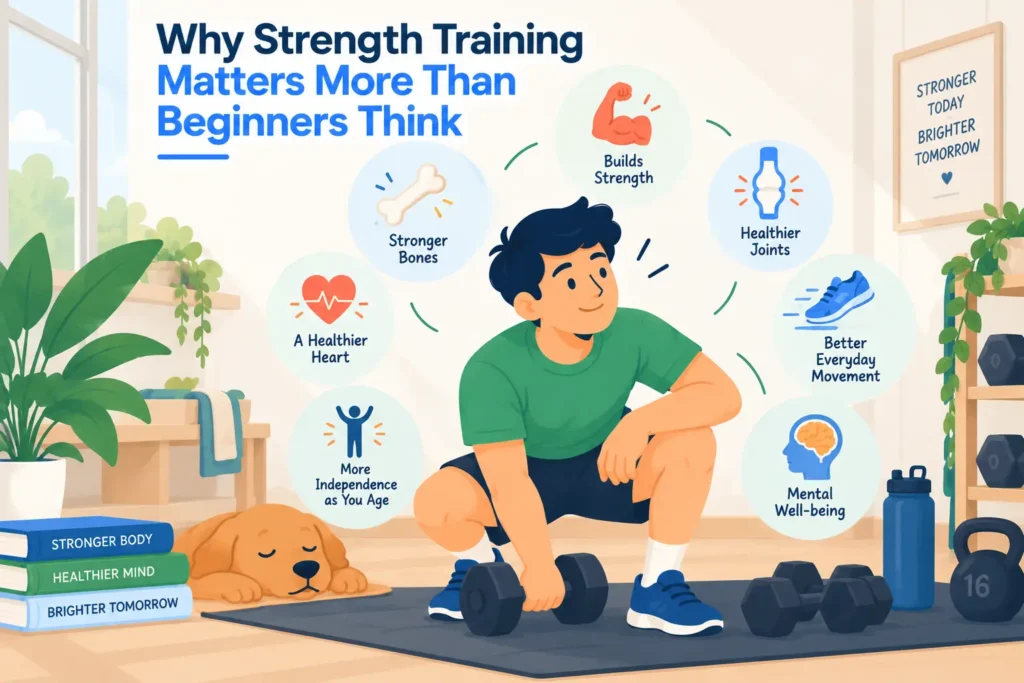
Bones are a good example. They adapt to load the way muscles do, so lifting on a regular basis helps protect your bone density as you age. Joints get something out of it too. When the muscles around your knees and hips are doing more of the work, the joint itself takes less of a beating. There’s a reason physios so often send people home with a few strength moves for a sore back.
A lot of what changes is pretty ordinary. You stand up from the floor without reaching for the sofa. You carry a suitcase up two flights and aren’t breathing hard at the top. Nobody posts about that, but it’s usually the first thing people notice.
Runners feel it quickly, in my experience. Late in a long run, when your legs are tired and your form starts to slip, stronger hips and a solid core are what keep things from falling apart. That’s also roughly when niggles and injuries tend to show up, so the extra strength matters more than it seems.
There’s a mental side as well. You can’t always tell if other kinds of training are working. With lifting, you can. You wrote down eight reps last Monday and today you got ten. Small wins like that add up, which is basically how building discipline in small, trackable steps works in every other area too.
Also, the lean muscle you put on now is far easier to hold onto than to rebuild at 60.
The Basics to Know Before Your First Session
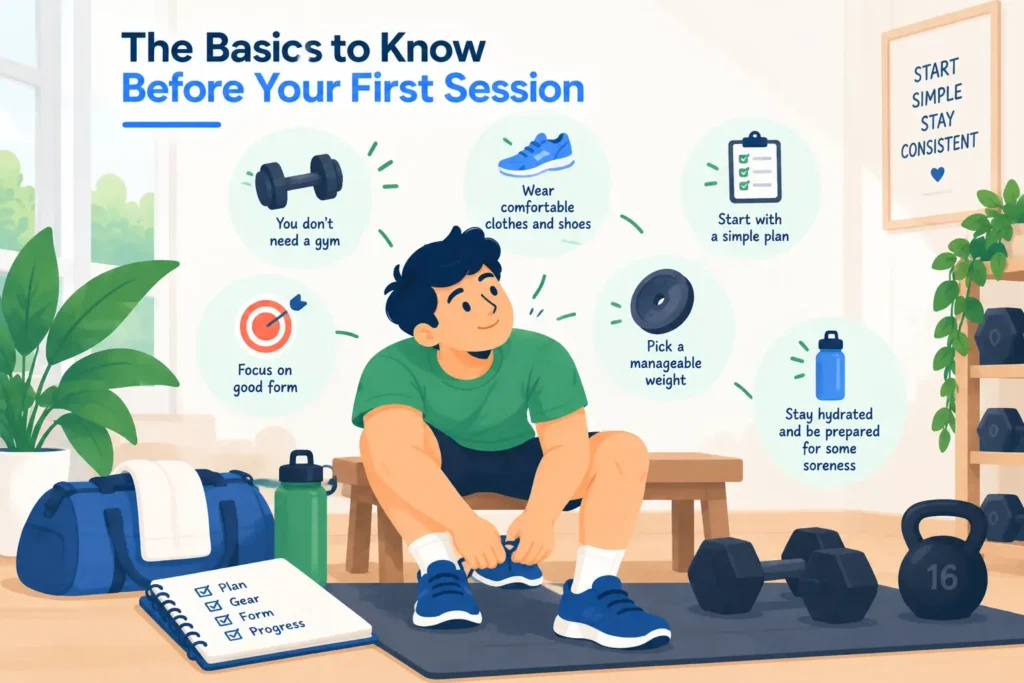
Strength training for beginners doesn’t come with a whole new vocabulary to learn. But a few terms come up in every plan, and if they’re fuzzy, the rest of the plan will be too.
Reps, Sets and Rest Periods in Plain Language
A rep is one full movement. Squat down, stand back up, that’s one. A set is a group of reps done without stopping, so ten squats in a row is one set of ten.
Where beginners usually go wrong is speed. Rushing through reps turns the exercise into a bouncing contest, and the muscle does far less of the work. Here’s what a good rep tends to look like:
- Lower slowly. Take around two to three seconds on the way down. That’s the part most people skip.
- Use the full range. Squat as deep as you can with your back still neutral. Half-reps look productive and don’t build much.
- Come up with control. Faster than the way down is fine, but no jerking or swinging.
As for sets and reps for beginners, this plan uses two or three sets of 8 to 12 reps per exercise. Rest about 60 to 90 seconds between sets, a bit more for leg exercises if you’re out of breath.
How do you know the rest was long enough? You should be breathing close to normal and able to do the next set with the same form as the first. If your reps drop sharply from set one to set two, say 12 down to 7, rest longer next time.
Use the rest properly, too. Write down what you just did. Sip some water. Scrolling your phone is how 90 seconds turns into five minutes.
Reps in Reserve: The One Concept That Makes Everything Easier
Reps in reserve (RIR) means how many more reps you could’ve done when you ended a set. Finish 10 squats knowing you had two more clean ones in you, and that’s two in reserve.
For beginners, finishing most sets with two or three left is the sweet spot. Hard enough to get stronger. Not so hard that form breaks down.
The catch is that if you’ve never lifted before, you honestly won’t know what “two left” feels like. Almost everyone underestimates it at first. A few signs you’re getting close:
- The bar or dumbbell starts moving noticeably slower.
- You want to hold your breath or lean to one side.
- Your form wants to change, like knees caving in or lower back rounding.
When one of those shows up, you’re about two reps away from your limit. Stop there.
Give yourself the first two weeks to calibrate. Every so often, on a safe exercise like a push-up or a machine, keep going until you genuinely can’t do another. You’ll be surprised how many reps you have left, and your guesses get much better after that.
How Many Days a Week Should a Beginner Strength Train?
The World Health Organization recommends working all your major muscle groups on two or more days a week. For a beginner, two or three full-body sessions covers that comfortably.
Pick the version that fits your real week, not your ideal one:
- 3 days: Monday, Wednesday, Friday. Best for progress if you can keep it up.
- 2 days: Tuesday and Friday, or Wednesday and Saturday. Slower, but still very effective.
Leave at least one day between sessions. Your muscles do their rebuilding on the rest days, so training the same muscles two days running in the early weeks usually just means doing a weaker workout while you’re still sore.
Missed a session? Don’t try to squeeze two into one day to catch up. Do the next one as planned and carry on. One missed workout changes nothing. Three weeks of “I’ll restart Monday” changes a lot.
How Long Each Session Should Take
Plan for 30 to 45 minutes. A typical session breaks down roughly like this:
- 5 minutes of warm-up
- 25 to 35 minutes of lifting
- 3 to 5 minutes to cool down and write up your log
If you’re regularly going past an hour, the usual culprits are long phone breaks between sets or piling on extra exercises. Neither helps much at this stage.
Short on time one day? Keep the warm-up, do the first four exercises, and skip the rest. A 20-minute session beats a skipped one every time.
The Six Movement Patterns Every Beginner Plan Needs
The first time you walk into a proper gym, the sheer amount of equipment can put you off before you’ve lifted anything. Rows of machines, dumbbells going up in tiny jumps, a cable station with handles you can’t identify. The good news is you can ignore most of it for now.
Almost every exercise worth doing is some version of six basic movements, and most of them are compound exercises that work several muscles at once. If your plan covers those six, you’re training your whole body.
| Pattern | What It Trains | Home Option | Gym Option |
|---|---|---|---|
| Squat | Quads, glutes | Bodyweight box squat, goblet squat | Goblet squat, leg press |
| Hinge | Glutes, hamstrings, lower back | Glute bridge, backpack hip hinge | Dumbbell Romanian deadlift, hip thrust |
| Push | Chest, shoulders, triceps | Incline push-up, floor push-up | Chest press machine, dumbbell shoulder press |
| Pull | Upper back, biceps | Band row, backpack row | Seated cable row, lat pulldown |
| Carry | Grip, core, shoulders | Shopping bag or water jug carry | Dumbbell farmer’s carry |
| Core | Deep abs, lower back stability | Plank, dead bug, bird dog | Plank, Pallof press on cable |
Why Patterns Beat Random Exercise Lists
Most beginner workouts you’ll find are just a list of exercises. That works right up until something on the list doesn’t suit you. Lunges might bother your knee. Your gym might not have the machine in the video. You might be in a hotel room with a towel and a chair. At that point a list gives you nothing to fall back on.
Once you know what job each exercise is doing, swapping becomes easy. If a row is in the plan to train your “pull,” any other pulling exercise can take its place. It also stops a very common problem, where people end up doing loads of pushing (push-ups, chest press, shoulder press) and hardly any pulling, and a few months in, their shoulders start creeping forward.
When you do need a swap, a few things help:
- Replace like with like. A squat variation can stand in for a squat, but not for a row.
- If a movement hurts, try changing the depth, the weight or the angle before you drop it. That fixes it more often than you’d expect. Leave a pattern out completely only if a physio or doctor has told you to.
- Start with the steadiest, simplest version and move up from there.
Squat
Squats hit your quads and glutes, plus the small muscles that keep your knees stable. You use this pattern every time you get out of a chair or a car.
I’d start with a bodyweight squat down to a bench or chair. Tapping the seat gives you the same depth every rep, and it takes away that slightly uneasy feeling of dropping backwards into nothing. When 12 of those feel easy, hold a dumbbell against your chest and you’ve got a goblet squat.
And your knees drifting past your toes? For most people, that’s completely fine. Just keep them pointing the same way as your feet, not falling in towards each other.
Hinge
A lot of beginner routines skip this, which is a shame, because it might matter more than any other pattern here. Hinging means bending forward from your hips while your back stays flat. Think of bumping a car door shut with your backside when your hands are full. Glutes, hamstrings and lower back all get worked.
People with a sore lower back tend to steer clear of it, though learning to hinge properly is often exactly what helps.
The easiest way to learn it is with a wall. Stand with your back to it, roughly a foot away, knees slightly bent, and push your hips back until they tap the wall. Take a small step forward and do it again. Once that feels natural, glute bridges at home or dumbbell Romanian deadlifts in the gym are the next step.
Push
Pushing trains your chest, shoulders and the backs of your arms. You can push forwards, as in push-ups or a chest press, or up overhead, like a shoulder press.
Can’t do a full push-up yet? Skip the knee version and put your hands on a kitchen counter instead. As you get stronger, move to a lower surface, maybe a table, then a step, until eventually you’re on the floor.
Pull
Pulling works your upper back and biceps, and it’s the one that does the most for your posture. Over a week, try to do at least as many pulling sets as pushing ones.
In a gym, start with a seated cable row or a lat pulldown. Home is harder, admittedly. A resistance band anchored in a door frame does the job, and so does rowing a loaded backpack with one hand while you lean on a chair with the other.
Carry
Grab something heavy in each hand and go for a walk. That’s a carry.
Your grip, core and shoulders all have to work together to keep you upright, which is why carries show up in so many strength programs. You’ve done hundreds without realising, every time you’ve hauled shopping from the car. Walk for 30 or 40 seconds, shoulders back, and try not to lean.
Core
At this stage, core work is about keeping your spine steady, not curling it up again and again. Crunches can wait.
Planks, dead bugs and bird dogs teach you to brace your midsection, and you’ll need that bracing for squats and hinges later. Keep holds short at first, 20 to 30 seconds, and care more about how they look than how long they last. Twenty seconds with a flat back is worth more than a minute of sagging.
How Much Weight Should a Beginner Lift?
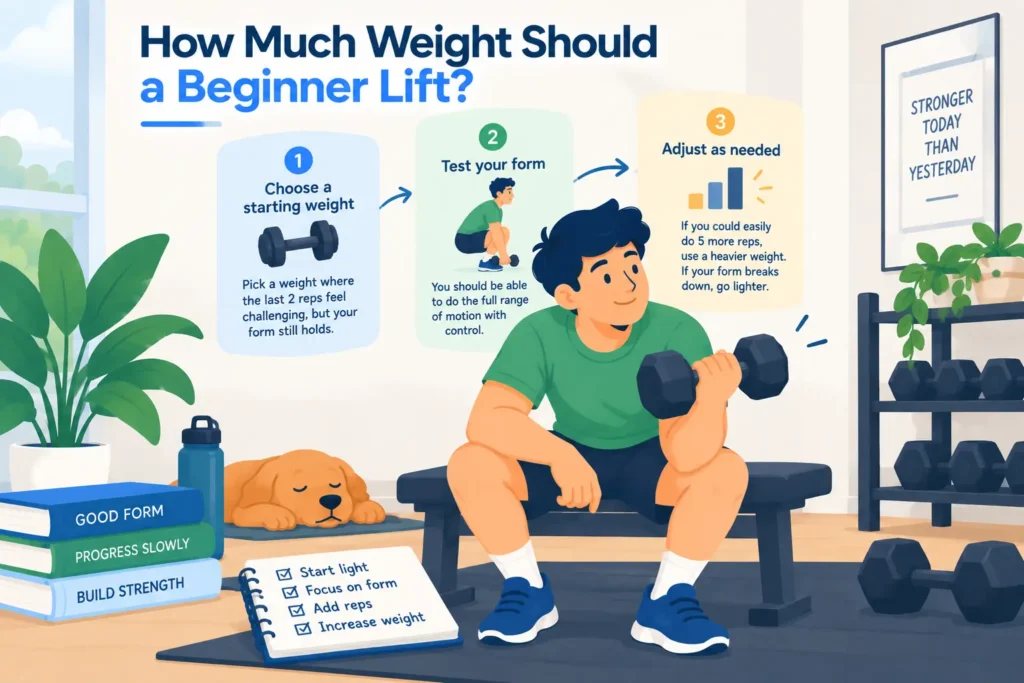
This is the question beginners ask most, and the one most guides dodge. “Pick a challenging weight” doesn’t help much when you’ve never lifted with any purpose. Here’s how to work it out in your first session.
The Starting Weight Test
Treat your first workout as a testing day. You’re not after a great session, just numbers to use for the next few weeks.
For each exercise:
- Do an easy warm-up set of about 10 reps with something that feels almost too light.
- Pick a heavier weight and aim for 10 reps. Ask yourself how many more you could’ve done with clean form.
- Four or more left? Go up a step. Couldn’t reach 8? Drop down one.
- Once the last two reps feel tough but still look tidy, write that weight down.
Expect different numbers for different lifts. Your legs will handle far more than your arms, and the shoulder press will likely be your lightest.
For bodyweight moves, change the angle instead. Hands higher makes a push-up easier, lower makes it harder. Two or three test sets per exercise is enough before fatigue skews things.
Signs the Weight Is Too Heavy or Too Light
Probably too heavy if:
- You’re swinging or jerking the weight to get it moving
- Your reps get shorter as the set goes on
- Your back rounds, knees cave in, or you feel it in a joint
Probably too light if:
- The last rep moves as fast as the first
- You could chat normally through the whole set
Sometimes one dumbbell is too light and the next is too heavy. Instead of forcing the heavier one, make the lighter one harder. Slow the lowering to three or four seconds, pause at the bottom, or add a couple of reps. Once 12 good reps feel manageable, move up.
Why Starting Light Is Not Wasted Time
Most beginners go too heavy early, partly from impatience and partly from feeling self-conscious about small dumbbells. Honestly, nobody’s watching. They’re busy with their own sets.
A lot of your early strength comes from your brain getting better at the movement, not from bigger muscles. That’s easier to learn when you’re not fighting the weight. Your tendons also adapt more slowly than your muscles, which is why so many people feel strong around week three, go heavier, and end up with a sore elbow or knee.
Starting light costs you a couple of weeks at most. What you get back is proper form that lasts and a habit of progressing on purpose.
Your Beginner Strength Training Program (Full Body, 3 Days a Week)
The plan is a full body strength workout for beginners, split into two versions, A and B, which you alternate each session. Between the two, all six movement patterns get covered. Go through the exercises in the order listed. The heavier lifts are at the top on purpose, since that’s when you’ve got the most energy.
Warm-Up (5 Minutes)
Skip the long stretching routine. Holding stretches for ages before lifting tends to leave you loose and a bit wobbly, which isn’t ideal before a squat.
- Get your heart rate up for two or three minutes. A brisk walk, marching on the spot, or a few minutes on the gym bike all work.
- Do 8 to 10 bodyweight squats, about the same number of hip hinges, and some arm circles.
- Right before your first real set, do one easy set of that exercise with around half the weight you plan to use.
Lots of people skip that last one. I’d keep it. It’s the quickest way to find out whether your body feels good that day or whether you should ease off a little.
Workout A and Workout B
On three days a week, week one goes A, B, A and week two goes B, A, B, then repeat. On two days, you just do A once and B once.
Stick to two sets per exercise for the first couple of weeks while the movements still feel new. Add the third set from week three.
A few things worth knowing:
- Rest somewhere between 60 and 90 seconds. After squats or deadlifts you’ll probably want a little longer, and that’s fine.
- On lunges and one-arm rows, the reps are per side. So 10 reps means 10 on the left and 10 on the right.
- Pressed for time? Pair two exercises that use different muscles, say the goblet squat and the row, and go back and forth with shorter rests. On a busy evening that saves ten minutes or so.
| Workout | Exercise | Pattern | Sets x Reps | Home Option | Gym Option |
|---|---|---|---|---|---|
| A | Goblet squat | Squat | 2–3 x 8–12 | Dumbbell or backpack goblet squat | Goblet squat or leg press |
| A | Romanian deadlift | Hinge | 2–3 x 8–12 | Dumbbell or backpack RDL | Dumbbell RDL |
| A | Push-up | Push | 2–3 x 8–12 | Incline push-up on counter or table | Chest press machine |
| A | One-arm row | Pull | 2–3 x 10–12 per arm | Backpack or dumbbell row on a chair | Seated cable row |
| A | Plank | Core | 2–3 x 20–30 sec | Plank | Plank |
| B | Reverse lunge | Squat | 2–3 x 8–10 per leg | Bodyweight reverse lunge | Dumbbell reverse lunge |
| B | Glute bridge | Hinge | 2–3 x 10–12 | Glute bridge on the floor | Hip thrust machine or bench |
| B | Shoulder press | Push | 2–3 x 8–12 | Dumbbell or band press | Seated dumbbell shoulder press |
| B | Lat pulldown | Pull | 2–3 x 10–12 | Band pulldown from door anchor | Lat pulldown machine |
| B | Farmer’s carry | Carry | 2–3 x 30–40 sec | Water jugs or shopping bags | Dumbbell farmer’s carry |
| B | Dead bug | Core | 2 x 8 per side | Dead bug | Dead bug |
Home Version vs Gym Version
Strength training at home for beginners works just as well as the gym version, as long as you keep making it a little harder over time. Where the gym wins is in how small the weight jumps can be.
At home, adjustable dumbbells, a resistance band with a door anchor, and a mat will cover nearly this whole plan. No dumbbells yet? A backpack loaded with books or a couple of full water bottles will get you through the first few weeks without any trouble.
In the gym, I’d use the machines for pressing and pulling early on. They’re simpler to get right, and changing the weight is just a matter of moving a pin.
Cool-Down
Walk around for a few minutes until your breathing’s back to normal. Stretch your hips or hamstrings if they feel tight, though it’s not essential.
Then write down each exercise, the weight, and the reps you got on every set. It takes a couple of minutes, and without it the next section of this guide doesn’t really work.
Progressive Overload for Beginners: How to Keep Getting Stronger
Muscles don’t change unless you give them a reason to. If you use the same weights for the same reps week after week, your body catches up pretty quickly and then just sits there. Progressive overload is simply the habit of making things slightly harder as you go. Slightly is doing a lot of work in that sentence, though. Most beginners who get stuck or hurt were trying to jump ahead too fast.
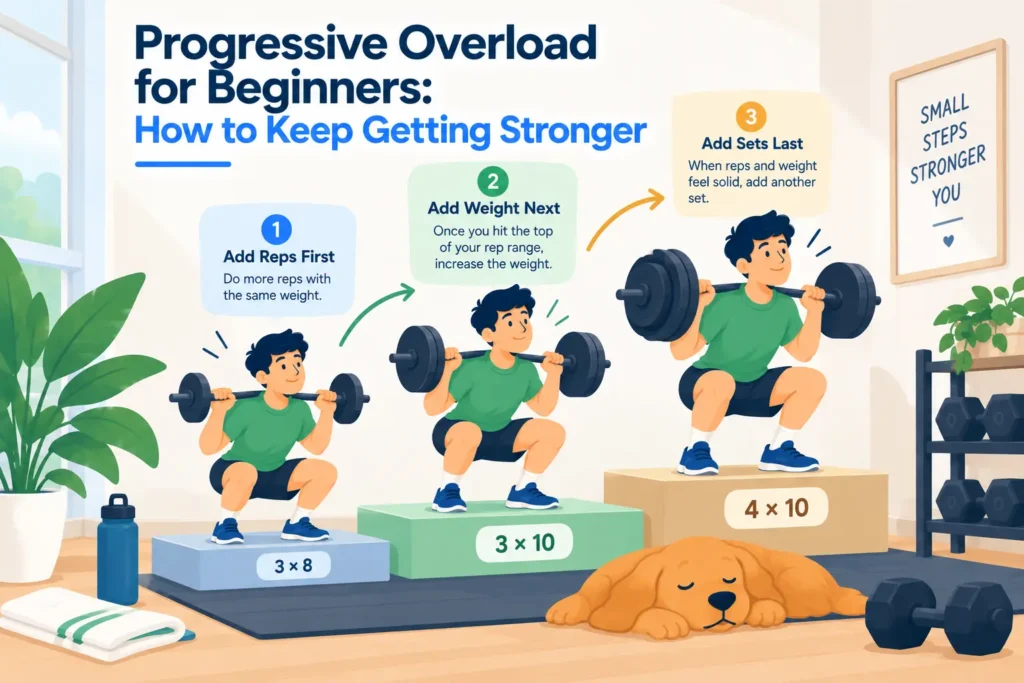
The Rule: Add Reps First, Weight Second, Sets Last
Keep the weight the same and try to squeeze out an extra rep here and there, staying within your range, which for most exercises in this plan is 8 to 12. When you finally get 12 on every set, bump the weight up and start again from around 8.
Say you’re doing goblet squats with an 8 kg dumbbell. Over a few sessions it could go something like:
- Session 1: 10, 9, 8 reps
- Session 3: 12, 11, 10
- Session 4: 12, 12, 12, so next time you pick up the 10 kg
- Session 5 at 10 kg: 9, 8, 8, and you build up from there
Plenty of sessions you’ll only manage one extra rep on a single set, and that’s still progress. Sets are the last thing to add because piling on volume is the quickest route to feeling wrecked.
When to Move Up in Weight (and by How Much)
Wait until you’ve hit the top of the range on all your sets, and your last rep looked about as clean as your first. Then go up by the smallest amount you’ve got:
- For legs and hips, around 2 to 5 kg (5 to 10 lb)
- For upper body, 1 to 2.5 kg, or just the next dumbbell along
- With bodyweight moves, use a lower surface, lower yourself more slowly, or hold a pause at the bottom
- On planks and carries, add 5 to 10 seconds before you think about weight
Don’t worry if your upper body lags behind. It’s pretty common for a shoulder press to stay on the same dumbbells for three or four weeks while squats keep going up.
Keeping a Simple Training Log
You don’t need a fancy app, the notes on your phone will do. Put down the date, the exercises, how heavy you went, and the reps for each set. If something felt off, add a few words about it. A typical entry might say “Goblet squat, 10 kg: 10, 9, 9. Felt solid.”
Have a quick look at it before each exercise, so you know what number you’re aiming to beat.
What to Do When You Stall
Sooner or later, usually a few months in, one of your lifts will stop going up. Before you blame the plan, be honest about sleep, food, and how many sessions you’ve actually made it to lately.
When a lift has been stuck for three sessions running, take about 10 percent off the weight and work back up the same way. Most people get past their old best within a couple of weeks. And try changing just one thing, rather than tearing up the whole program.
The 8-Week Plan: What Changes Week by Week
A single workout is easy enough to find online. What people usually don’t get told is what to do with it in week two, or week six. This part turns the workouts into a proper beginner strength training program, week by week. The workouts themselves stay the same the whole way through. What shifts is how many sets you do, how hard you push, and when the weights go up.
| Week | Focus | Sets x Reps | Effort (Reps in Reserve) | What to Change |
|---|---|---|---|---|
| 1–2 | Learning the movements | 2 x 8–12 | 3 left | Use your test weights, film a set or two to check form |
| 3–4 | Building reps | 3 x 8–12 | 2–3 left | Add the third set, try to add reps each session |
| 5–6 | First weight increases | 3 x 8–12 | 2 left | Go up in weight on any lift where you hit 12 on every set |
| 7 | Keep climbing | 3 x 8–12 | 1–2 left | Keep adding reps or weight, try a harder version of one exercise |
| 8 | Lighter week and retest | 2 x 8–10 | 3–4 left | Drop back to 2 sets, then compare your numbers to week 1 |
What Each Phase Feels Like
The first two weeks will probably feel too easy. That’s on purpose. You’re getting used to the movements, and working out which weights are right for you, and your legs will likely be sore for a few days anyway.
Somewhere in weeks three and four the extra set starts to bite. Sessions feel like real work now, but the reps should keep creeping up.
By weeks five and six, most people are moving up in weight on their lower-body lifts. Upper-body lifts may still be stuck on the same dumbbells, which is fine. Week seven is where you might also swap one exercise for a slightly harder version, like pushing up from a lower surface or moving from a backpack to a proper dumbbell.
How to Use the Lighter Week
Week eight isn’t a week off. You still train, just with two sets and more left in the tank than usual. It gives your joints and energy a chance to catch up after seven weeks of steady pushing.
At the end of it, open your log and compare your latest numbers to your very first session. For most beginners, the difference is bigger than they expected.
What Comes After Week 8
Start again from week three, using the new weights you’ve built up to. You can repeat this cycle for months and keep improving.
If you’ve missed a week or two along the way, don’t restart from scratch. Pick up from the last week you actually completed and carry on.
What Your First Month Actually Feels Like
People quit in the first month all the time, and usually not because it was too hard. It’s more that the first few weeks feel strange, and nobody warned them. So here’s roughly how it tends to go.
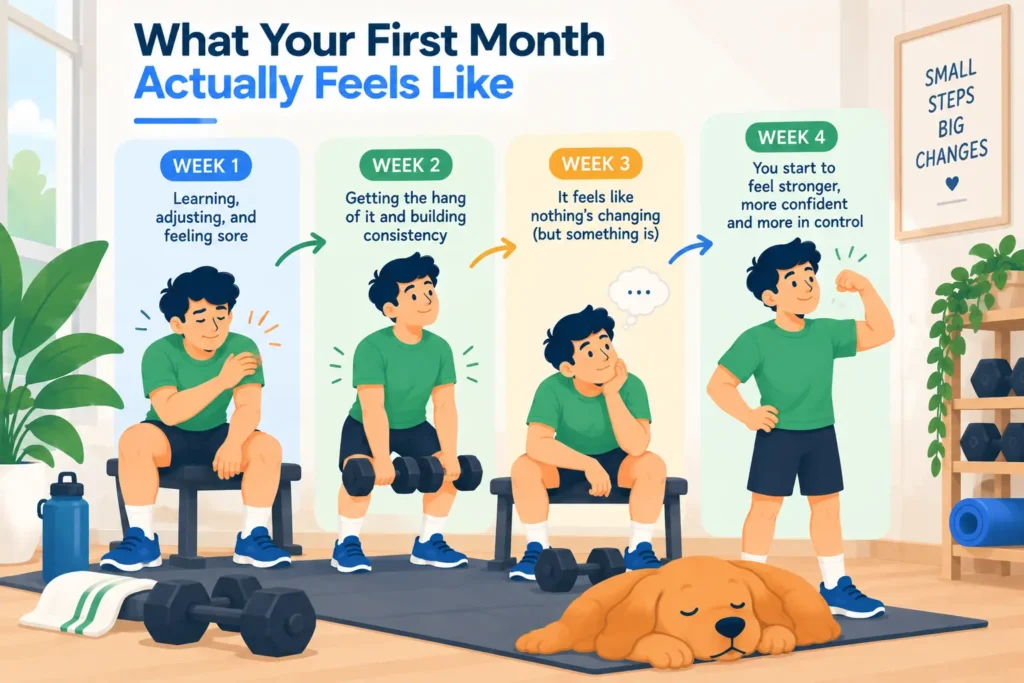
Week One: Sore in Places You Didn’t Know You Had
Day one after your first workout, you’ll likely feel okay. Maybe a bit smug. Day two is a different story. Stairs, especially going down them, become something you think about in advance, and even reaching up to a high shelf feels heavier than it should.
What you’re feeling is DOMS (delayed onset muscle soreness). Pretty much everyone gets it when their muscles do something they’re not used to, and it’s normally worst in that first week or two before your body gets the message. Lying on the sofa waiting for it to pass rarely helps much. A gentle walk works better than you’d think.
Weeks Two and Three: The Flat Spot
Then the soreness goes, and oddly, that can be discouraging. You look in the mirror, nothing’s changed, and the dumbbells feel exactly as heavy as they did. Plenty of people stop right about here.
What’s going on underneath is mostly your nervous system learning the movements. Not very exciting to look at, but it’s real, and your log will pick it up first. An extra rep on your rows, maybe a jump to the next dumbbell on squats. The stuff you can actually see in the mirror? Give it two or three months.
Week Four: Things Start Clicking
Around now you’ll probably notice you’re not talking yourself through every squat anymore. Carrying the shopping in from the car might feel a little lighter too. Worth flicking back through your log to your first session, just to see.
Soreness vs Pain: How to Tell the Difference
Normally fine:
- A dull ache spread through the muscles you worked
- Worse a day or two later, then fading bit by bit
- Stiff when you first get up, better once you’re moving around
Stop and get it looked at:
- Anything sharp or pinching, and especially in your knee, shoulder or lower back
- Pain on one side only that builds as you go through a set
- Swelling, numbness, tingling, or anything that’s still there after a week
Just sore? Train anyway, perhaps a bit lighter. Actual pain is different. Drop that exercise, try something gentler in its place, and if it keeps coming back, see a physio.
Recovery: Sleep, Food and Rest Days
Lifting is only half the job. The actual getting-strong part happens afterwards, while you’re resting, and if that side gets ignored, the training doesn’t go very far.
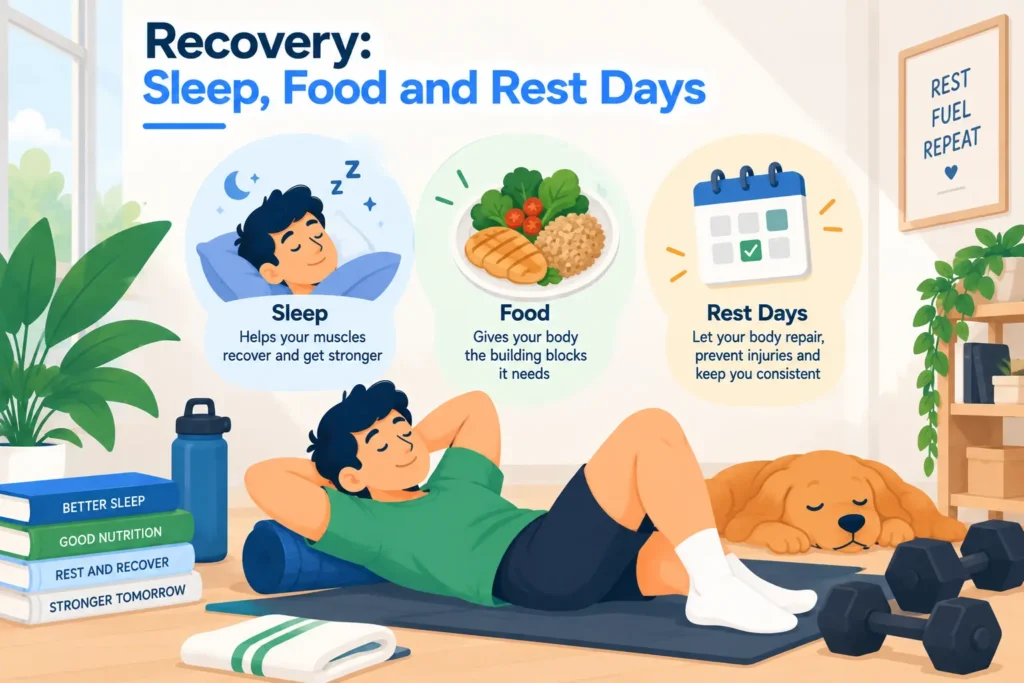
Sleep
This is the one people underrate most. When you’re short on sleep, the weights feel heavier, your form gets sloppier, and soreness tends to hang around longer.
You don’t need a perfect routine, just try to keep your bedtime roughly consistent and aim for seven hours or more on training nights. Sleep affects your concentration in the gym too, which ties into what I wrote about improving focus in a distracted world.
If your mind tends to race at night, a few minutes of simple meditation before bed can make it easier to switch off.
Food
No special diet needed. The main thing is getting enough protein, since that’s what your muscles use to repair.
An easy way to manage it without tracking anything is to include a decent protein source in every meal. Eggs, dal, paneer, chicken, fish, Greek yogurt, tofu, whatever you actually like eating.
Try not to train on a completely empty stomach, either. A banana or a slice of toast an hour or so before usually does the trick.
Rest Days
Rest days aren’t lazy days. That’s when the repair happens. You don’t have to lie still, though. A walk, an easy bike ride or some light stretching can help you feel less stiff for the next session.
If you’re still properly sore when your next workout comes round, train anyway but go lighter. Skipping it altogether usually makes the next one harder.
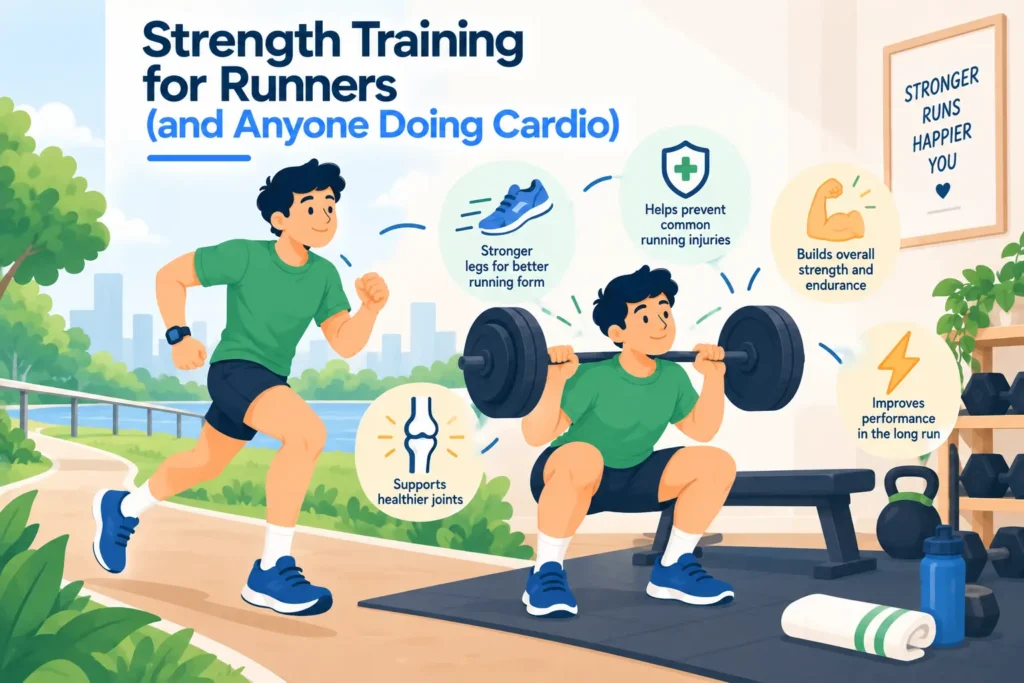
Strength Training for Runners (and Anyone Doing Cardio)
A lot of runners avoid the weights because they’re worried about getting heavy legs or bulking up. In practice, it tends to work the other way. A couple of short strength sessions a week can make running feel smoother, especially late in a run, when tired legs usually start to let your form slip. If you’re working on going further, this fits neatly alongside the ideas in my guide on how to run longer without burning out.
How to Fit Lifting Around Your Runs
Two strength sessions a week is plenty if you’re already running three or four times.
- Put them on the same days as your easy runs, not your hard ones. That keeps your rest days actually restful.
- Avoid heavy leg work the day before a long run or a speed session. Your legs won’t thank you.
- If you’re doing both on one day, run in the morning and lift in the evening if you can. Even a gap of a few hours helps.
Which Movements Help Runners Most
Running is basically a long series of single-leg hops, so single-leg work gives you the most bang for your buck. From the main plan, reverse lunges and Romanian deadlifts are the big ones. A few extras worth adding:
- Step-ups onto a box or sturdy stair, for knee and hip control
- Calf raises, either on a step or the edge of a weight plate, since calves take a pounding on every run
- Side planks or band walks for the outer hips, which help stop your knees from drifting inward when you’re tired
Cardio Before or After Strength Training?
It depends on what you care about more that day. If getting stronger is the priority, lift first while you’re fresh and do your cardio afterwards. If the run is the main session, like a tempo or interval workout, run first and keep the lifting lighter.
For most beginners who just want to get fitter overall, lifting first and finishing with some easy cardio is the simplest option. A short jog as a warm-up before lifting is completely fine either way.
Getting Past Gym Anxiety in Your First Few Weeks
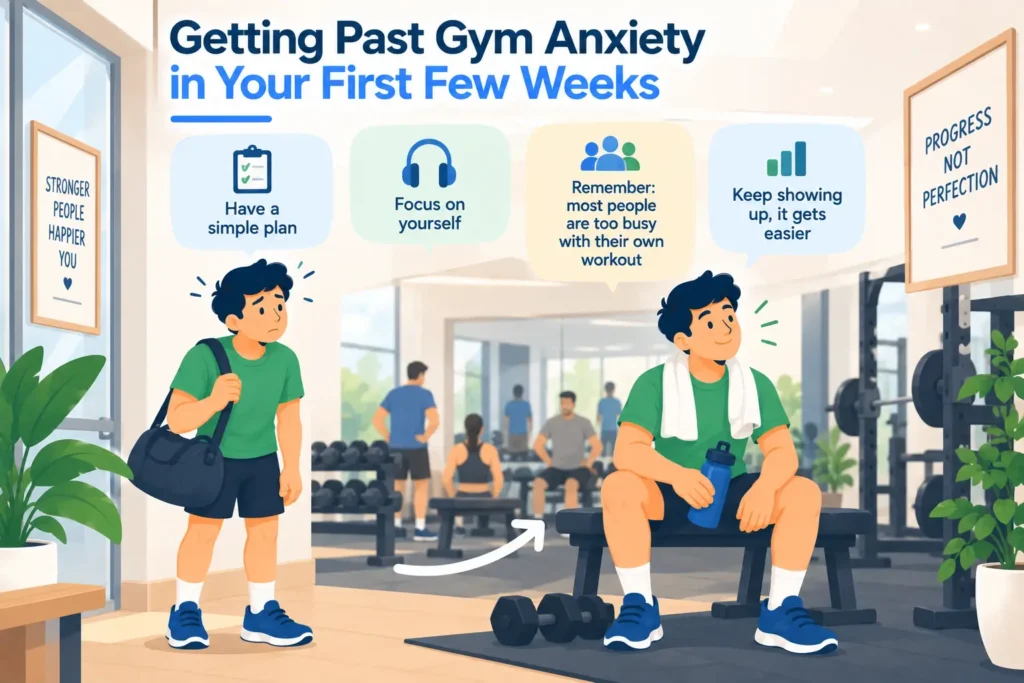
Feeling nervous about walking into a gym is incredibly common, and it stops a lot of people before they even start. Worrying that you’ll look like you don’t know what you’re doing, or that everyone’s watching. The truth is most regulars are far too wrapped up in their own sets to notice you. Still, knowing that doesn’t make the first few visits feel any less awkward, so here’s what actually helps.
Go When It’s Quiet
Most gyms are packed between about 6 and 8 in the evening. Mid-morning, early afternoon, or later at night are usually much calmer. Ask at the front desk, they’ll know the quiet times. If mornings suit you, it’s worth building the session into your morning routine so it becomes a fixed part of the day.
Have Your Plan Ready Before You Walk In
Standing around trying to decide what to do next is what makes people feel most exposed. Save the workout on your phone, with the weights from your last session, so you always know your next move.
A few other things that help:
- Wear headphones. They create a bit of a bubble and make it easier to focus.
- If you’re not sure how a machine works, ask a staff member. That’s literally their job, and most are happy to help.
- If someone’s on the equipment you need, just ask how many sets they have left. It’s a completely normal question.
Start Where You Feel Comfortable
You don’t have to begin in the free weights area if that’s the bit that intimidates you. Machines are a perfectly good place to start, and there’s usually a quieter corner with mats for bodyweight work. Move into the busier areas once you’re more confident with the movements.
When Motivation Dips
It will, probably around the flat spot in weeks two and three. That’s when having a routine matters more than feeling motivated. Keep the sessions short if you need to, but keep turning up. I’ve written more about this in how to stay consistent when motivation fades, and about [building discipline that actually lasts].
Common Beginner Strength Training Mistakes (and How to Fix Them)
Almost everyone makes a few of these early on. Catching them sooner just saves you a few frustrating weeks.
- Going to failure on every set: Grinding out every last rep feels productive, but your form falls apart and you’re drained for the next session.
Fix: End most sets with two or three good reps left. Save the all-out effort for the occasional test on a safe exercise like push-ups.
- Changing the plan every week: New workout videos are tempting, but if you keep switching, nothing has time to improve.
Fix: Stick with the same exercises for the full eight weeks. If one really doesn’t suit you, swap it for another from the same movement pattern and leave the rest alone.
- Lots of pushing, hardly any pulling: Chest and arms get all the attention while back work gets skipped, and over time your shoulders start rounding forward.
Fix: Match every pushing set with at least one pulling set. If you’re cutting a session short, drop a push before you drop a row.
- Leaving out the hinge: Romanian deadlifts and glute bridges feel awkward at first, so beginners tend to skip them.
Fix: Practise the wall hinge drill for a minute during your warm-up. Once it feels natural, the loaded versions get much easier.
- Lifting to impress: Grabbing weights you can’t control because someone nearby is going heavy just raises your chance of getting hurt.
Fix: Go by your log, not the room. If your form changes during a set, the weight’s too heavy, whatever anyone else is doing.
- Not writing anything down: Without a log you forget what you did last time and end up guessing.
Fix: Spend two minutes after every session noting the exercise, weight, and reps. Check it before your next workout.
- Training five days a week straight away: Enthusiasm is great, but more sessions early on mostly means more soreness and less recovery.
Fix: Start with two or three days and hold that for the full eight weeks. Add more only once the routine feels easy to keep.
Final Thoughts
Beginner strength training doesn’t have to be complicated. Two or three sessions a week, six basic movements, and a log that tells you what to beat next time. That’s really the whole system.
What makes the difference is sticking with it once the novelty wears off. The first month is mostly about showing up and learning how the movements should feel. After that, the numbers in your log start to climb, and a bit later, you’ll notice it in everyday life too. Stairs feel easier. Shopping bags feel lighter. Your runs might even feel a little smoother.
So start lighter than you think you need to, write everything down, and add a little each week. If your motivation starts slipping somewhere around week three, that’s normal. Shorter sessions still count, so keep the log going and keep showing up.
FAQs
Q. How many days a week should a beginner strength train?
A. Two or three days a week is plenty. Full-body sessions with at least one rest day in between give your muscles time to recover and still let you train everything often enough to improve. Three days tends to bring faster progress, but two done consistently beats three you keep missing.
Q. Should beginners use machines or free weights?
A. Either works, and a mix is usually best. Machines guide the movement, so they’re easier to learn and handy for pulls and presses early on. Free weights like dumbbells make your body stabilise itself, which builds coordination. Many beginners start on machines for the first few weeks and bring in more dumbbell work as they get comfortable.
Q. Can I build strength at home with no equipment?
A. Yes, especially in the first couple of months. Squats, push-ups, lunges, glute bridges and planks are all proper strength work. You can make them harder by changing the angle, slowing the lowering phase or adding a pause. A backpack loaded with books works as extra weight until you’re ready for dumbbells or bands.
Q. Will strength training make me bulky?
A. No, not by accident. Building noticeable size takes years of heavy training and eating a lot more than you need. Two or three sessions a week will make you stronger and firmer, and for most people that’s about as far as it goes.
Q. How long does it take to see results from strength training?
A. You’ll usually notice you’re stronger within two to four weeks, since your body quickly gets better at the movements. Your log will show it first, with extra reps or heavier weights. Visible changes in how your body looks tend to take around two to three months of steady training.
Q. Should I do cardio before or after strength training?
A. If getting stronger is your main goal, lift first while you’re fresh and do cardio afterwards. If your cardio session is the priority, like a hard run, do that first and keep the lifting lighter. A short, easy jog as a warm-up before lifting is fine either way.
Q. Is it okay to strength train when I’m still sore?
A. Usually, yes. General muscle soreness isn’t a reason to skip a session, and light training often makes it feel better. Warm up well and go a little lighter if you need to. If what you feel is sharp pain, joint pain or swelling rather than a dull ache, skip that exercise and get it checked.
Leave a Reply